








Few Americans have ever heard of Operation Bagration, but it was the largest hammer and most crushing blow that led to the fall of Berlin and Nazi Germany on May 8, 1945. Its Allied counterpart was Operation Overlord that commenced on June 6, 1944, with the D-Day assault on the beaches of Normandy. Soviet Premier Joeseph Stalin had originally planned to commence Operation Bagration on the same day as Allied Operation Overlord. but British weather and Soviet logistics pushed the dates apart about two weeks. The objective of Operation Bagration was the total destruction of German Army Group Center occupying the Belarusian SSR. This would allow the Red Army to rout retreating Wehrmacht forces and crush Berlin and any remaining German resistance. German Army Group Center consisted of four German armies—the Second, Fourth, Ninth, and Third Panzer—with nearly 500,000 combat troops and another 350,000 support troops. On June 22, Soviet forces intially assigned to Operation Bagration came to almost 1.7 million troops with a 10-to-1 advantage in artillery and an 8-to-1 advantage in tanks. Soviet aircraft support was 5,300 versus 1,350 for the Germans. The manpower advantage for the Russians would quicky turn from 2-to-1 to 4-to-1.
By early 1943, Stalin realized that to win the war he had to put more trust in his generals and professional military staff and delegate battlefield responsibility and decisions to practical levels allowing flexibility and innovation. He also realized that Russian soldiers were not very motivated by Communist ideology but by the desire to defend their homeland, families, and Russian culture. This meant Stalin had to relax persecution of Christianity and the Russian Orthodox Church. Stalin’s most emphasized propaganda theme, however, remained vengeance and hatred. An immense difference between Stalin and Hitler was that Stalin had learned from his mistakes, but Hitler never did. This played a huge role in German defeat on the Eastern Front.
Borodino—background to understanding Bagration and Russian military strategy
In 1812, Borodino was a small village 44 miles west of Moscow. The population is now about 15,000. As Napoleon’s forces approached Moscow, its salient characteristic as a defensive position was that it was a crossroad to Smolensk and Moscow. On September 7, 1812, approximately 110,000 French and Allied troops engaged 122,000 Russian Empire troops there. Infantry, cavalry, and a huge amount of artillery was employed. The French were able to engage 300 of their 580 heavy guns against the Russians, and the Russians were able to engage about 300 heavy guns of about 420 against the French. The French were surprised by the effectiveness of Russian artillery and fierce, innovative, and persistent Russian defense. Russian killed, wounded and captured were approximately 44,000, and French killed, wounded, and captured were about 35,000, of which about 6,500 were KIA over two days. Little medical care, however, was available for French wounded in their extended position. Russian Army Commander and Field Marshall Mikhael Kutunov decided to withdraw and inflict further attrition on the French as they extended their supply lines toward Moscow. Although Napoleon seemed the victor at Borodino, his Grande Army was fatally weakened and doomed to disastrous retreat. Retreating from Moscow on October 19, he had only 55,000 troops left by November 12. Of Napoleon’s Army of more than 450,000 that crossed into Russia in June 1812, about 350,000 died, about 100,000 in battle and the rest mostly from cold and disease.
General/Prince Pyotr Bagration commanded the left wing of the Russian Army at Borodino, under Kutuzov. Bagration, renowned for his military successes and heroism, was mortally wounded by artillery shrapnel at Borodino and died on September 24. Both Bagration and Kutuzov are portrayed in Leo Tolstoy’s 1869 novel, War and Peace, which he wrote near Borodino. The Battle of Borodina is the subject of Pyotr Tchaikovsky’s 1812 Overture, composed in 1880.
Bagration was of Georgian parentage, as was Stalin. Stalin named Operation Bagration for Georgian and Russian hero, Pyotr Bagration.
Operation Bagration began with a Russian plan to weaken the German Center Army Group by deception (maskirovka), It began to strengthen Russian forces facing the German North Ukraine Army Group to the south. The Russians had two objectives. A partial build up facing North Ukraine Army Group was to deceive the Germans into assuming the main anticipated assault against the Germans would be against the German North Ukraine Army Group. But this build up was actually going to protect the flank of Operation Bagration going through Belarus. Two weeks after Operation Bagration was successfully underway, more Russian forces would be brought in to devastate German defenses left in Ukraine.
The deception was successful. German Center Army Group transferred 15 percent of its troops to North Ukraine to defend against a Russian attack there. Moreover, it transferred 88 percent of its tanks, 50 percent of its tank destroyers, and 33 percent of its heavy artillery south to the North Ukraine Army Group, leaving German Center Army Group in a much weaker position
Operation Bagration had its real beginning on June 19, when 143,000 extremely well organized Belarusian partisans behind the German lines exploded 10,000 bombs along German rail lines supplying Center Army Group positions on the front. They then engaged in various sabotage and guerilla attacks on German troops in the rear.
On June 22, multiple small Russian combat-reconnaissance units penetrated the German Center Army Group lines across the entire front and began to create havoc in its rear. This was far more effective than expected. At 5:30 AM on June 23, the German trenches and front lines were hit with a massive heavy artillery attack and over 1,000 Soviet Air Force bombing sorties. It may have been the heaviest artillery barrage in history. Four massive Soviet infantry and tank columns pressed forward.
Soviet sources estimated German casualties during Operation Bagration to be 539,000 killed, missing, and captured. Of these about 381,000 were killed or missing and presumed dead, and 158,000 were captured. Soviet losses were also heavy due their vulnerability having to cross many rivers. Total Russian combat casualties were about 550,000, of which 180,000 were killed or missing.
By August 19, Bagration forces had reached German East Prussia and eastern Poland, but they were exhausted and their supply lines were extended. One advantage the Russians had during Operation Bagration was 220,000 Dodge and Studebaker trucks, used mostly to mobilize infantry, but of course, also as supply trucks. Total American lend-lease trucks supplied to Soviets in World War II totaled around 363,000.
Two other immense Soviet battles in World War II are better known in the West: Stalingrad from 17 July 1942 to 2 February 1943 and Kursk from 5 July to 20 August 1943. Bagration, from 22 June to 19 August 1944 was the final hammer blow that opened the way to Berlin and victory on May 8, 1945.
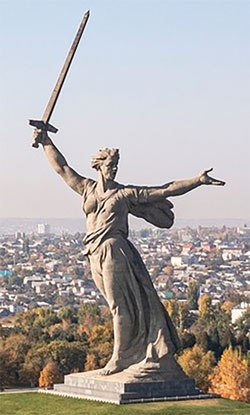
The Battle of Stalingrad (renamed Volgograd in 1961) is considered by many Russians as the greatest victory in the Great Patriotic War. It stopped the German advance into the Soviet Union and marked the turning point of the war to save Russia and defeat Nazi Germany. The situation was so chaotic for seven months that accurate estimates of troop strength and casualties are nearly impossible. About 700,000 soldiers of the German Sixth Army and Fourth Panzer Army were engaged, as well as about 350,000 Axis troops from Romania, Italy, and Hungary. At least 500,000 these died. At least 1.3 million Soviet troops were engaged, but perhaps over 2.0 million. Red Army casualties were estimated at over 1.3 million, with 675,000 dead. Many of the German casualties were from freezing temperatures. Few of the captured German soldiers ever returned to Germany. Known civilian casualties were about 350,000. Stalingrad has been called the deadliest battle of World War II.
The Battle of Kursk was the largest battle in the history of warfare and a decisive end to German offensive capabilities on the Eastern Front. It was the largest and deadliest tank battle in history. Its opening on July 5, 1943, recorded the highest aircraft losses in a single day in the history of air-warfare. At the end of the battle only 39 percent of German aircraft were left on the Eastern Front. It was also marked by hand-to-hand combat and street-to-street urban combat. Approximately 941,000 German and over 2.5 million Soviet soldiers were engaged. It was one of the costliest battles in World War II. Over 6,000 tanks and 4,000 aircraft were involved. Soviet killed and missing may have been as high as 500,000. Loss of German records prevents a reasonable estimate of KIA and missing, but it should be well over 100,000.
Many historians believe these three battles on the Eastern Front were the most decisive battles of World War II. This is arguable, but there is certainly no consensus. The June 6, 1944, Normandy Invasion was a spectacular and undeniably essential victory on the Western Front. The German Wehrmacht was crushed from two sides, but about 75 percent of action was on its East side and 25 percent was on its West side.
According to the National World War II Museum in New Orleans, approximately 5.5 million members of the German military were listed as killed or missing and presumed dead at the end of 1946. Historian Geoffrey Roberts estimates that 80 percent German military operations were against the Russians on the eastern front. My own estimate—see World War II on the Eastern Front, July 16, 2025, The Times Examiner—is that 4.5 million or 82 percent of German military killed or missing can be attributed to Soviet forces.
The online publication Meduza published an article on May 9, 2025, reviewing the number of Soviet civilian and military deaths during World War II. Total Soviet military deaths were 8.6 million. Civilian deaths were 18.0 million. So the total was 26.6 million dead. Basically, the numbers are uncountable, and must be determined by statistical analysis. Medusa agrees with the latest Russian Federation estimate, which checks as valid with independent analysis.
The 18.0 million civilian deaths in the Soviet Union during World War II are a grim reminder of the total tragedy of war. Over 1.0 million of these 18.0 million civilian deaths were from starvation and related disease during the Siege of Leningrad by German and Axis forces for 872 days from 8 September 1941 to 27 January 1944. Leningrad was a city of just 3.0 million at that time. Slightly more than one-third of its people died from starvation and disease due to military encirclement and siege. Leningrad returned to its former Russian Empire name of St. Petersburg in 1991. It is still Russia’s second largest city with 5.6 million people—the fourth largest city in Europe.
The three worst mistakes in battle and war are underestimating your enemy, overestimating your own security and capabilities, and failure to learn from mistakes. Blind hubris is usually involved in all three.
“If it is possible, as far as it depends on you, live at peace with everyone.”—Romans 12:18
 Mike Scruggs is the author of two books: The Un-Civil War: Shattering the Historical Myths; and Lessons from the Vietnam War: Truths the Media Never Told You, and over 600 articles on military history, national security, intelligent design, genealogical genetics, immigration, current political affairs, Islam, and the Middle East.