







Writing in December of 1861 in a London weekly publication, the famous English author, Charles Dickens, who was a strong opponent of slavery, said these things about the war going on in America:
“The Northern onslaught upon slavery is no more than a piece of specious humbug disguised to conceal its desire for economic control of the United States.”
Karl Marx, like most European socialists of the time, favored the North. In an 1861 article published in England, he articulated very well what the major British newspapers, the Times, the Economist, and Saturday Review, had been saying:
“The war between the North and South is a tariff war. The war, is further, not for any principle, does not touch the question of slavery, and in fact turns on the Northern lust for power.”
Five years after the end of the War, prominent Northern abolitionist, attorney and legal scholar, Lysander Spooner, put it this way:
“All these cries of having ‘abolished slavery,’ of having ‘saved the country,’ of having ‘preserved the Union,’ of establishing a ‘government of consent,’ and of ‘maintaining the national honor’ are all gross, shameless, transparent cheats—so transparent that they ought to deceive no one.”
The Reverend James Power Smith, the last surviving member of Stonewall Jackson’s staff had this to say in 1907:
“No cowardice on any battlefield could be as base and shameful as the silent acquiescence in the scheme which was teaching the children in their homes and schools that the commercial value of slavery was the cause of the war, that prisoners of war held in the South were starved and treated with barbarous inhumanity, that Jefferson Davis and Robert E. Lee were traitors to their country and false to their oaths, that the young men who left everything to resist invasion, and climbed the slopes of Gettysburg and died willingly on a hundred fields were rebels against a righteous government.”
The words of the South Carolinian journalist and poet Henry Timrod (1829-1867) in his moving Ode at Magnolia Cemetery should move our hearts to resolve:
“Sleep sweetly in your humble graves, sleep martyrs of a fallen cause,
Though yet no marble column craves the pilgrim here to pause.
In seeds of laurel in the earth, the blossom of your fame is blown,
And somewhere, waiting for its birth, the shaft is in the stone.
Meanwhile, behalf the tardy years, which keep in trust your storied tombs,
Behold! Your sisters bring their tears, and these memorial blooms.
Small tributes! But your shades will smile, more proudly on these wreaths today,
Than when some cannon-moulded pile shall overlook this bay.
Stoop, angels, thither from the skies! There is no holier ground
Than where defeated valor lies, by mourning beauty crowned.”
On June 27, 1863, near Chambersburg, Pennsylvania--just days before the momentous Battle of Gettysburg--Confederate General Robert E. Lee issued a general order to the Army of Northern Virginia, praising them for their honorable conduct thus far in their march into Union territory, but cautioning them on their continuing responsibility to respect all private property and the lives of all noncombatants.
“The commanding general considers no greater disgrace could befall the army, and through it our whole people, than the perpetration of the barbarous outrages upon the unarmed and defenseless and the wanton destruction of private property, that have marked the course of the enemy in our own country…It must be remembered that we make war only upon armed men, and that we cannot take vengeance for the wrongs our people have suffered…without offending against Him to whom vengeance belongeth, without whose favor and support our efforts must all prove in vain
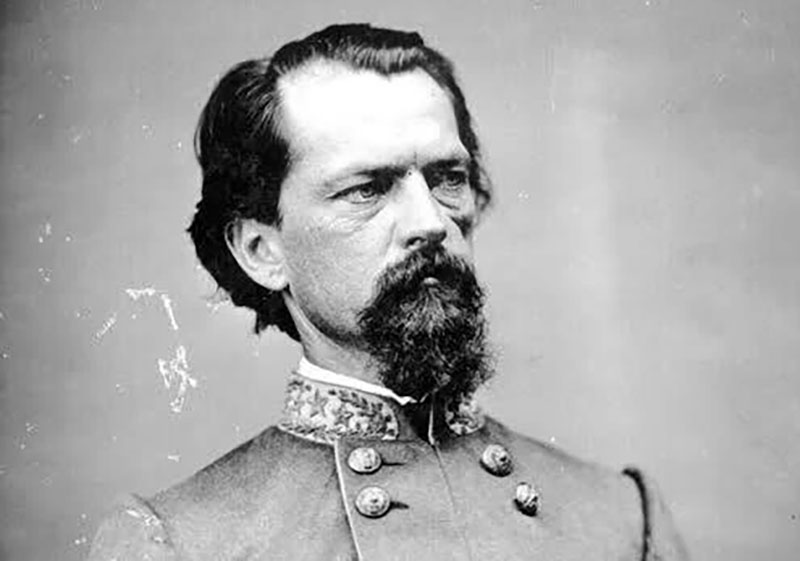
When Confederate General John Brown Gordon entered the town of York, Pennsylvania, during the Gettysburg campaign of 1863, he found the population in a state of panic, fearing retaliation for Union atrocities against Southern civilians. He gathered a large crowd of women in the street and told them this:
“Our Southern homes have been pillaged, sacked, and burned; our mothers, wives, and little ones driven forth amid the brutal insults of your soldiers. Is it any wonder that we fight with desperation? A natural revenge would prompt us to retaliate in kind. But we scorn to war on women and children. We are fighting for the God given rights of liberty and independence as handed down in the Constitution by our fathers. So fear not. If a torch is applied to a single dwelling or an insult offered to a female of your town by a soldier of this command, point me out that man and you shall have his life.
Speaking of the area along the route of the march, Union Captain Oakley also asserted that a traveler will,
“hear stories from the lips of women that would make him ashamed of the flag that waved over him as he went into battle. When the army passed nothing was left but a trail of desolation and despair. No houses escaped robbery, no woman escaped insult, no building escaped the firebrand…War may license an army to subsist on the enemy, but civilized warfare stops at livestock, forage, and provisions. It does not enter the houses of the sick and helpless and rob women of their finger rings and carry off their clothing.”
Confederate President Jefferson Davis was not alarmed by the Union plans to assassinate him , but others in his Cabinet were. It was decided to photograph them and release lithograph copies to the press and the British and French. Some in the Cabinet felt that the Dahlgren Raid prisoners should be shot, but the influence and words of Robert E. Lee dissuaded them:
“I do not think that reason and reflection could justify such a course. I think it better to do right, even if we suffer in so doing, than to incur the reproach of our consciences and posterity.”
Robert E. Lee had accepted defeat at Appomattox and encouraged his men to go home and be good Americans. But in 1870 after five years of Reconstruction he privately told Fletcher Stockdale, former Governor of Texas, this:
“Governor, if I had foreseen the use those people designed to make use of their victory, there would have been no surrender at Appomattox; no, sir, not by me. Had I foreseen these results of subjugation, I would have preferred to die at Appomattox with my brave men, my sword in my right hand.”
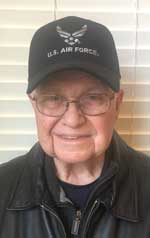 Mike Scruggs is the author of two books: The Un-Civil War: Shattering the Historical Myths; and Lessons from the Vietnam War: Truths the Media Never Told You, and over 600 articles on military history, national security, intelligent design, genealogical genetics, immigration, current political affairs, Islam, and the Middle East.