











South Carolina’s House Must Choose the Real Meal in Primary Reform – H. 3310
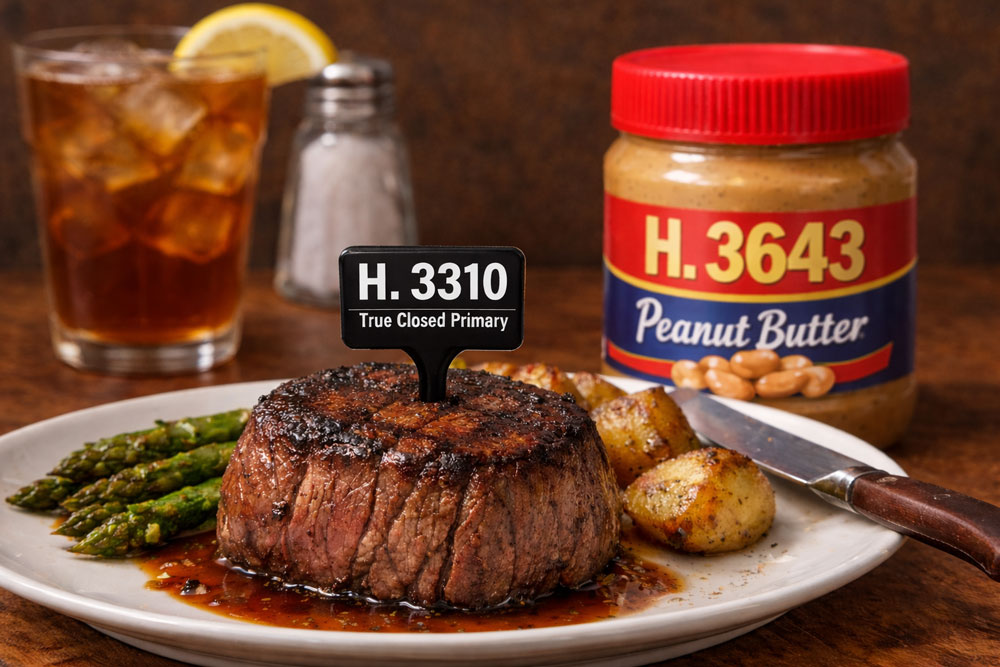
At a recent press conference at the South Carolina State House, Rep. Mike Burns delivered what could become the defining quote of this year’s state legislative fight over election reform. Referring to two competing primary election bills now before the House, Burns reached back to an old Jean Shepard country song At the Time, for illustration:
“‘If you’ve never had filet mignon, peanut butter tastes just fine.’ We have two bills: one is filet, and the other is peanut butter. We get to make a decision next Wednesday morning.”
This alimentary decision is expected to come before the House Judiciary Committee next Wednesday, January 21, at noon. It is not just about legislative preference. It is about whether South Carolina Republicans will finally enact true closed primaries or settle for something weaker, with less muscle behind it, an insider-controlled, establishment substitute being marketed as a strong, healthy reform.
Although Burns is technically sponsoring both bills, he made his preference unmistakably clear. As Burns puts it, the filet mignon is House Bill 3310, and the peanut butter is House Bill 3643. Both claim to protect the integrity of Republican primaries, but only one can win.
House Bill 3310 is straightforward, as it does four essential things:
- Limits participation in party primaries to registered members of that party, unless the party itself chooses to open its primary.
- Requires party affiliation to be recorded on voter registration forms.
- Establishes a clear process for voters to change party affiliation.
- Directs election officials to maintain party-affiliation records.
That’s it. It is clean, simple, and enforceable with no loopholes, no insider discretion, and no new barriers to candidate access. Just what grassroots Republicans have asked for repeatedly for years: only Republicans voting in Republican primaries.
Rep. Burns and a coalition of House members, many aligned with the South Carolina Freedom Caucus, introduced and sponsored H. 3310 precisely because prior “closed primary” proposals in Columbia have been anything but.
As for House Bill 3643, promoted by SCGOP leadership and House establishment as their preferred option, it contains five major provisions:
- Requires voters to register with a party or as unaffiliated at least 45 days before a primary.
- Automatically affiliates unaffiliated voters with a party when they vote in that party’s primary.
- Redesigns voter registration forms to track party status.
- Changes candidate filing deadlines and filing fee structures.
- Imposes new candidate eligibility rules tied to prior party participation — with waiver authority resting in party leadership.
It is not merely a closed-primary bill. It is a broader restructuring of candidate and party control mechanisms, inserting discretionary power into who may appear on ballots and when.
Despite being considered the established bill with the most support, many grassroots Republicans have taken notice, and several original co-sponsors of H. 3643 have recently removed their names from the bill as its implications have become clearer. That alone should tell voters this proposal is not the simple reform it is being advertised to be.
SCGOP's Position
In response to growing grassroots support for H. 3310, the South Carolina Republican Party has launched a strategically framed email/text campaign urging voters to pressure legislators to oppose it. An email from SCGOP states that H. 3310 is “a bill that would force us to allow registered DEMOCRATS to run as candidates in our Republican primaries – and drastically cut the number of Republicans who vote in our primaries.”
SCGOP is strategically framing what H.3310 does; they’re projecting onto it something it does not address, and using that vacuum to construct a narrative.
Those claims are not supported by the text of H. 3310. This bill does not open Republican primaries to Democrats. It does the opposite; it restricts primary voting to registered party members unless the party itself chooses otherwise. Nor does it give party insiders statutory power to approve or block who may appear on a primary ballot. Ironically, the SCGOP’s preferred bill, H. 3643, is the one that introduces new candidate eligibility controls and waiver authority held by party leadership.
Party leadership has framed these candidate access controls as necessary to block Democrat candidates from Republican primaries. But in practice, they place new authority in the hands of centralized party leadership over who may run as a Republican in the nominating process, creating the potential for favoritism and limiting the choices available to registered Republican voters.
In other words, grassroots Republicans are being told peanut butter is filet mignon – if they’ve never tasted the real thing.
Constitutional Scrutiny
Beyond policy and politics lies a more serious question. Which bill can actually withstand constitutional scrutiny?
H. 3310 respects long-established constitutional precedent recognizing that political parties are private associations with the right to define their own membership and nomination processes. Under this approach, the state simply provides neutral election administration while leaving internal party governance in the hands of the party itself. Party affiliation remains voluntary. No loyalty tests are imposed. No ballot access is conditioned on past voting behavior. No compelled political expression is created. This bill gets straight to the point. You must register to vote in the primary of your choosing, period.
One bill reforms primaries. The other risks being tied up in federal court before it ever takes effect.
H. 3643, however, even though it requires you to register at least 45 days before a primary, it takes a very different approach. It transforms internal party rules into state-enforced mandates. It conditions candidate eligibility on voting history and the duration of affiliation. It automatically converts unaffiliated voters into party members by operation of law. It places party discipline and candidate qualification under statutory control rather than voluntary party governance.
That combination raises three serious constitutional hazards:
- State intrusion into a party’s freedom of association
- Compelled political affiliation of voters
- New and disproportionate burdens on candidate ballot access
Federal courts have repeatedly struck down election laws that impose loyalty tests, compel political association, or allow the state to regulate internal party governance. Under modern election-law standards, laws that burden ballot access or political association must be narrowly tailored. H. 3310 imposes minimal administrative requirements. H. 3643 imposes layered restrictions, discretionary waivers, and automatic reclassification of voters; all of which invite legal challenge.
H.3310 closes primaries cleanly. H.3643 re-engineers party politics by embedding loyalty tests and candidate access controls into state law.
In plain legal language, one bill reforms primaries, and the other risks potentially being tied up in federal court. For some party activists, this is a familiar maneuver in the political arena. A clever tactic to show support for something they know will get tied up in legal wranglings and never become law. It will also be inconspicuous to the public, as it is written in a way that fails but still preserves their appearance to support it.
That risk is not theoretical. Disqualified candidates, forcibly affiliated voters, or reform factions within a party would have immediate standing to sue. Election-timing lawsuits often produce court injunctions that freeze new laws before they ever take effect. We have seen this on all levels of government: city, county, state, and especially on the federal level of late.
A reform that never survives judicial review is not reform at all. With these two bills, this constitutional distinction alone should give lawmakers pause.
Legislative View
Several Upstate legislators have now gone on record publicly explaining why these two bills are not interchangeable.
Rep. Jordan Pace, who helped lead the recent press conference on closed primaries, noted that over 80% of Republican primary voters have said for years they want closed primaries. He described H. 3310 as a clean bill that accomplishes that goal, while warning that party insiders have used party resources to muddy the issue and spread false narratives about House members whose voting records most closely align with the party platform. Pace also pointed out that while H. 3643 may have begun with good intentions, the additional provisions in the bill would block young people and many military veterans from running for office, while still allowing unaffiliated individuals to vote in Republican primaries.
Grassroots Republicans have asked for closed primaries for years. H.3310 answers that call directly — without adding new barriers or insider discretion.
Rep. Stephen Frank offered an even sharper distinction. Frank, who ran on closing primaries, stated plainly that South Carolina currently has two bills that claim to close primaries, but only one actually does. He described H. 3310 as a true closed-primary bill that treats political parties as private associations with the right to define their membership, while the state remains a neutral administrator. This model, he noted, is how most closed-primary states operate and finally ends primary raiding.
Frank contrasted that with H. 3643, which he described as “a different animal entirely.” Rather than simply closing primaries, he explained that H. 3643 re-engineers party politics by embedding loyalty tests and candidate access controls into statute rather than party governance. Under its provisions, a candidate would have to have voted in two of the last three statewide primaries of that party and meet affiliation-duration requirements before even appearing on a ballot. Frank warned that imposing loyalty oaths in state law, restricting who may run for office, and disadvantaging first-time candidates, reform challengers, and recently settled military families cross a line that invites serious constitutional challenges and imposes a financial burden on the state.
SCGOP's Resolution
Adding further gravity to this debate is a formal resolution recently adopted by the South Carolina Republican Party State Executive Committee. In it, party leadership calls explicitly for passage of H. 3643 as the preferred closed-primary bill. The resolution not only endorses partisan voter registration and new candidate qualification requirements, but also urges the Legislature to impose voting-history conditions on candidates seeking to run in party primaries – or subject them to approval by the State Committee itself.
Even more striking, the resolution declares that if such legislation does not pass, party leadership supports pursuing legal action against the State of South Carolina to compel adoption of these internal party governance provisions into state law.
That development is significant for two reasons.
First, it confirms that H. 3643 is not simply about closing primaries to non-Republican voters. It is about embedding party leadership authority, candidate access controls, and loyalty requirements into statute, rather than leaving them within voluntary party governance.
This debate is no longer just about election procedure — it is about who gets to define what it means to be a Republican candidate.
Second, it reinforces the constitutional concerns already discussed. Political parties do have a First Amendment right of association. But when internal party discipline is enforced through state statute rather than private party rule, it becomes state action, subject to judicial scrutiny. That is precisely why election-law courts have repeatedly rejected attempts to legislate party loyalty tests and candidate restrictions.
Ironically, the resolution itself cites Supreme Court precedent recognizing party autonomy – while simultaneously advocating legislation that risks crossing the constitutional line between party self-governance and state-imposed control.
That contradiction lies at the heart of the present dispute.
Other Scrutiny
Another practical concern has emerged from grassroots activists: who gets unintentionally caught in H. 3643’s new rules?
Under current law, an 18-year-old who just registers can participate in civic life without being assigned a permanent political label by the state. Under H. 3643, simply voting in a primary would automatically turn an unaffiliated young voter into a party registrant by “operation of law.” This isn’t just administrative, it’s a forced political association. This may seem minor to some, but when it comes to our legal system, such details matter and can lead to unforeseen consequences through precedent.
More significantly, H. 3643’s candidate-eligibility provisions tie ballot access to past participation and affiliation history, with waiver authority resting in party leadership. That structure inevitably disadvantages first-time candidates, young reformers, and even recently retired military personnel returning home after years of service who may not have prior voting records in South Carolina primaries. These are precisely the citizens most likely to enter public service with a fresh perspective and precisely the ones this bill risks sidelining.
As these statements show, this is no longer simply a policy disagreement; it is a defining question of party autonomy, ballot fairness, and legislative independence.
Both Bills' Sponsors
H. 3310 creates none of these new barriers. Many members of the Upstate House delegation are directly involved – on both sides. Legislators currently supporting H. 3310 are:
- Mike Burns (Greenville, District 17)
- Josiah Magnuson (Spartanburg, District 38)
- Don Chapman (Anderson, District 8)
- Rob Harris (Spartanburg, District 36)
- Chris Huff (Greenville, District 28)
- April Cromer (Anderson, District 6)
- Thomas Lee Gilreath (Abbeville/Anderson/Greenville, District 7)
- Stephen Frank (Greenville, District 20)
This email address is being protected from spambots. You need JavaScript enabled to view it. (Spartanburg, District 34)- Adam Duncan (Oconee/Pickens, District 2)
- Mark Willis (Greenville/Laurens, District 16)
- John R. McCravy III (Greenwood/Laurens, District 13)
- Daniel Gibson (Greenwood/McCormick, District 12)
- Dianne Mitchell (Greenville, District 21)
- Bill Chumley (Greenville/Spartanburg, District 35)
Meanwhile, H. 3643 began with a broad sponsorship list — but recent name withdrawals show the ground is shifting as legislators hear from their constituents. Here is the list currently available:
- Don Chapman (Anderson, District 8)
This email address is being protected from spambots. You need JavaScript enabled to view it. (Pickens, District 3)
Richard Blake Sanders (Anderson, District 9)- Patrick Haddon (Greenville, District 19)
- Mark Willis (Greenville/Laurens, District 16)
- John R. McCravy III (Greenwood/Laurens, District 13)
- Daniel Gibson (Greenwood/McCormick, District 12)
- W. Scott Montgomery IV (Spartanburg, District 32)
- Travis A. Moore (Spartanburg, District 33)
- Paul B. Wickensimer (Greenville, District 22)
- Bill Whitmire (Oconee/Pickens, District 1)
- Mike Burns (Greenville, District 17)
The vote on Wednesday morning will reveal whether lawmakers listen to party leadership emails or to the voters who sent them to Columbia.
Which Meal Fits the Bill?
The core question is simple. Do Republicans want clear, enforceable closed primaries or a complicated system that expands party bureaucracy, insider control, and legal risk? H. 3310 answers the grassroots call directly, but H. 3643 wraps a partial solution inside a larger restructuring that raises new concerns.
Rep. Burns’ metaphor was more than folksy humor. It was a warning.
A filet mignon is a complete, high-quality protein source. It delivers essential amino acids efficiently, builds strength, and provides vital nutrients with fewer calories per gram of usable protein. It is direct, potent, and purpose-built.
Peanut butter, by contrast, is certainly edible and enjoyable. It contains protein. It even has its place. But it is far higher in fat and calories, lacks a complete amino-acid profile, and requires a much larger serving to match steak’s protein efficiency. Nutritionally speaking, peanut butter is better classified as a fat source that happens to contain some protein – not a true muscle-builder.
In other words, both will sustain you, but only one builds strength efficiently. That is precisely the difference between H. 3310 and H. 3643.
And let’s be honest – if given a choice between a sizzling filet mignon and a peanut butter sandwich for dinner, no rational person hesitates. One is a special-occasion entrée. The other is what you eat when nothing else is available.
------------------------------
SC Upstate Legislatures not listed as sponsors of either bill at press time:
- Craig A. Gagnon (Abbeville/Anderson – District 11)
- Thomas Beach (Anderson/Greenville – District 10)
- Neal Collins (Pickens – District 5)
- Davey Hiott (Pickens – District 4)
- Alan Morgan (Greenville – District 18)
- Bruce Bannister (Greenville – District 24)
- David Vaughan (Greenville – District 27)
- Dennis Moss (Cherokee/Spartanburg/York – District 29)
- Brian Lawson (Cherokee/Spartanburg – District 30)
- Steven Wayne Long (Spartanburg – District 37)
- Doug Gilliam (Laurens/Union – District 42)
- Luke Rankin (Laurens – District 14)