








Reality versus the Western Narrative
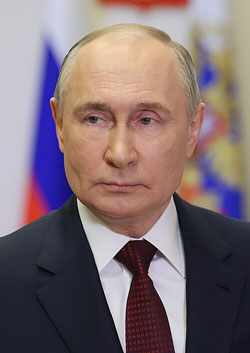
On December 19, Russian President Vladimir Putin gave his annual end-of-year press conference. Unlike most American and European press conferences, it lasted more than four hours. It was also much more open to both the public and international news media than is standard for American and European conferences. He answered questions from reporters there and ordinary Russian citizens by phone. His introductory remarks were a relatively brief summary of mostly economic statistics, but he went on for better than four hours answering questions not only from Russian media, but many international media organizations, including NBC.
Pre-polling indicated that two top concerns for the Russian public were economic growth and the continuing war in Ukraine, but these were not powerfully dominant. Thus Putin got a wide variety of questions on economic, social, and everyday issues. Channel 360 journalist, Regina Orekhova, even asked if he believed in love at first sight and if he was in love. He answered, “yes”, looking surprisingly sheepish, but did not elaborate. He went on to answer questions on AI regulation and education. Economic related issues outnumbered war concerns about two to one.
He began with a large hand-held placard about 20 inches wide and perhaps 15 inches deep showing the most prominent statistics.
Real economic growth for 2025 was just “one percent,” a drop from 2024 from 4.1 percent in 2024, which was probably the highest in Europe for 2024 . KPMG British global financial consulting has 1.3 percent real GDP growth for Russia for 2025. Putin explained that the drop in 2025 was expected because of labor shortages and government interest rate policy to bring down inflation. The labor shortage was partly driven by 400,000 military volunteers during 2025. The Russian military services have also raised their pay levels considerably to boost quality recruiting and retention. The resulting civilian labor shortage drove civilian wages up. Russian unemployment fell from just 2.5 percent to a very low 2.2 percent. The happy side of all this is that Russian salary levels increased 4.5 percent in 2025 and that most people who want jobs can easily find one.
Although the real growth rate was overall only 1.0 or most likely 1.3 percent, some sectors of the economy were stronger: manufacturing at 3.1 percent and agriculture at 3.3 percent.
Putin mentioned that inflation had been a major problem, but inflation for 2025 should be 5.7 to 5.8 percent for 2025, down from 8.24 percent in 2024.
One must also consider that the United States and most of its NATO and European allies have tried to bring down Putin and Russia with heavy financial and trade sanctions—19 packages of them so far—probably the greatest attempted economic and financial strangling of any nation since World War II. They have not worked very well for several reasons. The Russians had prepared for them by developing their own independent financial systems and maintaining a gold-standard currency. The BRICS economic cooperation organization to counter-balance Western influence is a significant factor. BRICS (Brazil, Russia, India, China, and South Africa) now has 10 member nations including Egypt, Ethiopia, Indonesia, Iran, and the United Arab Emirates (UAE), and many others are seeking membership. Even NATO member Turkey has shown strong interest. BRICS nations presently have 44 percent of global GDP.
The Russians also have comparatively little debt compared to the U.S. and its major European antagonists. They manage government and military spending with comparatively small budget deficits—2.6 percent in 2025 and expect only about 1.6 percent in 2026. These are the lowest budget deficits of any developed country.
Compare the 2025 Debt to GDP PPP (purchasing power parity) of Russia to its major antagonists according to the British KPMG financial consulting firm estimates:
Russia 18%. USA 117%, France 101%. UK 93%, Germany 58%.
Here are some others of interest: Italy 113%, China 77%, Poland 49%, Ireland, 30%
The promoters of “Project Ukraine” saw the 1.3 percent growth rate for Russia in 2025 as a sign of imminent collapse of the Russian economy. This delusional thinking common in the West supports continuing the Ukraine War, which now has no realistic probability of ending on terms favorable to the corruptocrat Zelensky government in Ukraine or NATO dreams of handing Russia a major strategic defeat. Misguided NATO dreams are instead destroying Ukraine and draining its remaining blood and hope for the future.
Here are some of the 2025 real growth rates of the Russian Federation’s most prominent NATO antagonists:
Germany 0.1%, France 0.6%, UK 1.2%, Netherlands 1.1%. All of these may suffer more in 2026. Germany, the once a manufacturing and engineering behemoth, is now virtually “de-industrializing” itself into green-oblivion. U.S. sanctions on Russia have so far backfired and seriously damaged the future of Germany, France, UK, Italy, the Netherlands, and more.
Some other significant 2025 real growth rates: Italy 0.5%, European Union 1.4%, “Eurozone” 0,9%. China’s real growth rate was 4.5%.
Some commendable growth rates for 2025 were Ireland and Poland with 3.3 real growth. According to KPMG, the U.S. was acceptable with 2.2 percent real growth.
The Sanctions backfire seems also to have resulted in higher unemployment in some European nations. Here are some results in addition to the recent Russian release from World Population Review:
Russia 2.2%, U.S. 4.2%, France 7.4%, Italy 6.8%, UK 4.2%, Germany 3.5%, China 4.6%, Poland 2.5%, Ireland 4.4%, Canada 6.5%, Netherlands 3.6%, Sweden 8.6%, Finland 8.3%, South Africa 33.2%. Was there a high cost for Sweden and Finland, neighbors of Russia, to join NATO? Sweden is also wrestling with cultural conflicts resulting from misguided immigration policies.
The Sanctions backfire will probably influence cost of living and inflation figures in the future. Excessive inflation is generally a sign of national instability. Energy price inflation can be especially painful. So far it is not painfully obvious in most 2025 inflation rates. Below are 2025 inflation estimates by World Population Review for selected nations. The Russian figure for comparison was taken from Putin’s statistics December 19.
Russia 5.75%, U.S. 2.6%, UK 2.3%, Germany 2.0%, France 1.2%, Turkey 48.6%, Iran 34.5%, Venezuela 25.8%, Argentina 193%, Syria 120%, China 0.3%. The IMF estimates the global inflation rate was 4.3% in 2025.
GDP PPP per capita gives an indication of relative national prosperity. Ireland is first at $134,000! The U.S. is tenth with $90,000. The Netherlands is $84,000. Germany is 74,000, France $66,000, and the UK $64,000. Poland is $55,000, Russia 49th of about 190 with $49,000, and China is $29,000 at 77th place. Venezuela is only $8,400, and Uganda by no means near of bottom in Africa is $3,900.
Various international organizations publish economic statistics by country. In this article, I have used the British firm KMPG, the World Population Review, the American-based IMF, and cross-checked with others. The results often vary, but usually not by much. Much of the difference is the age of the data, which is a moving target. Politics and various other biasing factors make a difference. Monetary and business interests make a difference. Millions in the West have an image of Russia they do not want to change despite the fact their image or narrative may be outdated by 50 or 75 years. Also, people have a strong desire for group belonging. Giving up an old understanding for a new one sometimes threatens group belonging—related to the cancel culture phenomenon and other mens of political manipulation and suppression.
Putin also talked about the war. Most Russians know the origin and conduct of the war and support Putin. According to Statista, Putin has an 86 percent approval rating by the Russian people. But some are becoming impatient to get the war behind them.
Putin indicated in his press conference that the Russian negotiating position has not changed. The primary roots of the problem must be addressed. These are that Russian national security is threatened by Ukrainian de Jure or de Facto membership in NATO, and that Ukraine must change its constitution to recognize the cultural, linguistic, and political rights of its large Russian ethnic minority—about 38 percent within the 2013 Ukrainian borders. These have been abused to the point of cultural and ethnic genocide since the 2014 Maidan Revolution and 2015 civil war that continued in February 2022. The 2014 Maidan Revolution was a U.S. and British backed coup that overthrew the elected president of Ukraine and installed a pro-American government.
The Russians now feel that military victory is the only route left to permanent settlement and their own national security. They have already annexed but not completely occupied five predominantly Russian-ethnic states—Crimea, Lugansk, Donetsk, Zaporizhia, and Kherson. They may also annex the other four predominately Russian ethnic states; Kharkiv, Dnepropetrovsk, Mykolaiv, and Odessa. For security purposes, they might also occupy the other Ukrainian states east of Kiev and the Dnieper River, which are 30 to 39 percent Russian ethnic.
The whole Ukraine situation could be better solved by state referendums monitored by United Nations approved observer nations—perhaps India, Switzerland, and Serbia.
“…by setting forth the truth plainly we commend ourselves to every man’s conscience.”
—2 Corinthians 4:2
 Mike Scruggs is the author of two books: The Un-Civil War: Shattering the Historical Myths; and Lessons from the Vietnam War: Truths the Media Never Told You, and over 600 articles on military history, national security, intelligent design, genealogical genetics, immigration, current political affairs, Islam, and the Middle East.