








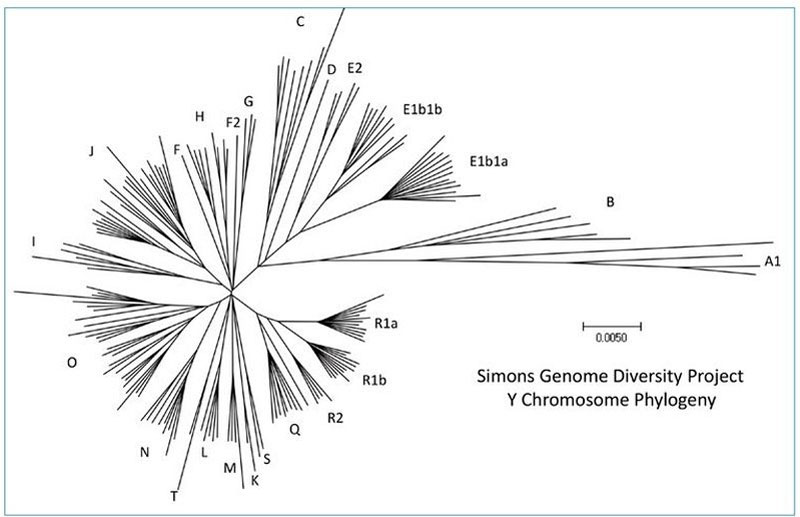
Genetic studies of the human Y chromosome from around the world uncovered a finding that surprised researchers: the data indicated that all living men trace their paternal lineage back to a single male ancestor. This outcome appears inconsistent with the evolutionary concept of universal common descent, which holds that humans arose from large, diverse populations; numbering at least in the thousands; not from a single individual. Under standard evolutionary theory, there should be no such thing as a 'first man.' Yet one group had long maintained that all humans ultimately descend from a single ancestral man.
Bible‑believing Christians, especially young‑earth creationists, have continued to assert that all humans descend from a single man, despite the evolutionary claim of universal common descent. Creationists argue that this genetic finding supports the Biblical narrative; something they have maintained for centuries based on Scripture. In their view, it was only a strictly atheistic commitment to explaining everything through purely naturalistic processes, excluding God from consideration regardless of the evidence, that led to the opposing claim.
We are left with a crucial question: what does the evidence actually indicate? Either it points to humanity descending from a single man roughly 4,500 years ago, or from one man who lived within a population of thousands around 200,000 years ago; whose Y‑chromosome lineage alone persisted to the present.
What is Y chromosome DNA?
[Human y-chromosome DNA,jpg]
Y‑chromosome DNA is the genetic material found on the human Y chromosome, one of the two sex chromosomes (X and Y). It is passed exclusively from father to son, making it central to male biological development and paternal ancestry. The Y‑chromosome consists of about 59 million base pairs of DNA, making up about 2% of the total human genome. It contains an estimated 70–200 genes, though the exact number is still being refined due to its complex structure. The Y‑chromosome determines the sex of a child, because it carries the SRY gene, which triggers male development in the embryo. Many Y‑linked genes are essential for sperm production, Making it an essential part of male reproduction.
What does the Bible say about our Y chromosome DNA?
The Bible does not directly mention the Y chromosome, but it provides enough detail about human male lineage to form expectations about what genetic studies should reveal. According to Scripture, the first man was Adam; hence the inspiration for the term 'Y‑chromosome Adam.' Ironically, however, the Biblical account suggests that Adam would not be the actual Y‑chromosome ancestor of all living men. Instead, that role would belong to Noah, since he is presented as the most recent common male ancestor of all humanity, living roughly 4,500 years ago. Because the only other men who survived the Genesis Flood were Noah’s three sons, Shem, Ham, and Japheth, we would expect a close but distinct three‑branch division in Y‑chromosome lineages. Moreover, this three‑way split should appear tighter than the patterns seen in women’s mitochondrial DNA.
What does the data say about our Y chromosome DNA?
When this research was carried out, the results showed that all living humans do indeed descend from a single male ancestor. This is a remarkable finding, because under the concept of universal common descent, humanity should trace back to a large ancestral population numbering at least in the thousands. By that reasoning, it should be impossible for all living humans to converge on one male ancestor; yet that is precisely what the data reveals. Beyond that, an even greater surprise emerges when you examine how the ancestral lines are distributed.
When the data is examined closely, it reveals a very tight three‑way division. This is exactly what you would expect if those three lines were traced back to three brothers. The split is also much narrower than what appears in mitochondrial DNA. This suggests that the three male ancestors were far more closely related; consistent with being brothers; than the three female ancestors indicated by mitochondrial evidence.
Evolutionary response #1 - Last common paternal ancestor.
Evolutionists, unwilling to let contrary evidence disrupt their conclusions, often respond with a familiar, rehearsed objection whenever someone draws a Biblical connection to Y‑chromosome findings. They insist, with noticeable certainty, that this ancestor is merely the most recent common paternal ancestor; not the first man, and not the only man alive at the time. Yet they cannot offer a concrete explanation for the bottleneck itself, relying instead on speculative, untestable stories to account for it.
Response to Evolutionary response #1 – Agreed he is Noah not Adam himself.
We actually agree that Y‑chromosome Adam is not the Biblical Adam himself. According to the Biblical account, the most recent common male ancestor would be Noah, not Adam. The Bible also offers a straightforward explanation for the bottleneck: the Genesis Flood, during which only Noah and his three sons survived. In other words, critics are responding to an argument we are not making. They assume we are claiming direct genetic evidence for Adam as the first man, when our actual point is that the data align with Noah as the last common male ancestor.
Evolutionary response #2 – He lived 200–300 thousand years ago.
At this point, evolutionists often respond by saying, ‘We’ve caught you here!’ They argue that the scientific consensus, based on molecular‑clock calculations, places Y‑chromosome Adam at 200,000 to 300,000 years ago. Since the creationist model places him only about 4,500 years ago, they claim this discrepancy proves the model is wrong at its most crucial point. In their view, he could not possibly be the Biblical Adam; or even Noah; because the genetic ancestor is said to have lived more than forty times earlier than the Biblical timeline, thereby invalidating the entire creationist framework.
Response to Evolutionary response #2 - Dates not based on empirical data
One factor often left out of this claim is the basis for the 200,000–300,000‑year estimate. In most cases, those who repeat this figure neither know how it was derived nor show any interest in finding out. It simply serves as an authoritative‑sounding number that allows them to dismiss any alternative timeline. The reality is that the 200,000–300,000‑year figure is not based on direct measurements of mutation rates. Instead, it relies on what is called the substitution rate; yet even this rate is not empirically measured. Both the consensus date and the substitution rate are calculated by comparing human Y‑chromosome DNA to that of chimpanzees and then estimating a rate and a timeline based on the assumption that humans and chimpanzees shared a common ancestor roughly 6 million years ago.
This date is not determined by examining direct, objective measurements of how quickly the Y‑chromosome changes over time. Instead, it rests entirely on the assumption of universal common descent and on estimates of when humans supposedly shared a common ancestor with chimpanzees. In other words, critics reject the Biblical timeline using a date that is itself derived 100% from the presupposition that the Biblical account is already wrong. This is circular reasoning: the conclusion is based not on independent evidence, but solely on the assumption of universal common descent. You cannot disprove a claim by relying on calculations that begin by assuming that claim is false." This is an example of a logical fallacy I like to call, “Your theory does not work under my theory; therefore, your theory must be wrong.”
A key element of this argument is the appeal to scientific consensus. What is completely missing, however, is any explanation of how that consensus is determined or on what basis it is claimed. For instance, it is safe to assume that no young‑earth creationists were included in forming this consensus. This is like declaring unanimous jury agreement after removing all dissenting jurors and replacing them with alternates who already support the verdict. Invoking scientific consensus in a scientific debate is ultimately an appeal to authority, not a substantive argument.
Direct empirical estimates of Y‑chromosome mutation rates have been made by comparing multiple generations. As documented in mainstream scientific papers, these calculations come from examining differences between fathers and sons, and even grandfathers and great‑grandfathers when possible. When these measured rates are compared with the variation found among human Y‑chromosome DNA, they yield an estimated age for Y‑chromosome Adam of about 4,500 years; aligning with the Biblical timeline for Noah rather than the roughly 6,000 years attributed to Adam. In light of the Genesis Flood, this result fits precisely with the Biblical account.
Evolutionary response #3 – The three main migrations out of Africa
Evolutionists often respond to the Three‑Way Split by asserting that standard population genetics accounts for it within the Out‑of‑Africa model. In that framework, the three major Y‑chromosome haplogroups are linked to three primary migrations out of Africa. We acknowledge that they have proposed an explanation for the Three‑Way Split, but this does not negate the fact that the data align precisely with what the Biblical account would predict. Can the Out‑of‑Africa model be used to explain the Three‑Way Split? Yes. Is the Three‑Way Split a natural or expected feature of that model? No. Does the Out‑of‑Africa model predict such a pattern? No. In reality, it could have accommodated virtually any pattern that emerged.
Response to Evolutionary response #3 - Problems with three main migrations out of Africa.
There is a significant problem with the claim that the Three‑Way Split arose from three major migrations out of Africa. Such migrations should have produced a four‑way split, with the fourth branch representing the population that remained in Africa. Moreover, there is no inherent reason for any evolutionary model to yield a clean, symmetrical three‑way division. For instance, one branch could easily have split off from another rather than forming three independent lines. And three migrations would not naturally produce a tidy three‑way split unless each migrating group consisted of a single family; one father, one mother, and their children; which would be required to generate this pattern. If even one additional man had sons, and those sons were not brothers, the neat division would disappear. In fact, any migrating population large enough to be viable would contain multiple Y‑chromosome lines. The observed pattern does not logically follow from evolutionary expectations and must be artificially explained to fit the model.
The key point is that the data show a clean, well‑defined three‑way split originating from a single point. This is exactly the pattern you would expect if three brothers survived a catastrophe and later had children who repopulated the Earth. It matches the Biblical prediction precisely, and once again evolutionists must attempt to explain it away. Their proposed explanation, however, is not sufficient to dismiss a pattern that aligns so directly with the Biblical account.
Which model explains the data naturally and the best?
The question we must address is which model explains the data most naturally and most effectively. We need to examine the evidence as it actually is, not as we might prefer it to be. The issue is not whether a model can be adjusted to fit the data, but which model explains it straightforwardly and does so best. You are free to reject that model if your worldview requires you to do so regardless of the evidence, just don’t claim that such a rejection is scientific.
When we look at the data itself, what does it actually show? First, human Y‑chromosome DNA traces back to a single male ancestor. Direct measurements of mutation rates indicate that he lived about 4,500 years ago. In addition, the data reveal a distinct three‑way split, pointing to three branches that originated from three other men. The closeness of these branches is fully consistent with those men being brothers. So which of the two models accounts for this evidence most naturally? And we must remember that scientifically testing a model depends on its ability to accurately predict future findings.
Let’s begin by examining the evolutionary model. Under this framework, we should not expect human Y‑chromosome DNA to trace back to a single man. At any point in time, thousands of men would have been alive and producing surviving offspring, resulting in numerous independent branches that could not all converge on one ancestor. To make the evolutionary model fit the data, a hypothetical genetic bottleneck must be proposed; one that eliminated all Y‑chromosome lines except one. Because the date produced by direct mutation‑rate measurements was unacceptable within this model, researchers instead assumed a shared ancestry with chimpanzees and calculated a ‘substitution’ rate that produced a more agreeable date of roughly 200,000 years. Finally, there is no inherent reason to expect a clean three‑way split in the Y‑chromosome lines, let alone one originating from a single point. It would be more reasonable, within the evolutionary framework, to expect one branch to split off from another African lineage rather than aligning neatly with two additional splits.
The Biblical account, by contrast, not only predicts a three‑way split but also anticipates that the branches would form such a clean, orderly pattern. When the age of the Y‑chromosome ancestor is calculated using direct mutation‑rate measurements, it comes out to roughly 4,500 years; precisely within the Biblical timeframe. All of these features align naturally with the data.
The question, then, is which model explains the data most naturally and most effectively. The evidence points clearly toward the Biblical model. This is not a matter of accepting it ‘on faith,’ but of recognizing where the data itself leads. The Biblical account not only predicts the observed results, it also naturally explains the single genetic bottleneck required. These conclusions follow directly from taking the Biblical narrative at face value and predicting what pattern should appear in human Y‑chromosome DNA. The evolutionary model, by contrast, predicted something different and then relied on ad‑hoc explanations to account for the actual findings, while inflating the age of Y‑chromosome Adam through assumptions of universal common descent. The evidence fits the Biblical creation model most closely; without requiring any prior assumption that it must be correct.
Conclusion
The simple fact is that Y‑chromosome DNA data aligns clearly and naturally with the Biblical account of creation and the Genesis Flood. It does so without relying on additional assumptions—only on the straightforward expectation of what our Y‑chromosome DNA should look like if the Biblical narrative is accurate. The data fits that account perfectly. By contrast, evolutionists must rely on evolutionary assumptions and ad‑hoc explanations merely to give the appearance that the data fits their model. This is a clear example of evidence that naturally supports the Biblical account, yet is dismissed in favor of complex evolutionary reinterpretations rather than following the data where it plainly leads.