














During my years as a judicial law clerk for a South Carolina Circuit Court Judge and later as Assistant Solicitor (state prosecutor) for the 13th Circuit Solicitor’s Office, I spent a great deal of time in courtrooms. I saw judges preside over complicated cases, attorneys advocate for their clients, and jurors make decisions that could change people’s lives.
Today, as Greenville County’s Clerk of Court, I see the judicial system from a different perspective. Much of my attention is now devoted to things most people never see. How can we make court records easier for judges to access? Why are we paying for a service we no longer need? What can we do about equipment that has been neglected for years?
These questions may not sound particularly exciting, but finding practical answers to them has become one of the most rewarding parts of my work.
I was born and raised in Greenville County, and this community has always been home. When I was elected Greenville County’s 20th Clerk of Court in November 2024, I knew I was accepting responsibility for an important public office. I also knew there would be opportunities to improve how it serves the people of our county.
Since taking office in January 2025, I have spent considerable time learning the details of our operations, listening to employees and judges, meeting with other county departments, and examining procedures that have been in place for years.
I have found that some of the most useful ideas come from the people who do the work every day. Others come from visiting another courthouse, listening to an attorney’s concern, or noticing something that could be done more efficiently.
I want our office to be a place where people feel comfortable asking questions and offering suggestions. We may not always be able to provide the answer someone wants, but we should always be willing to listen and explain what we can do. That begins with helping the public understand what the Clerk of Court’s Office actually does.
What the Clerk of Court Actually Does
The position of Clerk of Court is one of South Carolina’s oldest public offices, with roots reaching back to the English legal system. Several of the statutes governing our responsibilities today can be traced to legislation enacted by the General Assembly in 1839.
In 1868, South Carolina established the Clerk of Court as an elected constitutional office. Article V, § 24 of our State Constitution continues to require the election of a Clerk of the Circuit Court in every county for a four-year term.
Although elected by county voters, the Clerk serves within South Carolina’s unified judicial system and must carry out responsibilities established by state law, court rules, and judicial directives.
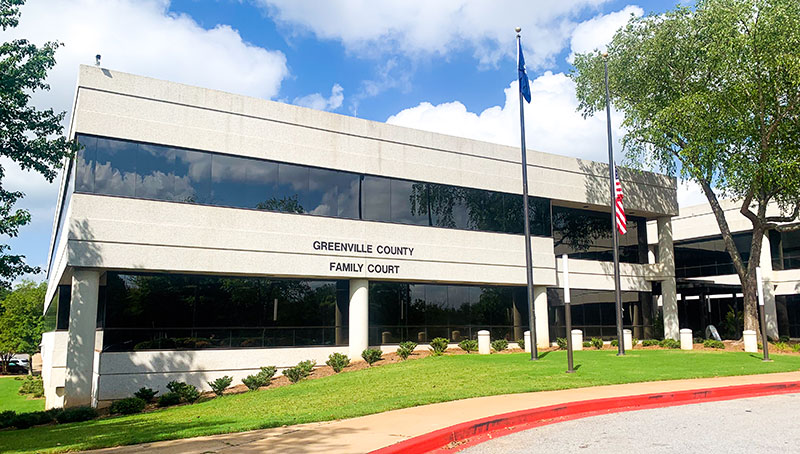
In Greenville County, our office has approximately 100 employees working across two courthouse locations. Our downtown courthouse, the Greenville County Courthouse, serves both divisions of Circuit Court. The Court of Common Pleas handles civil lawsuits involving contracts, property, personal injuries, and other disputes. The Court of General Sessions handles felony prosecutions and certain misdemeanor cases. Our Family Court, located at 350 Halton Road, handles matters involving divorce, child custody, child support, adoption, juvenile proceedings, and other issues affecting families.
Across these courts, our employees receive and process filings, preserve official records, enter judgments and judicial orders, administer jury services, coordinate court schedules, and account for court fines and fees. We also process criminal warrants and bond documents, assist with support enforcement proceedings, and report certain criminal case dispositions and court orders to the South Carolina Law Enforcement Division.
There are even some responsibilities that might surprise people. For example, state law assigns the Clerk of Court the duty of administering oaths of office to magistrates and constables.
While our work is essential to the court system, we do not decide lawsuits, determine guilt or innocence, prosecute criminal defendants, or impose sentences. Those responsibilities belong to judges, juries, and prosecutors.
The Numbers Behind the Work
The Clerk’s responsibility is to carry out the administrative work of the courts accurately, faithfully, and impartially. It is a substantial undertaking, particularly in a county that has grown as much as Greenville.
During 2025, our office received over 8,400 new Common Pleas cases, approximately 13% more than the previous year. Our Criminal Records Department entered approximately 17,400 General Sessions warrants and processed 24,244 criminal court orders. Our Jury Services Department issued over 7,000 jury summonses.
At Family Court, employees scheduled 5,285 hearings, handled more than 4,000 Rule to Show Cause matters involving support obligations, and scanned nearly half a million documents into electronic records.
Our Circuit Court Accounting Department also collected approximately $4.24 million in fines and court fees, money that must be properly accounted for and distributed according to law.
Those figures represent only part of what our employees handle.
The demands have continued into 2026. Through September, Greenville County received 7,329 new Common Pleas cases while 7,674 cases were disposed of, producing a clearance rate of approximately 104.7%. That means more civil cases were disposed of during that period than were newly filed. It is encouraging progress, reflecting the collective work of our judiciary, attorneys, court personnel, and others. The Clerk’s Office plays an important supporting role, but the disposition of cases rests with the judicial process as a whole.
Modernizing How the Courts Work
As these numbers grow, so does the importance of finding better ways to manage the work. One of the first areas I wanted us to address was how Family Court records are maintained and accessed.
Family Court judges regularly serve in different counties, yet important filings were not always as readily available electronically as they needed to be. After working with our judges and employees to understand the problem, we developed a process that allows newly filed Family Court documents to be digitized directly into the statewide Family Court Case Management System. Judges and authorized court personnel can now access those documents electronically when preparing for hearings, without the same reliance on physical files and separate records.
It was not a particularly glamorous project. It required working through the details, adjusting procedures, and making sure employees were comfortable with the changes. But it has made an important difference in how information is available to the Court.
Another priority has been making court information easier for the public to find.
Our office began regularly publishing weekly courtroom assignments for Circuit Court and Family Court. We expanded the availability of court rosters and improved the information provided through our website. More recently, we installed new digital signage at the downtown courthouse to help people locate courtrooms and navigate the building, and will soon be doing the same at Family Court.
Anyone who has walked into an unfamiliar courthouse knows how confusing it can be. People may already be worried about a legal matter, serving on a jury, or appearing as a witness. They should not have to spend unnecessary time trying to figure out where to go.
We have also made changes to criminal court administration. At the direction of the Chief Administrative Judge, our office recently assumed responsibility for coordinating the General Sessions motions docket, a function previously handled by the Solicitor’s Office for decades.
We established a dedicated point of contact for attorneys, developed more consistent scheduling procedures, and expanded the publication of court rosters. The Court continues to retain authority over approving dockets and making scheduling decisions.
We have also worked with the South Carolina Judicial Branch to improve access to interpreter services, including securing the assignment of the first full-time Spanish-language interpreter in our local court system.
At Family Court, we completed the county’s transition to the South Carolina State Disbursement Unit for regular child support payments in October 2025. This brought Greenville County into alignment with the statewide payment processing system. We also installed automated payment kiosks to provide another convenient option for parents.
These are examples of how an office can improve without losing sight of its basic responsibilities. Sometimes the solution involves technology. Sometimes it involves clearer communication or changing a procedure that no longer works as well as it should.
I am particularly interested in improvements that save time, reduce unnecessary work, or make life a little easier for the public. That same attention to detail is important when it comes to spending taxpayer money.
Looking After Taxpayer Dollars
Since taking office, we have reviewed expenses, eliminated unnecessary services, examined existing arrangements, and looked for ways to better coordinate administrative work between Circuit Court and Family Court. One of the more visible examples involved the condition of our courthouse buildings.
When I began meeting with Greenville County Property Management about needed improvements, I learned that the downtown courthouse had not received a comprehensive exterior cleaning in approximately three decades.
Both courthouse exteriors were cleaned this summer. By comparing options and working closely with Greenville County Property Management, we were able to have both buildings cleaned for substantially less than one estimate we received for the downtown courthouse alone. There is nothing complicated about the principle behind that decision. When spending public money, it pays to ask questions, compare alternatives, and make sure we are getting a reasonable value.
We have taken a similar approach to improvements in our Jury Assembly area. Much of the seating and furniture has been in use for decades. When replacement seating was quoted at a very high amount, I wanted to examine whether the existing furniture could be refurbished or whether a less expensive alternative would meet our needs.
I believe government should take care of what it already owns before automatically seeking to replace it. At the same time, being careful with taxpayer money does not mean overlooking legitimate needs.
A Courthouse Under Pressure
Our downtown courthouse is facing significant challenges involving space, aging equipment, and security.
When the courthouse expansion opened in 1997, the building accommodated approximately 162 county employees and judicial staff. A courthouse space review prepared in 2024 reported that number had grown to approximately 242. As of today, it is even higher.
During that same period, the number of judicial offices increased from seven to eleven.
Our county has grown considerably, but the space available for courthouse operations has not kept pace. Departments share conference rooms, divided offices, and make other accommodations to continue serving the public. Those efforts have helped, but they are not permanent solutions.
Courthouse security is another concern that requires attention. Much of our downtown courthouse’s security infrastructure is between 20 and 30 years old, and some equipment is no longer functioning as intended.
I have brought these concerns to County Council and our County Administrator and outlined an estimated $2.7 million proposal to modernize surveillance equipment, including infrastructure needed to support it, create perimeter protection, and address other deficiencies.
I recognize that this is a substantial amount of money. It should be examined carefully, just as any major public expenditure should be. But courthouse security is a responsibility we cannot simply put off indefinitely. Judges, jurors, witnesses, attorneys, employees, law enforcement officers, and members of the public deserve a reasonably safe environment.
I have continued working with County Administration, County Council, the judiciary, Sheriff’s Office, and others to evaluate these needs and the longer-term future of the courthouse.
I appreciate those relationships. Our courthouse operations involve many different offices and agencies, each with its own responsibilities. Getting things accomplished often requires people to sit down together, share ideas, and work toward a solution.
The People Behind the Progress
I have also enjoyed learning from other Clerks of Court around South Carolina. No county has every answer, and there is no reason Greenville should hesitate to learn from something another office is doing well.
The same willingness to learn is important within our own staff. We have expanded cross-training so that critical responsibilities are not dependent on a single employee. We have also worked to improve coordination across our departments and develop opportunities for employees to grow professionally.
This summer, we established a structured internship program involving Greenville Technical College and other college students. The interns spent time in both Circuit Court and Family Court to better understand the many jobs involved in operating a judicial system. Two of those internships have already resulted in employment with our office.
I want young people to see that there are worthwhile careers in court administration and public service. I also want our existing employees to know their ideas, experience, and dedication are valued.
Why Impartiality Matters
Beyond these administrative responsibilities, there is something even more important about the work entrusted to a Clerk of Court. Our courts must operate in a manner that deserves the public’s confidence.
The conduct of the former Colleton County Clerk of Court during the Murdaugh trial brought national attention to the responsibilities of this office. In May 2026, the South Carolina Supreme Court ordered a new trial after finding that the former Clerk had improperly influenced jurors.
The decision is a serious reminder that everyone who comes before our courts is entitled to a fair proceeding and an impartial jury.
As an attorney and elected Clerk of Court, I recognize the importance of professional restraint and the obligation to respect the rights of all parties. A court official’s personal views must never interfere with the judicial process.
Our responsibility is to support the Court and uphold the law, regardless of who the parties may be or how much public attention a case receives.
When Jury Duty Goes Unanswered
Citizens themselves also play an essential role in maintaining that system.
Shortly after I took office, a major criminal trial was postponed after only 59 of 161 summoned citizens reported for jury service. That experience reinforced how much our courts depend on people being willing to serve.
The right to trial by jury is one of the great protections of American liberty. It allows ordinary citizens to participate directly in the administration of justice and helps ensure that important decisions are made fairly and according to law.
We often speak about the importance of voting, and rightly so. Jury service is another fundamental responsibility of citizenship. I understand that receiving a jury summons can be inconvenient. It may require taking time away from work, adjusting family schedules, or postponing other commitments. But our rights as Americans come with responsibilities. When citizens fail to respond to jury summonses, trials can be delayed, taxpayer resources can be wasted, and people waiting for their cases to be heard are affected.
If you receive a summons, please take it seriously. Read the instructions, respond promptly, and contact our Jury Services Department if you have questions or believe you qualify for an exemption or postponement.
Don’t Fall for a Jury Duty Scam
I also want to warn the public about jury duty scams, which have become increasingly sophisticated in Greenville County and elsewhere.
Criminals have contacted residents by telephone, text message, and email, claiming they missed jury duty and must immediately pay money to avoid arrest or other penalties. Some of these scams include official-looking documents, court seals, fabricated case numbers, QR codes, and the names of real judges or law enforcement officers. Please do not be fooled.
Official Greenville County Circuit Court jury summonses are sent through the United States Mail. Our office does not demand payment through telephone calls, text messages, emails, or QR codes to prevent someone from being arrested for missing jury duty. As I have said before, no one can text you into jail, and no one can text you out of it for a fee.
If you receive suspicious communication, do not send money, click unfamiliar links, or disclose personal financial information. Instead, contact our Jury Services Department directly at (864) 467-8511 or
Making Court Information More Accessible
Our office has made a greater effort to communicate these warnings and other useful information directly to the public.
I encourage Greenville County residents to follow the Greenville County Clerk of Court’s Office on Facebook and Instagram. Each week, we publish courtroom assignments for Circuit Court and Family Court, along with courthouse announcements, jury service information, scheduling updates, and other notices.
These posts can be especially useful for attorneys, jurors, litigants, and families who need to know what is happening at our courthouses. Assignments remain subject to change, and online posts do not replace official court notices or judicial orders.
Our website also provides access to the Greenville County Public Index, where residents can search available civil and criminal case information. Images of many Common Pleas filings are available electronically, although certain records remain confidential or restricted under South Carolina law.
Our employees can assist with obtaining eligible public court records and certified copies. They can explain administrative procedures and help direct people to the appropriate department, although they cannot provide legal advice.
It is also helpful to know that some commonly requested services are handled elsewhere. Probate Court handles estates and marriage licenses, while the Register of Deeds maintains land records. Applications for criminal expungements are generally handled through the Solicitor’s Office.
I have enjoyed welcoming students, civic organizations, and community groups into our courthouses to learn more about how the judicial system and our office works. These visits are a reminder that people are interested in their government when given an opportunity to understand it. I also welcome feedback from those who use our offices.
If there is a procedure that is unnecessarily confusing, a service that could be improved, or something we have overlooked, I want to hear about it. We cannot always make every change someone requests, but we can listen, explain our responsibilities, and give good ideas fair consideration.
I am especially grateful for the employees of the Clerk of Court’s Office. Much of their work takes place outside public view, but their knowledge and dedication are what allow us to handle thousands of filings, court orders, hearings, and other responsibilities each year.
I am equally grateful for the cooperation of our judges, attorneys, law enforcement officers, and county and state partners. Our courts depend on people in many different positions doing their jobs well and working together.
The Work Still Ahead
Greenville County will continue to grow, and our judicial system must continue adapting to meet its needs.
The Clerk of Court is an office with a long history, but respecting that history does not mean resisting change. I believe we can preserve the traditions and responsibilities that matter while improving the way we serve the public.
There is still plenty of work ahead. Some problems will require significant investments. Others may be resolved through a better procedure, a useful conversation, or simply taking the time to address something that has been overlooked. My responsibility is to keep working through those issues, one at a time, with the people who help make our courts function.
Most people may never give much thought to the Clerk of Court’s Office until they need it. When they do, I want them to find knowledgeable employees, accurate records, clear information, and people willing to help. That is what public service should look like, and it is what I want our office to provide.
---------------------------------
For information about court records, jury service, courtroom assignments, and courthouse updates, visit www.greenvillecounty.org/ClerkOfCourt and follow the Greenville County Clerk of Court’s Office on social media.
The Greenville County Courthouse is located at 305 East North Street in downtown Greenville and may be reached at (864) 467-8551. Family Court is located at 350 Halton Road and may be reached at (864) 467-5800.
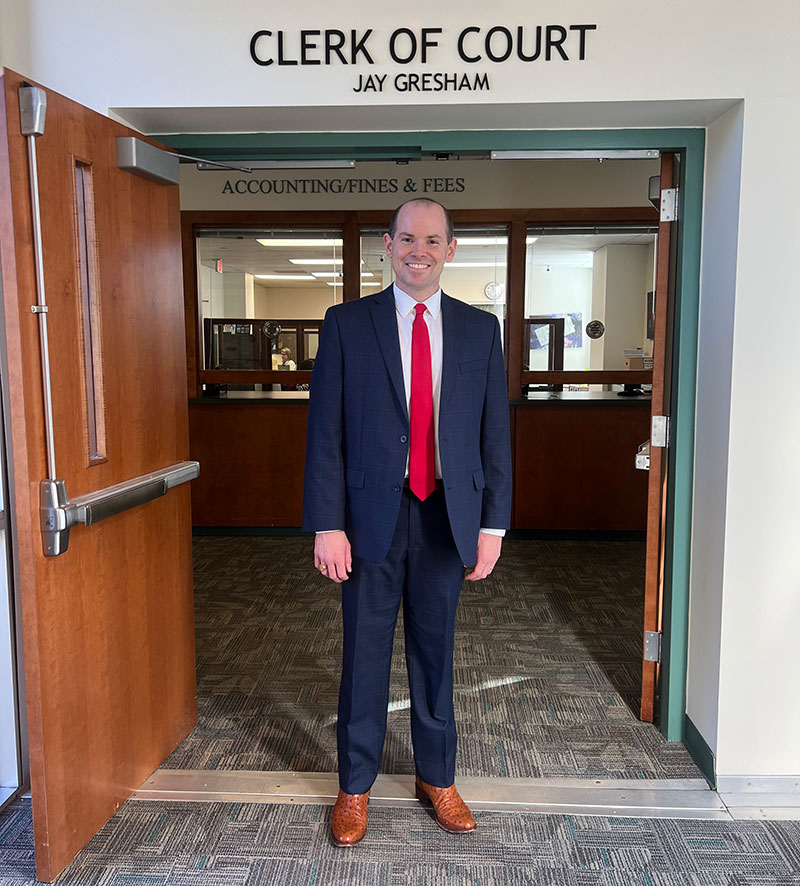
Jay Gresham is Greenville County’s 20th Clerk of Court and the youngest person in county history to hold the office. Born and raised in Greenville County, he graduated with honors from The Citadel, The Military College of South Carolina, and earned his law degree from the University of Wyoming College of Law. Before his election in 2024, he served as a judicial law clerk and Assistant Solicitor in the 13th Judicial Circuit. He is only the second attorney to serve as Greenville County Clerk of Court.