








Russians Warn Full Military Response
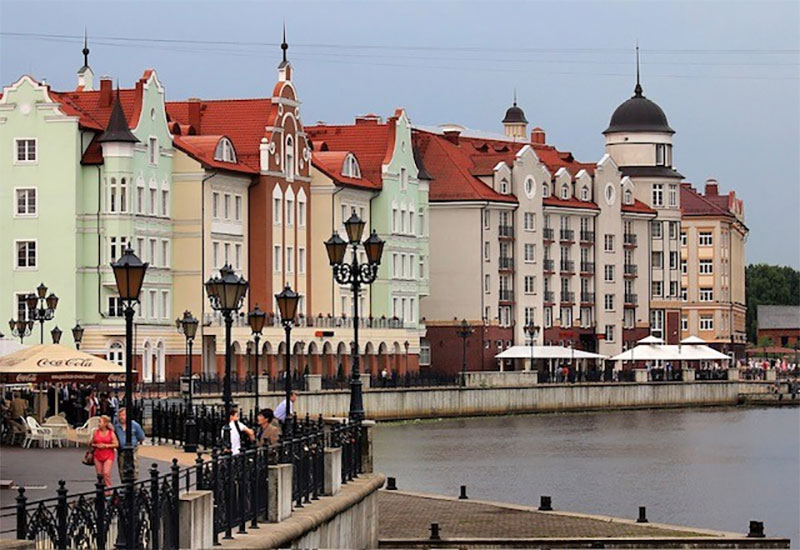
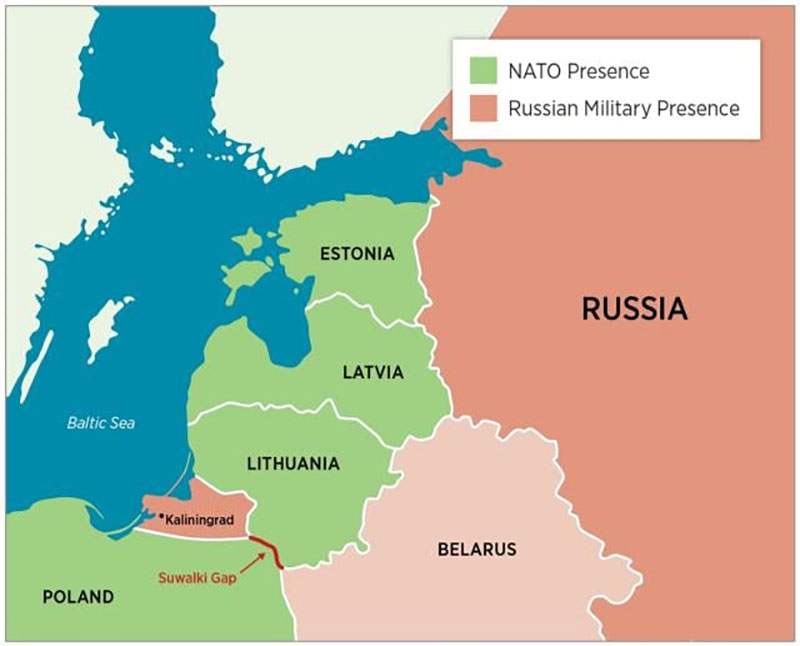
Kaliningrad is a Russian exclave between Lithuania and Poland on the Baltic Sea. It is the Russian Federation’s only ice-free port in Europe and a major Russian naval and military base. On July 17, US General Chris Donahue, Commander of US Army forces in Europe, issued a statement meant to warn the Kremlin that NATO could take control of it “in a timeframe that is unheard of, ” if Russian aggression extended beyond Ukraine. In response, Leonid Slutsky, Chairman of the Russian Duma (parliament) Committee on Foreign Affairs, warned that any attack on Kaliningrad would be met “with all the corresponding retaliatory measures, including nuclear weapons.”
By the way, Slutsky, a doctor of economics, holds his position in the Duma as a member and Leader of the LDPR (Liberal Democratic Party), rather than Putin’s United Russia Party. As mentioned in my recent article on the September Russian Duma Elections, the LDPR is actually conservative and comparatively right of the United Russia Party. It placed third in the popular vote with 9%, also rising to third in Duma deputies with 23 of the 450 Duma total.
On October 1, Russian Federation President Vladimir Putin warned that Russia is prepared to “use all weapons, including nuclear” to protect Kaliningrad.
This undoubtedly represents the carefully considered consensus of the constitutional Russian National Security Council (SCRF) with 13 permanent members. President Putin is the Chairman of the Council, which also includes Deputy Chairman, Dmitry Medvedev, former Russian President and Leader of the United Russia Party; Sergei Shoigu; Secretary and former Defense Minister; Prime Minister, Mikhail Mishustin; Chairwoman of the Russian Senate, Valentina Matviyenko; Chairman of the Duma,Vyacheslav Volodin; Defense Minister, Andrey Belousov; Foreign Minister, Sergei Lavrov; Internal Affairs Minister, Vladimir Kolokoitsev; Director of the Federal Security Service (FSB, formerly Soviet KGB), Alexander Bornikov; and Director of the Foreign Security Service (SVR), Sergei Naryshkin.
When you see the Russian National Security Council/Committee mentioned in media news, or any of the names above, pay attention! This Council is the ultimate authority of the Russian Federation.
Putin has stated that he is not threatening pre-emptive war, but that he is concerned that NATO and European Union leaders persist in saying they are preparing for a war with Russia in 2029 or 2030. These statements have come especially from current Polish, Lithuanian, and German leaders. Plus the present UK government is constantly issuing belligerent statements regarding Russia. Estonian and German officials in the European Union frequently warn that the West must prepare for Russian aggression if Ukraine falls.
This fear of Russia has reached a fever pitch because the war is going terribly for Ukraine and both the Ukrainian military and economy are near collapse. Population dynamics in Ukraine are especially grim. Because of Russian territorial gains and massive Ukrainian migration fleeing the war, economic despair, and corrupt and despotic government, Ukraine has lost close to half of its population since 2014. In 2014, the Obama Administration backed and financed a coup in Ukraine that removed the pro-neutrality President of Ukraine, Viktor Yanukovych, duly elected n 2010, and resulted in a new anti-Russian Ukrainian government. The Ukrainian Constitution actually specified international neutrality at the time. The coup was largely orchestrated under the project leadership of then Vice President Joe Biden. The new US and UK backed Ukrainian government attempted the “Ukrainization” (political suppression and cultural cleansing) of the 38% Russian and Russian-Ukrainian minority, especially concentrated in the eastern and southern oblasts (states). The February 2022 Russian “unprovoked” invasion of eastern Ukraine was really an extension of the 2014-2015 civil war that followed the new Ukrainian government suppression of Russian culture, language, religion, and pro-Russian political sympathies. The 2015 Minsk Peace Agreement outlined a plan to correct the abuses of Ukrainization and Ukrainian government cultural cleansing. However, they were never implemented.
The Western NATO powers involved in the Minsk Peace Agreement—France, Germany, the US, and UK—never intended their implementation. The Western powers deliberately used the Minsk Peace Agreement only to gain time to build up Ukrainian forces to levels that made Ukraine a NATO bulwark of anti-Russian power. Chancelor Angela Merkel of Germany and President François Hollande later admitted this.
By February 24, 2022, Russian Federation President Vladimir Putin had run out of patience regarding NATO’’s de facto use of Ukraine as an existential threat to Russian national security. Moreover, he stated the importance of Ukrainian government and military actions against the 38% Russian and mixed Russian ethnic minority in his military intervention across the Ukrainian border.
“The purpose of this operation is to protect the people, who for the past eight years, have been subjected to humiliation and genocide by the Kiev regime. To this end, we will seek to demilitarize and denazify Ukraine as well as to bring to justice those who have perpetrated numerous bloody crimes against civilians, including citizens of the Russian Federation.”
In his 2023 book, Ukraine between War and Peace, former Chief of Swiss Strategic Intelligence, Col. Jacques Baud, also points out that in 2019 the Rand Corporation, the foremost American military think-tank, on request of the Defense Department, published two papers entitled Extending Russia and Overextending and Unbalancing Russia, including warnings of the risks of their implementation. This plan called for provoking the Russians into invading Ukraine, and then using sanctions to destabilize the Russian Federation, resulting in Russian regime change, elimination of Russia as a major international military and industrial power, and opening it to resource exploitation. The Trump Administration evidently rejected or bypassed this Rand Corporation proposal. However, the Biden Administration evidently adopted the proposal in 2021. The Ukraine War that resulted is now reaping devastation in Ukraine and has seriously depleted US munitions and financial resources. It is causing economic and political chaos in NATO and the European Union.
The Ukraine War has now spilled over into a potential war and nuclear crisis over Kaliningrad.
Previous to World War II, Kaliningrad was Königsberg, a famous German port on the Baltic Sea established in 1255. Before World War II, Königsberg was the capital of East Prussia. It was also a stronghold of German Lutheran and Reformed Protestantism.
Following the Potsdam Agreement of August 1945, at Stalin’s request, the Allied powers agreed to give Königsberg to the Soviet Union as a compensation for the loss of 27 million dead and for inflicting more than 80% of German military casualties. In 1946, the name was changed to Kaliningrad, honoring Mikhail Kalinin, an influential Soviet leader from 1919 to 1946.
The population of the city of Kaliningrad is about 489,000. It has never recovered to the level of its German population of over 1.0 million before World War II. The population of Kaliningrad oblast (state) is slightly over 1.0 million today. The demography has completely changed. Approximately 79% are Russians, and 14% do not admit their ancestry. There are small percentages of Belarusians and Ukrainians. Only 0.4% admit to being German. The Germans were forced out in 1946. Most were able to relocate in Germany.
The most common religious identity is Russian Orthodox with 31%, This is much lower than the overall Russian Federation, which is overwhelmingly Russian Orthodox. More people, 34%, say they are spiritual but not religious. Approximately 22% claim to be atheists or non-religious.
The Kaliningrad oblast is about the same size as the US State of Connecticut. Its economy includes engineering, metalworking, and paper-pulp. Shipbuilding, electric propulsion systems, and car and truck assembly. The latter includes GM, BMW, and Kia.
The Suwalki Gap (or Corridor)
The Suwalki Gap is the approximately 60-mile distance from Belarus to Kaliningrad along the winding border separating Poland and Lithuania. This is important to the Russians logistically because it connects its close ally Belarus with its Kaliningrad exclave. If the Russians or Belarusians held the Suwalki gap, it would expedite logistical support to Kaliningrad and would also block ground transportation from Poland to Lithuania, Latvia, and Estonia. There is at least one German brigade and one Polish brigade stationed there, equipped with armor, and air defenses. NATO probably has plans to flood additional units and weapons into the Gap as necessary, as US Army General Chris Donahue has essentially indicated.
Kaliningrad is a naval headquarters with dozens of warships and considerable missile and air defense equipment and support including S-400 anti-missile systems. Kaliningrad also has heavy electronic warfare means. It has at minimum 10,000 Army troops there equipped with armor and drones. Before the Ukraine War, it had about 30,000 army troops there. If the Suwalki Gap is open, heavy reinforcements from Russia and Belarus are available. About 10,000 Belarusian armor and mechanized infantry troops are near the border. Kaliningrad may have nuclear weapons. In any case, it is likely that Russian Navy surface ships and submarines nearby may have nuclear weapons.
On a lighter note, Kaliningrad is a beautiful, clean, and historically picturesque city. Politicians and Generals who want to bomb it should be tarred and feathered.
 Mike Scruggs is the author of two books: The Un-Civil War: Shattering the Historical Myths; and Lessons from the Vietnam War: Truths the Media Never Told You, and over 600 articles on military history, national security, intelligent design, genealogical genetics, immigration, current political affairs, Islam, and the Middle East.