












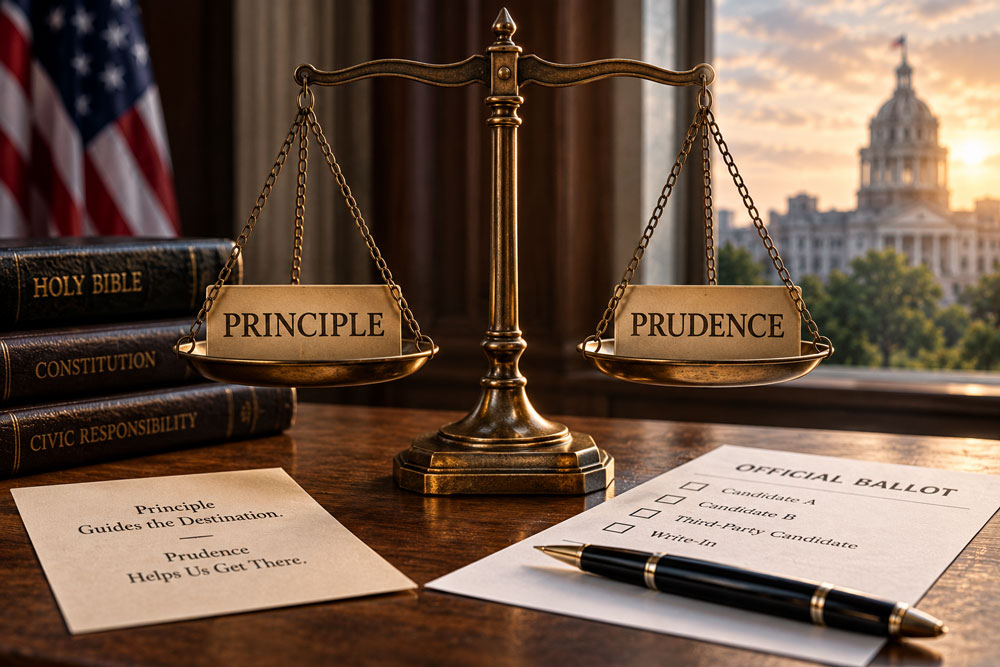
A vote for an imperfect candidate does not necessarily require the surrender of principle. Sometimes it requires the prudence to understand what a vote actually does.
There is a familiar phrase that returns every election season, usually spoken with considerable conviction: “I refuse to vote for the lesser of two evils.”
I understand the sentiment. There is something admirable about a citizen who does not want political expediency to become an excuse for abandoning principle. We should be concerned whenever winning becomes more important than truth, character, or conviction. But there is a problem buried inside that familiar phrase. It assumes that voting for an imperfect candidate necessarily means endorsing the imperfections of that candidate.
I reject that premise.
When I enter a voting booth, I am not canonizing a candidate. I am not signing my name beneath every statement that person has made, every vote cast, every policy supported, every association maintained, or every mistake committed. A ballot is not a certificate of moral perfection. It is a decision between the choices actually before me, and like most important decisions in life, it produces consequences.
That distinction is where the conversation about principle must begin. There is an enormous difference between compromising a principle and using prudence in pursuit of that principle. Principle establishes what I believe to be right. Prudence requires me to consider how, under the circumstances that actually exist, I can best move toward it.
Principle Establishes the Destination
Suppose an election leaves me with two viable candidates, neither of whom represents everything I believe. Candidate A disagrees with me on several important matters. Candidate B disagrees with me on considerably more. Recognizing that difference does not automatically mean that I have abandoned my principles. It may mean that I am applying those principles to an imperfect set of circumstances.
Imagine that one political outcome moves government ten miles away from where I believe it ought to be, while another moves it one hundred miles away. Refusing to recognize the difference does not somehow place government at my preferred destination. The political road does not disappear simply because neither available route takes me exactly where I wanted to go.
This is where prudence becomes important.
Principle tells me where I ought to go. Prudence helps me determine how to get there. The two should not be enemies.
Prudence without principle can become mere expediency, because there is no fixed destination. But principle without prudence can become ineffective, because there is no practical consideration of how to move toward that destination. Properly understood, prudence is not necessarily the surrender of principle. Sometimes it is principle put to work in the world as it actually exists.
“Principle tells me where I ought to go. Prudence helps me determine how to get there.”
Consider a more concrete example. Suppose I were a South Carolina legislator faced with an anti-abortion bill that I believed could save 10,000 unborn children. The bill is not everything I want. Perhaps it contains exceptions I oppose, or perhaps it stops short of the protections I believe every unborn child deserves. I could refuse to vote for it because it gives me only part of what I believe is right.
But what happens to those 10,000 children while I wait for the perfect bill?
If I believe those 10,000 lives can be protected by the legislation before me, I will vote to protect them. I have not surrendered my principle that the remaining unborn children deserve protection too. I have simply accomplished what is possible today while refusing to abandon what still needs to be accomplished tomorrow.
Then I begin the next battle.
I work for the next bill. I fight to remove the exceptions I opposed. I work to extend protection to those who were left unprotected by the first legislation. I do not throw away the good that can be accomplished today simply because I cannot accomplish everything today.
That is not abandoning principle for compromise. That is principle working through prudence.
The alternative would be a strange application of principle: because I cannot save 100 percent, I refuse an opportunity to save thousands. In trying to preserve the appearance of perfect consistency, I may actually produce an outcome farther from the very principle I claim to be defending.
That is the same question a voter sometimes faces. Prudence does not ask them to change their society’s destination. It asks them to recognize where it is, what choices are actually available, and which choice moves their country, their state, their county, their cities and their communities closer to that destination. What remains unfinished becomes the next battle, not a reason to surrender the ground that can be gained today.
The Primary and General Election Ask Different Questions
Much of the confusion surrounding this issue comes from treating every stage of an election as though voters are being asked the same question.
They are not.
A primary is the appropriate place for voters participating in a party's nominating process to argue vigorously over which candidate should carry that party's banner. That is the time to examine records, challenge positions, ask difficult questions, support the candidate who most closely reflects one's convictions, and attempt to persuade other voters to do the same.
Fight for the candidate you believe is best. But sometimes that candidate loses.
When that happens, political reality changes. The general election does not ask voters which candidate they wish had won the primary. It presents the candidates who remain on the ballot. The decision has therefore changed from selecting a preferred party nominee to choosing among the available candidates for the office itself.
That does not require anyone to forget what happened during the primary. Nor does casting a general-election vote for a candidate opposed during the primary magically transform that candidate into the voter's ideal representative.
There is a time to fight for the candidate one believes is best, and there is a time to judge the consequences of the choices that remain. Confusing those two decisions can make political purity look remarkably similar to political paralysis.
Conscience Does Not End at the Voting Booth
This brings us to the part of the “lesser of two evils” argument that deserves more thought. Conscience is sometimes treated as though its responsibility ends the moment the ballot is marked. I would argue that conscience must consider not only the action itself, but also the reasonably foreseeable consequences of that action.
None of us can know every consequence of an election. Political events are too complicated for that. Candidates change positions, circumstances change, legislatures intervene, courts rule, and unforeseen events alter administrations. Nevertheless, responsible citizenship requires some consideration of what the available choices are likely to produce.
Suppose I refuse to vote for Candidate A because that candidate holds several positions I oppose. Candidate B, however, advocates considerably more positions I oppose, including some I consider substantially more damaging. I can refuse Candidate A and make a perfectly clear personal statement.
But making a statement and accomplishing an objective are not necessarily the same thing.
“My vote did not purchase my silence. Nor did it certify their perfection.”
That distinction matters because government is not an abstraction. Whoever wins will exercise actual authority. Governments make laws, levy taxes, spend public money, appoint officials and judges where applicable, administer agencies, enforce statutes, and make decisions that can remain in place long after the election is forgotten.
Therefore, conscience should ask more than, “What does my vote say about me?” It should also ask, “What might my decision help produce?”
That is not an argument for abandoning conscience. It is an argument for requiring conscience to finish the job.
The Right to Choose Is Not the Question
Let me be clear about something else. This argument is not intended to disparage voters who support a third-party candidate, write in another candidate where the law permits it, or ultimately decide that they cannot support either of the leading candidates. The ballot belongs to the voter. Every voter has the responsibility to examine the choices and make that decision according to their own judgment and conscience.
My disagreement is with the strategy, not with the voter's right to make the choice.
If, after examining the candidates, the issues, the consequences, and the realistic alternatives, a voter concludes that a third-party candidate best represents their principles, then they have made a reasoned decision. If a voter concludes that a write-in vote is the best expression of their convictions, that too can be a deliberate decision. I may disagree with the political strategy, but disagreement with someone's strategy is not the same thing as denying their right to choose it.
What concerns me is something different. It is the decision that begins and ends with, “My candidate lost, so I am done.” It is the self-centered pouting impulse that says, “If I cannot have 100 percent of what I wanted, I will choose zero percent instead.”
That is the fallacy I am challenging.
The better response is this: “My candidate lost. Now I will reassess the choices that remain, apply my principles again, consider the consequences, and decide what my conscience and judgment require.”
That approach does not dictate what the voter's final decision must be. It may lead one voter to support the party nominee and another to vote for a third-party candidate or choose an available write-in option. Some may even choose not to vote at all, a choice I strongly disagree with. The important distinction here is how the decision was reached. It came after applying principle, conscience, reason, and prudence to the choices that remained, rather than allowing the disappointment of losing a primary to make the decision.
Disappointment should not make the decision for us. Refusing to let it do so is not surrendering principle. It is refusing to let emotion substitute for judgment.
When Emotion Takes the Steering Wheel
There is another participant in political decision-making that deserves attention: emotion.
Politics produces plenty of it. Anger, frustration, disappointment, loyalty, enthusiasm, fear, resentment, and even a sense of betrayal can become powerful forces during an election. Those emotions can be genuine and sometimes justified. But they should not be permitted to do the work that belongs to reason, judgment, principle, and prudence.
I have come to think of it this way: emotion is an action after the decision, not before.
Reason should examine the facts. Principle should establish the objective. Prudence should evaluate the available choices and their foreseeable consequences. Once that work has been done, emotion can supply the enthusiasm and determination necessary to act.
Reverse the order and something dangerous happens. Anger can begin masquerading as principle. Disappointment can disguise itself as conscience. Retaliation can feel like courage. A voter can gradually become more interested in punishing someone for yesterday than in determining what will best serve tomorrow.
That does not mean emotion has no place in politics. Human beings are not machines, nor should we pretend to be. But emotion makes a better passenger than a driver.
Imperfect Candidates in an Imperfect World
Perhaps the deepest problem with the expression “lesser of two evils” is the word “evil” itself.
Evil certainly exists. There are evil ideas and evil actions, and history contains no shortage of examples. As Paul noted in his letter to the Roman Christians, “There is none righteous, no, not one.” If every candidate who violates one of my principles becomes an “evil” candidate, I will eventually discover that no human being is qualified to receive my vote. Including me.
We elect imperfect human beings to govern other imperfect human beings through institutions created and operated by imperfect human beings. There will rarely be a candidate who reflects every conviction a voter holds. Recognizing that reality does not mean principles suddenly become negotiable. It means judgment becomes necessary.
I can vigorously oppose a candidate in a primary and still conclude that the same candidate is my preferred choice among those available in the general election. If that candidate wins, I can support them when I believe they are right and oppose them when I believe they are wrong. I can criticize their decisions, hold them accountable, and work to replace them in the next primary.
My vote did not purchase my silence. Nor did it certify their perfection. It answered the question that was actually before me on Election Day.
“Emotion may provide plenty of fuel for the journey. But never hand emotion the steering wheel.”
Principle and Prudence
None of this settles every difficult voting decision. There may be circumstances in which a voter concludes that every available candidate crosses a moral line that conscience will not permit them to cross. Different voters can examine the same facts and reach different conclusions about where those moral lines belong. The point is not that conscience should be ignored whenever an election becomes inconvenient.
As for me, that same careful examination could lead me to a third-party candidate or an available write-in option. But the standard has not changed. I must consider the choices, the differences, and the consequences, then make the decision through principle, reason, conscience, and prudence, not disappointment or emotion.
Whatever the decision, bring your conscience into the voting booth. Bring your principles. But bring reason, judgment, and prudence with them.
Elections do not occur in the world as we wish it existed. They occur in the world as it exists at that moment, with the candidates, circumstances, and consequences before us. Principle should establish the destination. Prudence should help us navigate the road. Emotion may provide plenty of fuel for the journey.
But never hand emotion the steering wheel.
God did give us a brain in a multi-colored world! Use it!