










After voters rejected proposals in 2002, 2014 and 2024, a new $1.1 billion referendum brings familiar questions about road funding, taxpayer costs and government accountability back to the ballot.
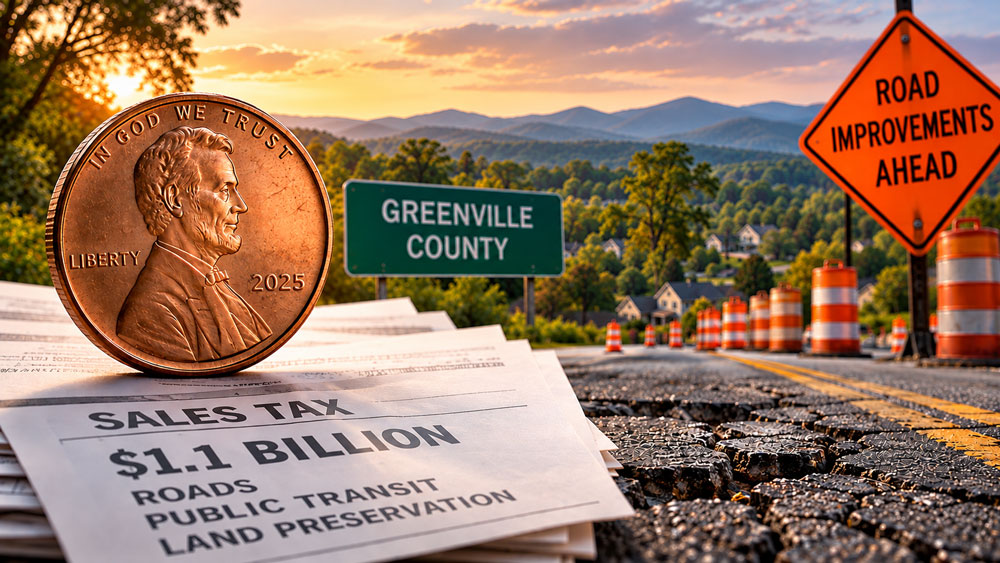
A penny is hardly worth bending over to pick up these days. In fact, the United States Mint stopped producing pennies for general circulation in November 2025, ending a 232-year tradition because making one costs more than its face value. Yet while the federal government has decided that producing another penny is no longer worth the expense, Greenville County voters are being asked whether collecting another penny in sales tax is worth the investment. Multiply that penny by millions of taxable purchases over eight years, and suddenly Greenville County is discussing something considerably larger than loose change.
They are discussing a proposed transportation sales tax that could collect as much as $1.1 billion.
The question before voters on November 3 is whether Greenville County should impose an additional one-percent sales and use tax to finance road improvements, transportation projects, public transit and land preservation. Supporters see the proposal as a necessary response to years of inadequate road funding and rapid population growth. Opponents see a government seeking substantially more revenue before demonstrating that it has made the best use of existing resources.
Both sides have numbers to support their arguments. Both acknowledge that Greenville County has roads needing attention. And both raise questions about how much money is necessary, who would pay it and what taxpayers would receive in return.
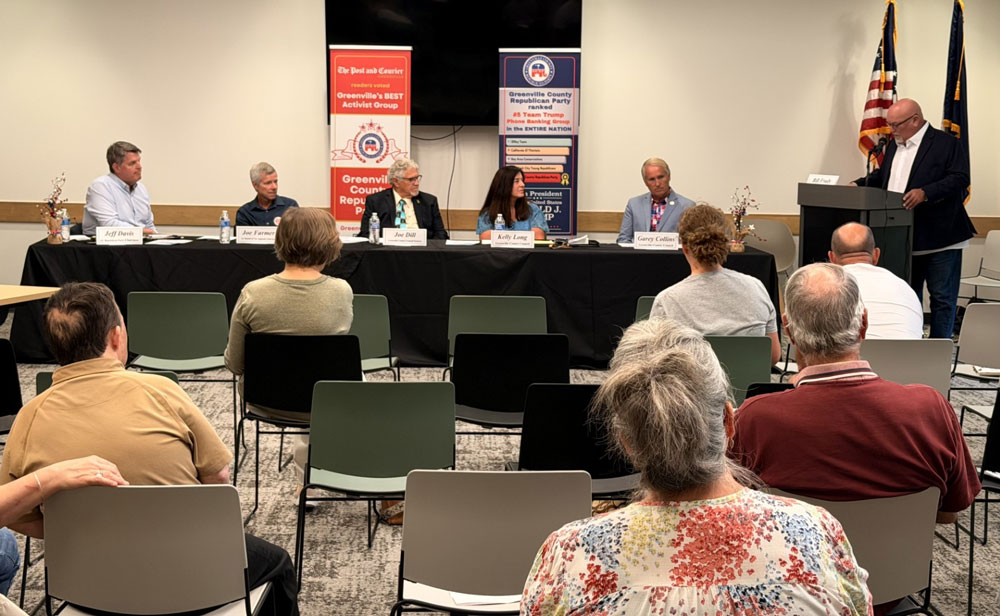
The disagreement became especially apparent October 8 at a public No Penny Tax forum featuring Greenville County Council members Garey Collins and Kelly Long, former Councilman Joe Dill, financial analyst Joe Farmer and Jeff Davis. Bill Frady moderated the discussion, which included questions from residents and an exchange with County Councilman Curt McGahhey, a supporter of the referendum.
The evening demonstrated that the debate is about more than whether Greenville County needs better roads. It concerns how those roads should be financed, what government should be expected to accomplish with existing revenues and how much confidence taxpayers should place in long-term spending projections.
The Case for More Road Funding
McGahhey has argued that Greenville County's transportation problems did not develop overnight and cannot be corrected through ordinary annual budget adjustments alone.
During an earlier, separate presentation at a Back to Basics breakfast, he described a county road system that had received comparatively modest annual appropriations for years. He said previous councils had sometimes budgeted approximately $12 million for roads while spending closer to $8 million. As Greenville County continued growing, maintenance and improvement needs accumulated.
McGahhey has also pointed to recent increases in county road spending as evidence that County Council is attempting to address the problem. At the October 8 forum, he said the county had paved approximately 72 miles during the year. Collins had earlier described a lower mileage figure while discussing the county's recent road work.
For supporters, the central concern is that increased appropriations alone have not eliminated the accumulated backlog. Roads continue to deteriorate, intersections become more congested, and the county must plan for future development while maintaining infrastructure already in place.
McGahhey has argued that a dedicated sales tax would allow Greenville County to undertake improvements that otherwise might remain unfunded for years. Unlike property taxes, the proposed sales tax would also collect revenue from taxable purchases made by visitors and people living outside Greenville County.
That distinction matters in a county serving commuters, shoppers and travelers from across the Upstate.
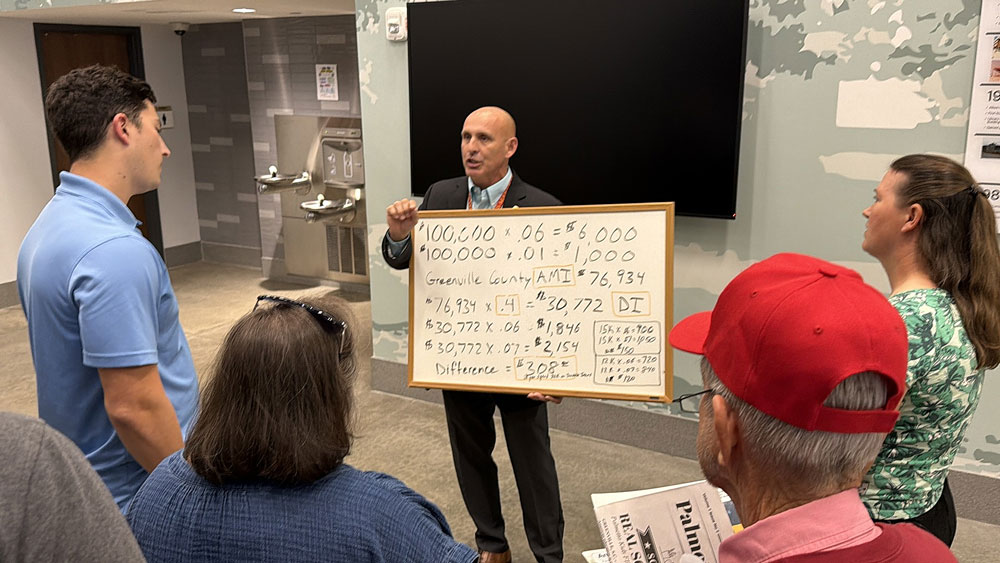
Supporters also argue that the additional tax should be measured against actual taxable purchases rather than a household's entire income. A one-percent tax adds $1 to a $100 taxable purchase. Under that calculation, a household would need to make $100,000 in purchases subject to the additional tax to pay $1,000 directly through the new sales tax.
The proposed tax would not apply to certain exempt purchases, including qualifying groceries, prescription medications and gasoline. As a result, McGahhey contends that some estimates circulated by opponents overstate what an individual household would directly pay.
His argument is not that the tax would be free. It is that voters should calculate its cost using taxable spending rather than simply dividing projected county revenue equally among residents.
The Opposition's Case: Show the Numbers First
At the October 8 forum, opponents approached the proposal from the other end of the financial equation.
Rather than beginning with the tax on an individual purchase, they began with the total amount government expects to collect.
Using the projected $1.1 billion over eight years and an assumed Greenville County population of 550,000, opponents calculated that the referendum represents $2,000 in collections per resident over the life of the tax, or $250 annually. For a family of four, that produces an annual per-capita equivalent of $1,000.
Davis and Farmer questioned whether lower household-cost estimates adequately account for the total revenue the county expects to receive. They also raised the possibility that businesses purchasing taxable materials and supplies would pass some of their additional costs along to customers.
Dill, who operates a business, described the effect that higher purchasing costs can have on what customers ultimately pay. Others attending the forum raised similar concerns about construction materials and household necessities.
Those concerns introduce an important distinction. The direct sales tax paid by a household at a checkout counter is not necessarily the entire economic effect of a sales-tax increase. Businesses may absorb some costs, pass some along through prices or adjust purchasing decisions. The extent of those effects depends on the business, the market and which transactions are actually taxable.
Opponents also emphasized that many ordinary necessities remain taxable. While qualifying groceries and prescription medicines would be exempt, purchases such as diapers, toiletries, cleaning supplies and many over-the-counter medications could be subject to the additional penny.
Their concern is that households with limited disposable income may experience a greater burden relative to their earnings, even when their total dollar contribution is smaller than that of wealthier households.
That is a different question from whether the average household would pay $308, $650 or $1,000 annually. It concerns how the burden is distributed.
When Both Calculations Are Correct
One of the most useful lessons from the debate is that two calculations can be mathematically correct while describing different things.
Consider the projected $1.1 billion in collections. Divided equally among 550,000 residents, that represents $2,000 per person over eight years. But that does not establish that every resident will personally pay $2,000.
Now consider the assumption that 35 percent of collections would come from visitors and nonresidents. Under that assumption, the calculation changes.
Of the projected $1.1 billion, visitors would contribute approximately $385 million, leaving $715 million attributed to county residents. Spread over eight years, the resident share would amount to $89.375 million annually. Divided among 550,000 residents, that equals $162.50 per person per year, or $650 annually for a family of four.
Those figures depend on the assumed visitor contribution. They also represent an average allocation of collections rather than a prediction of what any particular household would pay.
The calculation illustrates why both sides can point to legitimate arithmetic without necessarily reaching the same conclusion. The opposition's figures describe the scale of government collections. McGahhey's calculation describes the direct tax on a household's purchases.
Neither calculation, by itself, establishes the actual burden on a typical Greenville County family.
Households do not all spend the same amount, and they do not spend identical proportions of their income on taxable goods. Businesses make taxable purchases, visitors contribute revenue, and some business costs may eventually appear in the prices consumers pay.
In other words, the argument is not resolved merely by finding someone who can divide $1.1 billion correctly.
Where Would the Money Go?
The referendum would not direct every dollar toward pavement.
The proposal allocates approximately 90 percent to transportation and road-related projects, 7 percent to the Greenville County Historic and Natural Resources Trust for land preservation, and 3 percent to Greenlink public transportation.
Using $1.1 billion as the total, those allocations represent approximately $990 million, $77 million and $33 million, respectively.
Supporters regard the proposal as a transportation funding package that also addresses public transit and preservation of land in a growing county. McGahhey has previously acknowledged that the allocations reflect compromises involved in developing the proposal.
Opponents question whether money described to voters primarily as road funding should also support transit and land preservation. Farmer argued at the forum that eliminating certain non-road allocations and reviewing existing expenditures could reduce the amount of new revenue necessary.
He estimated that the county-maintained roads on the project list could be addressed for approximately $500 million to $600 million, substantially less than the overall referendum amount. His approach separates county-maintained roads from projects involving state and municipal roads, which he believes should be funded through their respective governments.
The distinction between county-maintained roads and state-maintained roads is important. Many heavily traveled roads in Greenville County fall under the South Carolina Department of Transportation rather than County Council. Opponents argue that taxpayers already contribute through the state gasoline tax and should expect the state to fulfill its transportation responsibilities.
Supporters counter that residents experience congestion and deteriorating pavement regardless of which government maintains the road, and that cooperation between county and state agencies can help complete projects that might otherwise be delayed.
Both positions lead to a practical question: Which government should pay for each project, and how much should Greenville County contribute when a road is primarily a state responsibility?
The $40 Million Question
The most revealing exchange at the October 8 forum came when McGahhey challenged opponents to identify a workable alternative.
Speaking from the audience, he described the county's existing financial obligations and questioned how officials could find another $40 million annually without affecting essential services.
“Where do we get $40 million from? I'd like to know. You know, it's not simple,” he said.
He continued by pointing to the relatively small savings that would result from eliminating certain existing programs, arguing that those reductions would still leave a substantial transportation funding gap.
“What's the solution?” McGahhey repeatedly asked.
Collins responded that county government needed to reconsider how it had operated for the previous 20 years, including restructuring services and identifying efficiencies. He acknowledged that the county could not immediately repair decades of neglected roads and argued that restoring public confidence in spending should come before imposing another tax.
The exchange exposed the central difference between the two approaches.
McGahhey wanted opponents to identify enough specific savings or alternative revenues to meet the transportation needs he described. Collins maintained that the county should begin by restructuring government and determining what could be accomplished before establishing another major revenue source.
Farmer offered a more numerical alternative. He suggested that approximately 5 percent in efficiencies, reduced duplication and outsourcing could free up around $25 million, based on a county budget approaching $500 million. He also argued that existing road appropriations and a narrower project list could substantially reduce the amount of additional funding required.
The discussion revealed that the two sides were not necessarily working from the same definition of the problem. McGahhey was describing the funding needed to address a broader transportation backlog, while Farmer was concentrating on a narrower group of county-maintained roads and potential savings elsewhere in the budget.
The disagreement is therefore not simply whether government should save money. It is whether the savings and existing revenue available would be sufficient to address the transportation needs each side considers necessary.
Roads, Contractors and the Cost of Waiting
The October 8 forum introduced another concern that receives less attention in the public discussion: Even if Greenville County collects additional money, how quickly can transportation projects actually be completed?
Collins questioned whether the region has enough available road contractors and construction crews to handle a major increase in projects. He described concerns about contractors traveling from other states, the expense of moving equipment and the possibility that a sudden influx of transportation funding could increase construction prices.
Other participants questioned the accuracy of preliminary project estimates and whether road improvements had been sufficiently designed before being presented to voters.
One audience member asked why taxpayers should approve such a large sum without more detailed engineering plans, contractor estimates and project schedules.
Collins explained that project estimates were developed using SCDOT engineering information and pavement-condition assessments. He also acknowledged that the work would not immediately eliminate the county's transportation problems.
Supporters argue that additional funding would allow the county to move forward with projects that might otherwise remain delayed. Opponents question whether the proposed amount, project priorities and implementation schedule are sufficiently developed to justify the new tax.
The disagreement extends beyond how much money would be collected. It also concerns how effectively Greenville County could turn that money into completed improvements.
The Question of Accountability
Throughout the opposition forum, participants returned to transparency, existing transportation revenue and the responsibilities of state government.
Several questioned whether Greenville County receives an appropriate share of state gasoline-tax revenue. Others argued that the county should review spending practices and existing financial obligations before approving a new tax.
Long discussed work toward a budget-compliance audit that would examine whether county expenditures align with their authorized purposes. Participants also raised questions about project oversight, bond financing and whether existing road money could later be redirected toward other programs.
Supporters point to the dedicated nature of the proposed sales tax, its stated allocations and the oversight mechanisms associated with transportation-tax revenue. They argue that a separate funding source would provide a more dependable means of planning and completing projects over several years.
Opponents question whether those safeguards would prevent other county spending priorities from changing once additional transportation money becomes available. Their concern is not limited to how the new revenue would be spent, but also whether existing funds could be shifted elsewhere.
The proposed authorization for up to $150 million in general obligation bonds became another point of discussion. Opponents raised concerns about interest, underwriting expenses and whether borrowing costs would reduce the amount available for construction.
Bond financing could allow certain projects to begin before all sales-tax revenue is collected. It would also create repayment obligations and financing expenses.
For supporters, the ability to begin major projects sooner is part of the value of a dedicated revenue source. For opponents, borrowing against future collections adds another financial obligation to a proposal they already consider too costly.
The question is not simply whether Greenville County can collect more money, but how that money would be managed over the eight-year period.
A Different Referendum, a Familiar Debate
The penny itself may be headed into history, but the debate over a Penny Tax in Greenville County has proved considerably more persistent. Voters rejected earlier one-percent sales tax proposals in 2002, 2014 and 2024. The proposal before voters in 2026 differs in its structure and spending priorities, but it returns to a familiar question: How should Greenville County pay for the roads and transportation improvements its supporters say are overdue, and what assurances should taxpayers receive before approving another source of revenue?
McGahhey opposed the 2024 proposal but has argued that changes in the current measure, together with his examination of county finances after taking office, explain his support for the new referendum.
Opponents remain skeptical that those changes justify another tax. Some argue that the county should first demonstrate how it will address transportation needs with existing revenues and what additional money would be required after those alternatives are exhausted.
The current referendum would operate for no more than eight years or until $1.1 billion has been collected, whichever occurs first. The proposal assigns maximum amounts of $990 million for transportation-related projects, $33 million for mass transit and $77 million for greenbelts.
A separate question would authorize the issuance of bonds, while county officials have also discussed repealing the existing Road Maintenance Fee if voters approve the new sales tax.
These provisions form part of the broader financial discussion. The referendum is not simply a question about whether residents want better roads. It asks them to consider a particular method of raising and spending money for transportation and related purposes.
The Question Behind the Question
After several public presentations, competing calculations and lengthy discussions, one point has become clear: Greenville County has transportation needs that will require continued attention and funding.
The disagreement is over the best way to provide that funding.
Supporters argue that waiting for budget reforms or changes in state transportation funding could allow existing problems to grow more expensive. Opponents argue that authorizing another tax before completing a thorough examination of current spending could perpetuate the same financial practices that contributed to the backlog.
Supporters emphasize the accumulated cost of years of inadequate road funding, the demands of continued growth and the limitations of existing county revenue. Opponents emphasize government accountability, the responsibilities of state transportation agencies, the economic burden of another tax and the possibility of accomplishing more through changes in spending priorities.
The debate has produced several different calculations, but those calculations answer different questions. The $1.1 billion figure describes the proposed total collections. The per-capita figures illustrate the scale of those collections relative to the county's population. Household taxable-spending estimates describe what particular spending patterns would cost directly. And the competing road-funding estimates reflect different assumptions about which projects should be included and which government should pay for them.
Greenville County voters will decide the referendum November 3. They will not be voting on whether roads need repair. They will be deciding whether this particular financing plan is the appropriate way to pay for them.
And that brings the debate back to the penny.
One side believes Greenville County has waited too long to collect the money needed to fix its roads. The other believes county government has waited too long to account for the money it already collects.
The question is no longer whether a penny adds up. It is whether the government's numbers, and the opposition's alternatives, do.