






“It is when a people forget God, that tyrants forge their chains.”
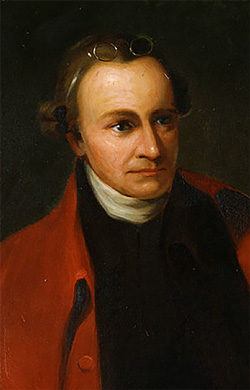
Patrick Henry was a “founding father” of American Independence who urged the delegates to the Second Virginia Convention on March 23, 1775, to break away from the rule of the British King and Parliament and resist the increasing tyranny they had borne since 1760. He closed his elegant and fiery plea with: “Give me liberty or give me death.”
Patrick Henry was born in Hanover County, Virginia, in 1736. He was the son of Scottish immigrant Col. John Henry (1703-1773, immigrated 1727) who later became a Judge identified with Colonial Legislative Rights. Patrick attended a local school until age 10 and thereafter was tutored by his father, who had attended King’s College at the University of Aberdeen in Scotland. Patrick became a lawyer by self-study in 1760, becoming known for his elegant and sometimes fiery defense of Colonial Rights. Building that reputation further by opposing the British Parliament’s passage of the 1765 Stamp Act taxation rules, Patrick was elected to the Virginia House of Burgesses in 1765.
Patrick Henry held a number Virginia Convention, House of Burgesses, and Colonial Congress offices and became the first and sixth post-Colonial Governor of Virginia on July 5, 1776, to June 1779 for three one-year terms and for two terms from 1784 through 1786. He served as Colonel of the First Virginia Militia Regiment from 1775 through 1776. Patrick’s first wife, Sarah Shelton, who he married in 1754, died in 1775. He married Dorothea Dandridge in 1777. Patrick Henry died at the age of 63 on June 6, 1799, and was the father of 17 children.
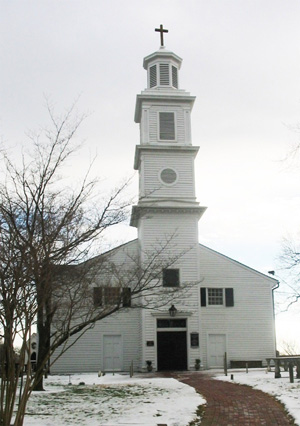
Highlights of Patrick Henry’s March 23, 1775, 2nd Virginia Convention speech, Henrico Parrish Church (now historic St. John’s Church in Richmond):
No man thinks more highly than I do of the patriotism, as well as abilities, of the very worthy gentlemen who have just addressed the House. But different men often see the same subject in different lights; and, therefore, I hope it will not be thought disrespectful to those gentlemen if, entertaining as I do opinions of a character very opposite to theirs, I shall speak forth my sentiments freely and without reserve. This is no time for ceremony. The questing before the House is one of awful moment to this country. For my own part, I consider it as nothing less than a question of freedom or slavery; and in proportion to the magnitude of the subject ought to be the freedom of the debate. It is only in this way that we can hope to arrive at truth, and fulfill the great responsibility which we hold to God and our country. Should I keep back my opinions at such a time, through fear of giving offense, I should consider myself as guilty of treason towards my country, and of an act of disloyalty toward the Majesty of Heaven, which I revere above all earthly kings.”
“Mr. President, it is natural to man to indulge in the illusions of hope. We are apt to shut our eyes against a painful truth, and listen to the song of that siren till she transforms us into beasts. Is this the part of wise men, engaged in a great and arduous struggle for liberty? Are we disposed to be of the number of those who, having eyes, see not, and, having ears, hear not, the things which so nearly concern their temporal salvation? For my part, whatever anguish of spirit it may cost, I am willing to know the whole truth; to know the worst, and to provide for it. I have but one lamp by which my feet are guided, and that is the lamp of experience. I know of no way of judging the future but by the past. And judging by the past, I wish to know what there has been in the conduct of the British ministry for the last ten years to justify those hopes….”
“Sir, we are not weak if we make a proper use of those means which the God of nature hath placed in our power. The millions of people, armed in the holy cause of liberty, and in such a country as that which we possess, are invincible by any force which our enemy can send against us. Besides, sir, we shall not fight our battles alone. There is a just God who presides over the destinies of nations, and who will raise up friends to fight our battles for us. The battle, sir, is not to the strong alone; it is to the vigilant, the active, the brave.”
“It is in vain, sir, to extenuate the matter. Gentlemen may cry, Peace, Peace– but there is no peace. The war is actually begun! The next gale that sweeps from the north will bring to our ears the clash of resounding arms! Our brethren are already in the field! Why stand we here idle? What is it that gentlemen wish? What would they have? Is life so dear, or peace so sweet, as to be purchased at the price of chains and slavery? Forbid it, Almighty God! I know not what course others may take; but as for me, give me liberty or give me death!”
Other Patrick Henry Quotes
“The Liberties of a people never were, nor ever will be, secure, when the transactions of their rulers may be concealed from them.”
“Bad men cannot make good citizens. It is when a people forget God that tyrants forge their chains. A vitiated state of morals, a corrupted public conscience, is incompatible with freedom. No free government, or the blessings of liberty, can be preserved to any people but by a firm adherence to justice, moderation, temperance, frugality, and virtue; and by a frequent recurrence to fundamental principles.”
“Power is the great evil with which we are contending. We have divided power between three branches of government and erected checks and balances to prevent abuse of power. However, where is the check on the power of the judiciary? If we fail to check the power of the judiciary, I predict that we will eventually live under judicial tyranny.”
“That religion, or the duty which we owe to our Creator, and the manner of discharging it, can be directed only by reason and conviction, not by force or violence; and therefore all men are equally entitled to the free exercise of religion, according to the dictates of the conscience; and is
the mutual duty of all to practice Christian forbearance, love, and charity towards each other.”—June 12, 1776.
“Whether this will prove a blessing or a curse, will depend upon the use of our people will make of the blessings which a gracious God hath bestowed on us. If they are wise, they will be great and happy. If they are of a contrary character, they will be miserable. Righteousness alone can exalt them as a nation. Reader! Whoever thou art, remember this: and in thy sphere practice virtue thyself, and encourage it in others.”
“United we stand, divided we fall. Let us not split into factions which must destroy that union upon which our existence hangs.”—March.4, 1799
“The militia is our ultimate safety. We can have no security without it. The great object is that every man be armed.”
“You ought to be extremely cautious, watchful, jealous of your liberty; for instead of securing your rights, you may lose them forever. Guard with jealous attention the public liberty. Suspect everyone who approaches that jewel. Unfortunately, nothing will preserve it but downright force. Whenever you give up that force, you are inevitably ruined.”—June 5, 1788.
“Show me the age and country where the rights and liberties of the people were placed on the sole chance of their rulers being good men, without a consequent loss of liberty?”
“Human nature will never part with power. Look for an example of a voluntary relinquishment of power from one end of the globe to another—you will find none.”
“Were my soul trembling on the wing of eternity, were this hand freezing to death, were my voice choking with the last struggle, I would still, with the last gasp of that voice, implore you to remember the truth: God has given America to be free.”
“The great pillars of all government and of the social life [are] virtue, morality, and religion. This is the armor, my friend, and this alone, that renders us invincible.”
“Perfect freedom is as necessary to the health and vigor of commerce as it is to the health and vigor of citizenship. “
“The Bible is worth all the other books which have ever been printed.”
“Adversity toughens manhood, and the characteristic of the good or the great man is not that he has been exempt from the evils of life, but that he has surmounted them.”
“Being a Christian... is a character which I prize far above all this world has or can boast.”
“The eternal difference between right and wrong does not fluctuate; it is immutable."
“Let us trust God and our better judgment to set us right hereafter.”
“I have now disposed of all my property to my family. There is one more thing I wish I could give them, and that is the Christian religion…This is all the inheritance I give to my dear family. The religion of Christ will give them one which will make them rich indeed.”
“My most cherished possession I wish I could leave you is my faith in Jesus Christ, for with Him and nothing else you can be happy, but without Him and with all else you'll never be happy…”
The First Great Awakening religious revival that swept through Britain and the American Colonies in the 1730s and 1740s reached Virginia when Patrick Henry was a boy. His father was staunchly Anglican, and Henry and his family remained Anglican all his life, but he had considerable sympathetic exposure to other Protestant denominations—Baptist, Methodist, and especially Presbyterian. His mother, Sarah Winston Syme Henry, was of English ancestry, but frequently took Patrick to hear Presbyterian preachers. One Presbyterian evangelist who resided in Hanover County at that time was Samuel Davies (1723-1761), who had a substantial influence on Patrick in his Christian Faith and a broader Christian understanding of social and public responsibilities, as well as his oratorical style and ability to reach both the hearts and reason of people in plain and familiar language. Patrick often consulted Samuel Davies, who became the fourth President of Princeton University from 1759 until his death in 1761.
Patrick Henry also knew and liked Thomas Jefferson (1743-1826), when Jefferson was a young boy. Jefferson also followed Patrick Henry’s third term as Governor of Virginia, serving from 1779-1781. They later clashed on the Constitution in 1787, Patrick Henry believing Federal Government was given too much power and that States Rights might be endangered. Jefferson, however, later became an advocate of States Rights through the ten amendments of the Bill of Rights in 1791.
The Virginia Declaration of Rights, Article 15, passed by the Virginia House of Delegates on June 12, 1776, is attributed to George Mason, but it also reflects a familiar theme and words of the first post-Colonial Governor of Virginia to take office on July 5, 1776, Patrick Henry.
"No free government, or the blessings of liberty, can be preserved to any people but by a firm adherence to justice, moderation, temperance, frugality, and virtue."
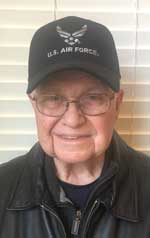 Mike Scruggs is the author of two books: The Un-Civil War: Shattering the Historical Myths; and Lessons from the Vietnam War: Truths the Media Never Told You, and over 600 articles on military history, national security, intelligent design, genealogical genetics, immigration, current political affairs, Islam, and the Middle East.