







Also Reviewing the Battles of Kings Mountain and Guilford Courthouse
I am writing this on July 4, 2026, the Birthday of the Declaration of American Independence. I have always been a strong supporter of the tremendously important principles of the Declaration of Independence and an admirer of Thomas Jefferson and his other writings, political ideas, immense intellect, and character. One of my great-great grandfathers on my mother’s side was named Thomas Jefferson Bradsher. Folks back then frequently revealed their own principles and sometimes politics by the names they gave their children. At least two of my ancestors on my father’s side are recorded as having served the American cause at the Battle of Cowpens in South Carolina on January 17, 1781.
The Battle of Cowpens was named for Hannah’s cattle pasturing and pens in upstate, Spartanburg County, South Carolina, near the North Carolina border. The town of Cowpens, SC, was formed near there later in 1880. The population now is about 2,000. The home of Robert Scruggs on the Cowpens battlefield was built in 1828. His father Richard Scruggs II had moved his family from Rutherford County, North Carolina, near the South Carolina border in 1805, and gave Robert 200 acres there in 1828. The Cowpens National Battlefield is about 9 miles NE of Spartanburg on U.S. Highway 29. It is about 41 miles NE from Greenville, SC
The Cowpens Battle was one of the most significant turning points for American victory in the Revolutionary War. It was the worst British defeat, since the Saratoga campaign from June through October 1777.
Defeat of the British Saratoga Campaign June-October 1777
In the Saratoga Campaign in upstate New York and southern Vermont, nearly 8,000 Hessian and other German mercenary troops under British Lt. General Burgoyne were forced to surrender because of logistical extremities and overwhelming opposition by combined American forces of 24,000. Moreover, the French were convinced to ally with and aid the Americans—an extremely important factor in eventual American victory.
British Southern Strategy
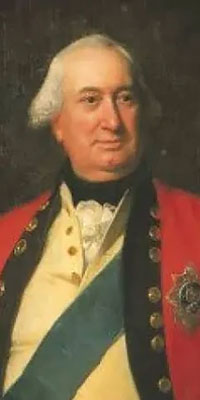
Following the unsuccessful Saratoga campaign the British decided to concentrate on the Southern states, as it was believed that there were more British Loyalists there. British Lt. General Charles, Lord Cornwallis was given charge of this Southern Strategy. The political judgement that there were more loyalists in the South came out of London with little appreciation of contradictory factors—like the fiercely independent and anti-British mindset of most of the Scots-Irish, concentrated especially in the western parts of the Carolinas. Many of the themes of Thomas Jefferson’s Declaration of Independence are reflected in the Mecklenburg Resolves also recognized by North Carolina as the Mecklenburg Declaration of Independence written and declared in Charlotte, North Carolina, on May 20, 1775, the first such declaration of the Thirteen Colonies. There is a controversy around the nature and date of the Mecklenburg Declaration, but there is little controversy over fierce Scots-Irish opposition to continued British rule over their lives.
Kings Mountain October 7, 1780
Only a little more than three months before Cowpens, on October 7, 1780, at Kings Mountain, North Carolina, on the South Carolina border, British Loyalist forces from South Carolina of about 1,125 men under British Major Patrick Ferguson (a Scot) were badly defeated by a combined force of 900 predominantly Scots-Irish Mountain men mostly from North Carolina and South Carolina but with some coming from Virginia, Tennessee, and Georgia. They were led by a hastily organized coalition of 9 militia units riding from Cowpens to Kings Mountain. The Loyalists, although on high ground, were taken by surprise and after 65 minutes incurred 984 losses—157 killed, 163 wounded, and 668 captured. The Mountain Patriots lost 28 killed and 62 wounded. This British disaster set the trend for Patriot victories in the South.
The Siege of Charleston May 12, 1780
Before Kings Mountain in October 1780 and Cowpens in January 1781, the British Southern strategy was going well. The Siege of Charleston ended on May 12, 1780, with British control of Charleston, the largest city in the South, the capital of South Carolina, and the foremost Southern port. The British capture of Charleston was the greatest American defeat of the war, resulting in the surrender of 5,000 American Patriot troops, their weapons, supplies, and port facilities. The British did not complete their evacuation of Charleston until December 14, 1782, more than a year after Cornwallis’s surrender at Yorktown. Until Kings Mountain and Cowpens, most battles in the South seemed to be easy British victories.
Nathaniel Greene American Southern Strategy
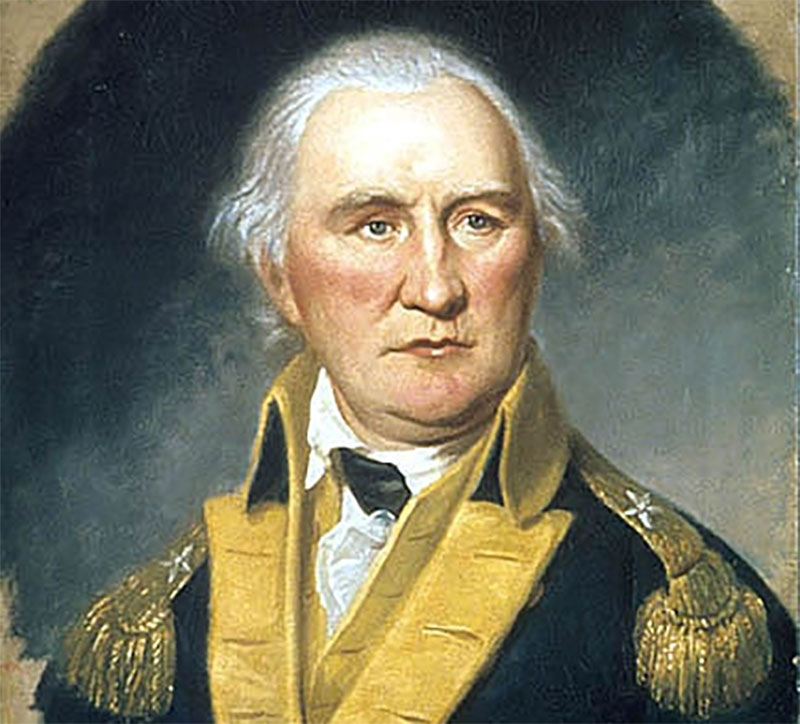
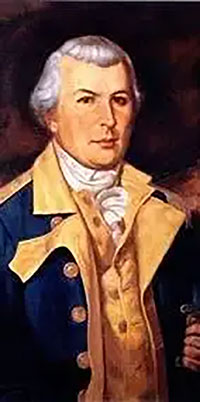
In December of 1780, the American Continental Commander in the South, headquartered in Charlotte, was Major General Nathaniel Greene. With less than 2,000 men, he decided that his army was too weak to oppose Cornwallis in open battle. Cornwallis’s British and Loyalist forces numbered more than 4,000. Nathaniel Greene made the controversial decision to divide his army into two wings. The western wing would be commanded by Brigadier General Daniel Morgan, who had distinguished himself at Saratoga. Lord Cornwallis began pursuing Morgan with about 2,500 British and Loyalist troops. On January 2, 1781, thinking Morgan with at most 900 troops was about to attack a Loyalist fort near Greenwood, SC, Cornwallis ordered Lt.Col. Banastre Tarleton with his Legion of over 1,000 British and Loyalist troops to intercept and destroy Morgan’s forces. Tarleton’s Legion also had two “Grasshopper” cannons. Banastre Tarleton had achieved a remarkable series of victories and accomplishments and had a reputation as an aggressive and sometimes ruthless officer.
Cowpens
Daniel Morgan vs. Banastre Tarleton
On January 12, Tarleton received another 150 British regulars bringing his total strength to 1,150 and received accurate information that Morgan was at Cowpens. Tarleton set his troops on a hard march to intercept Morgan before he could escape across the Broad River. However, Morgan believed fording the Broad River would be too difficult and dangerous with Tarleton in pursuit. He decided to stand and fight and carefully drew up a plan to do so minimizing his weaknesses and maximizing his strengths.
Late on January 16, Tarleton did not encamp his troops for the night. He was eager to catch up with Morgan at Cowpens and destroy him before he could escape. Tarleton’s regular and Loyalist troops were some of the best, but they had been out of food for more than a day and were exhausted by hard marching. But Tarleton had them up at 2 AM and on a hard march by 3 AM in the morning to surprise Morgan about sunrise at 7 AM. They emerged from the woods around Cowpens at that time, but Morgan was waiting for them.
According to historian Lawrence Babit’s detailed analysis of Morgan’s forces at Cowpens (A Devil of a Whipping: The Battle of Cowpens, 1998. UNC), Morgan’s Patriot forces numbered about 1,900 on January 17, 1781, considerably more than Cornwallis and Tarleton expected. These included about 550 experienced Continental Army troops, 1,050 relatively experienced militia, including many Kings Mountain veterans and several veteran Virginia and Georgia militias. He also had about 300 inexperienced militia troops. Inexperienced militia had a well-deserved reputation for headlong retreat at the first sign of heavy resistance, but Morgan took account of this in his plans.
Morgan placed his troops in three lines facing the British coming from the east. The first line consisted of 150 skilled sharpshooters from NC and Georgia acting as skirmishers. The second line consisted of the 300 inexperienced militia, but commanded by the most experienced militia and guerilla warfare officer, Andrew Pickens. The second line were instructed that they would only fire two volleys, firing especially at British officers, and then fake a retreat to their left and get behind the much larger and experienced third line. The third line was strategically placed on the highest ground which sloped downward toward incoming British assailants..
The British were stunned and delayed by the effectiveness of the sharpshooters, but renewed their charge when the sharpshooters seemed to retreat. However, the sharpshooters were deceptively disappearing to join with the second line. Tarleton continued to charge the second line, thinking the Americans were already beginning to retreat. Two strong volleys disproportionally struck British officers. When the second line retreated to the left and behind the very strong third line, Tarleton, thinking Morgan’s lines were collapsing, drove his already exhausted men into a full charge. Tarleton was especially encouraged when he thought the American right flank was pulling back in retreat. But the experienced Virginia militia companies deceptively pulled back about 20 yards, did an about face, and fired a devastating volley directly into the onrushing but exhausted British chargers from about 30 feet, some almost point-blank, mauling the left wing of the British force. The third line then went to bayonets and enveloped the British into a deadly trap. Meanwhile Morgan’s cavalry jeopardized Tarleton’s retreating cavalry. It was all over in an hour, about 8 AM. About 100 of Morgan’s cavalry under William Washington (cousin of George) chased and skirmished with Tarleton’s cavalry for 16 miles.
Tarleton’s forces had included 300 cavalry, 50 light dragoons (mounted infantry), 500 regular infantry, 24 regular artillery, and about 280 provincial Loyalist militia. About 480 or 42% of Tarleton’s force was Loyalist and the rest British. Of Tarleton’s British and Loyalist forces, 110 were killed, 229 were wounded and captured, and 520 were captured or missing for a total of 868, or over 75% of Tarleton’s forces—a major military disaster. All 24 of Tarleton’s artillery men were either killed or badly wounded. Heavy casualties for the artillery undoubtedly reflected Morgan’s extensive use of sharpshooters. Both guns were captured. Of the 282 that escaped including Tarleton himself, probably all of them were from Tarleton’s 300 cavalry, which he had kept in reserve.
Morgan’s regular and militia losses included 25 killed and 124 wounded for a total of 149 with none captured or missing.
Southern Strategy Clash at Greensboro and Guilford Courthouse
When Tarleton reported back to Cornwallis, he had to report that about one-quarter of Cornwallis’s Southern Army had been lost. Cornwallis is said to have broken his sword when he heard the news. However, although Kings Mountain, Cowpens, logistical failures, recruiting failures, and various attritions of war had worn down Cornwallis’s forces to 2,500, he was determined to destroy Nathan Greene’s forces in North Carolina. Greene’s forces in Charlotte were still only about 2,100 but they were rapidly accumulating Patriot militia strength.
The Battle of Guilford Courthouse, March 15, 1781.
Greensboro is the third largest city in North Carolina with a population of 300,000 with a larger metropolitan area. It is named for Revolutionary War Major General Nathaniel Greene. Greensboro is also the county seat of Guilford County. My grandfather’s name was Greene Scruggs, and the county he lived in most of his life is Greene County, Arkansas. Both are named for Nathaniel Greene, sometimes remembered as the “Savior of the South,” although he was from Rhode Island. As the Commander of the Continental Army in the Southern theater, he eventually drove British Southern Commander Lord Cornwallis out of the South and into to a trap between George Washington and our allied French Navy. Cornwallis was forced to surrender to American and French forces at Yorktown, Virginia on October 19, 1781. That ended the War and won our Independence! At least, we became thirteen independent colonies, but you know the rest of the story of the Constitution ratified in 1788 and in effect by1789 and the Bill of Rights ratified in 1791.
The Battle of Guilford Courthouse. fought on March 15, 1781, was not a territorial battle for Guilford County; it was a battle of maneuver and attrition between British forces under Cornwallis and American forces under Nathaniel Greene. In early March, Greene’ s forces numbered just over 2,000, about 1,400 Continental Army regulars and 600 militia forces from North Carolina and Virginia. However on March 12, he was joined by additional North Carolina and Virginia militias and Continental Army regulars, bringing his total forces to over 4,400 including over 1,800 Continental regulars.
Cornwallis had left his headquarters in Camden, South Carolina, with over 2,400 effective troops seeking to destroy Greene’s Army in North Carolina but had been reduced to just over 2,000 by attrition, desertions, and disease by the time he found Nathaniel Greeene’s forces near Guilford Courthouse.
In Greene’s maneuvering to face Cornwallis’s advance into North Carolina, he occupied the area around Guildford Courthouse and set up a defense plan similar to Morgan’s at Cowpens. In the 90 minute March 15 battle, Cornwallis was able to force Greene to withdraw from the battlefield, but he could not pursue Greene because his own losses had been so great.
The casualties tell the story. Nathaniel Greene’s force of 4,400 lost 79 killed, 185 wounded, and another 75 wounded and captured by the British, 339 total casualties. Of Cornwallis’s force of 2,000, 93 were killed, 413 wounded, and 26 were captured or missing totaling 532 casualties, nearly 27% of Cornwallis’s troops. Lt.Col Banastre Tarleton was one of the British wounded, shot in the arm. One of Cornwallis’s officers remarked that Cornwallis had ruined his army. In the British Parliament, Whig Party Leader Charles James Fox, echoing ancient Greek precedents, remarked: “Another such victory would ruin the British Army.”
Nathaniel Greene had won a strategic and political victory echoing throughout the South and in the British Parliament. Kings Mountain, Cowpens, and Guilford Courthouse led to the American victory at Yorktown just 7 months later on October 19, 1781.
May God bless our country in the future with liberty, freedom, truth, wisdom, and humble spiritual righteousness!
This article is dedicated to:
Private Andrew Edwards, Continental Army—Virginia Line R3262, fought at Black Mountain and Cowpens. 1753 VA—1819 SC.
Private William Slone, Virginia Milita S7528, fought at Cowpens and Guilford Courthouse. 1756 VA—1841 VA
 Mike Scruggs is the author of two books: The Un-Civil War: Shattering the Historical Myths; and Lessons from the Vietnam War: Truths the Media Never Told You, and over 600 articles on military history, national security, intelligent design, genealogical genetics, immigration, current political affairs, Islam, and the Middle East.