












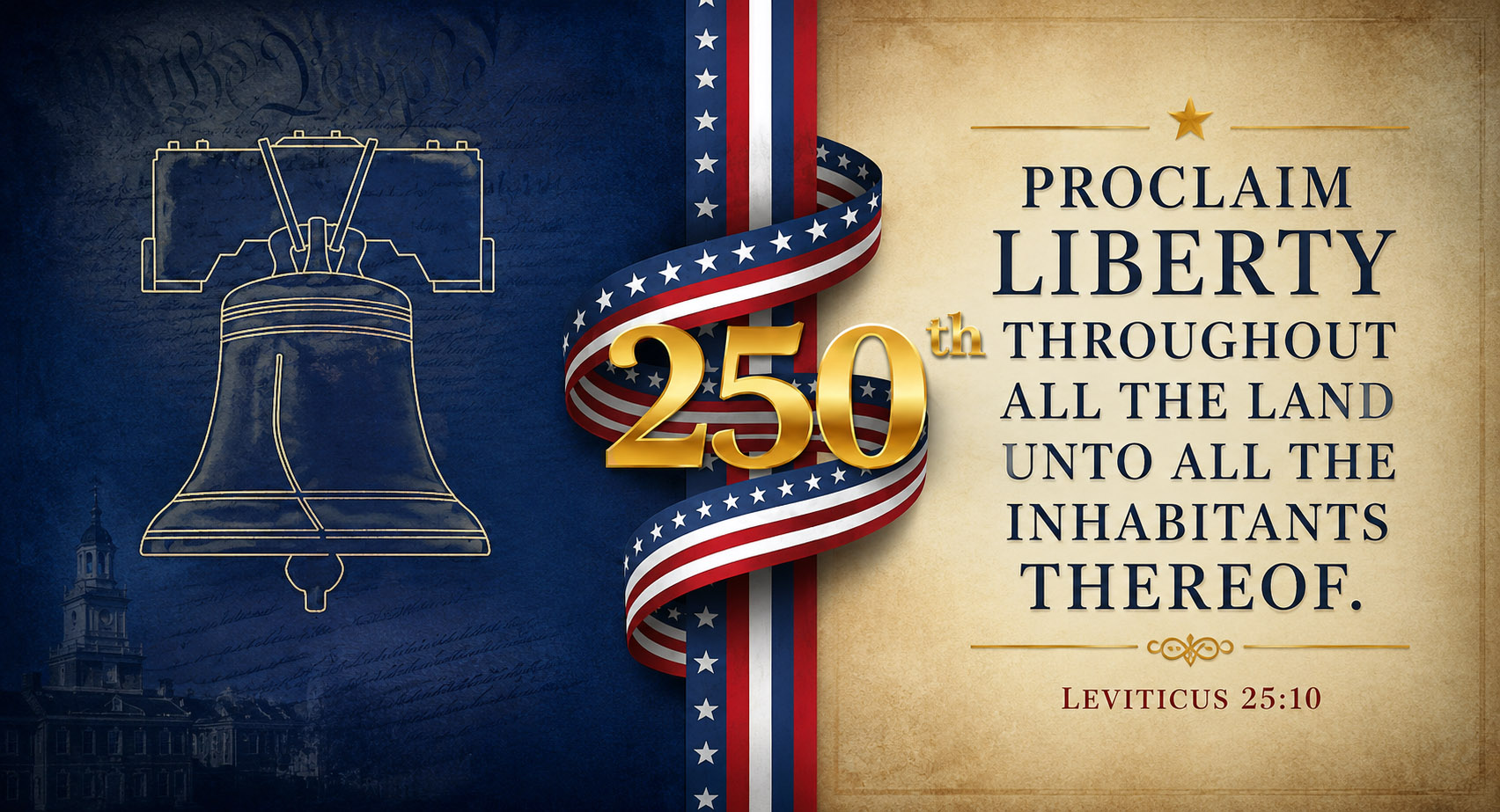
While America celebrates its 250th Anniversary, let us remember the most famous bell, which became immortal only after it could no longer ring. The forgotten story behind its inscription, its crack, and the liberty it continues to proclaim reveals far more than most Americans have ever been told.
Like millions of other Americans, I had always taken the Liberty Bell for granted. It was simply one of those familiar symbols that had always been there, like the American flag, the bald eagle, the Statue of Liberty or Mount Rushmore. I knew it represented liberty, but I had never stopped to ask what that actually meant.
That changed just a few days ago.
As my wife, who proudly became an American citizen less than a decade ago, and I reflected on America's 250th birthday, she asked me, a lifelong American, a simple question that caught me completely off guard. It was a question I should have asked long ago.
"What does the Liberty Bell actually stand for?"
Confident in my assumptions, I thought I knew the answer. I didn’t.
That simple question sent me on an unexpected journey through history. The deeper I dug, the more I realized that the story most Americans think they know is only a small part of a much richer one. By the time I finished my research, I hadn't simply answered my wife's question. I had received a historical spanking.
The Bell That Would Not Be Silenced
Every year, millions of visitors quietly file past an old cracked bell in Philadelphia. Cameras flash as families pause for photographs. Schoolchildren gather around tour guides who recount stories of the Founding Fathers, Independence Hall, and the birth of a nation. Nearly everyone notices the crack. Many even read the inscription. But remarkably few ever pause to ask why those particular words were cast into the bronze in the first place.
Perhaps that is the greatest irony of all.
The Liberty Bell is one of the world's most recognizable symbols, yet the message that gave it its name has largely faded from public memory. Most Americans know what the bell looks like. Far fewer know why it was made, what its inscription originally meant, or how an ordinary colonial bell became one of the most powerful symbols of liberty ever known.
Even more remarkable is this paradox. The Liberty Bell served as a working bell for only a brief chapter of its history. It has spent nearly two centuries unable to ring. Yet after its voice was silenced by a crack, it somehow began speaking louder than ever.
Before There Was America
Contrary to popular belief, the Liberty Bell was not commissioned to celebrate the Declaration of Independence. It was ordered in 1751 for the Pennsylvania State House, now known as Independence Hall, to commemorate the fiftieth anniversary of William Penn's Charter of Privileges. That charter had granted Pennsylvania citizens significant religious liberty and representative government long before independence from Britain became a serious consideration.
Twenty-five years later, the bell hung in the very building where the Declaration of Independence would be debated, adopted, and later signed by most of its delegates. Eleven years after that, it was still there when the Constitutional Convention met and the United States Constitution was signed. Whether the Liberty Bell actually rang during those historic moments remains the subject of historical debate. What is beyond debate is that the old bell was already there, silently witnessing the birth of the nation whose symbol it would eventually become.
Despite its historical witness, its purpose was practical. The bell summoned lawmakers to legislative sessions, called citizens together for public meetings, announced civic events, and marked important occasions. It was simply another public bell among many throughout the colonies.
What made this bell extraordinary was never its sound. It was its message. Cast into its bronze are the words:
"Proclaim Liberty Throughout All the Land Unto All the Inhabitants Thereof."
Those words did not originate with Benjamin Franklin. They were not penned by Thomas Jefferson, George Washington, or any member of the Continental Congress. Long before Greece became a democracy, long before the Roman Republic, and nearly three thousand years before America declared its independence, those words had already been written in the Book of Leviticus.
The Liberty Bell was proclaiming a biblical truth before there was an American nation to hear it.
Liberty Before Politics
Today, liberty is almost always discussed in political terms. We speak of civil liberties, constitutional liberties, economic liberty, or individual liberty. Yet the biblical idea from which the Liberty Bell drew its inscription reaches much deeper.
It is also worth pausing to consider another irony. In our own time, there are continuing efforts to remove biblical references from schools and colleges, government institutions, public buildings, and civic life based on the claim that America's founders never intended faith to have a public role in the nation's institutions. Yet one of America's most enduring national symbols, commissioned before the nation itself existed and displayed in the very building where the Declaration of Independence and Constitution would later emerge, bears a verse of Scripture permanently cast into its bronze. The founders and colonial leaders who selected that inscription were not embarrassed to acknowledge the Bible as the source of the liberty they wished to proclaim.
Leviticus 25 introduces the Year of Jubilee, one of the most remarkable social institutions in human history. Every fiftieth year, debts were forgiven. Hebrew servants were released. Families returned to their ancestral inheritance. Property reverted to its original owners. Economic inequality was periodically reset, not to eliminate personal responsibility, but to prevent permanent generational bondage.
In Scripture, liberty was never merely freedom from government. It was restoration. It recognized that true freedom involved justice, mercy, responsibility, and accountability before God.
Long before America embraced the word "liberty," God had already defined it.
The Bell Finds a New Voice
Ironically, the Liberty Bell was not widely known as the Liberty Bell during the Revolutionary era. That name gained prominence decades later through abolitionists, who looked beyond the crack and beyond the bronze to the words permanently cast into it. To them, the inscription from Leviticus was not merely decorative. It was unfinished business.
The same verse that had been chosen by America's founders decades earlier became a rallying cry for a nation still struggling to understand the full meaning of liberty. The founders had proclaimed principles that would shape the nation's future, even though they themselves would never live to see those principles fully realized. Like the Liberty Bell itself, the inscription endured while America slowly grew into its meaning.
Over time, others found their own voices in the bell's message. Advocates for women's suffrage embraced it. Civil rights leaders drew inspiration from it. New citizens viewed it as a symbol of hope. Political movements across the spectrum wrapped themselves in its image.
Generation after generation claimed the Liberty Bell. Yet through every changing cause, the inscription itself never changed.
Perhaps that is the real story. The bell was never changing its message. America was changing its understanding of it.
The Crack That Changed Everything
Every bellmaker knows that a cracked bell has lost its usefulness. It can no longer ring with the clarity for which it was created.
Ironically, the Liberty Bell's story with cracks began almost as soon as it arrived in America. The original bell, cast in London, fractured during its first testing and had to be melted down and recast by Philadelphia founders John Pass and John Stow. The now-famous crack came much later, after decades of faithful service, gradually growing until the bell finally fell silent.
Yet history had other plans and reversed the bellmaker's rule.
Had the Liberty Bell remained perfect, it might have lived out its useful life, been replaced, melted down, or quietly forgotten like countless other colonial bells.
Instead, the crack transformed it into something greater than anyone could have imagined.
It ceased being merely a bell. It became a witness. Its silence became its loudest proclamation.
History often remembers broken things that refuse to surrender their purpose. Some of civilization's greatest symbols carry scars. Those scars remind us not merely of damage, but of endurance. The Liberty Bell's crack did not erase its message. It magnified it.
Perhaps that is true with America as well.
More Than Bronze
Today the Liberty Bell no longer summons lawmakers. It no longer announces the hour. It no longer calls citizens together with the sound of bronze echoing through Philadelphia. Instead, it continues performing a far greater service. It asks questions that every generation must eventually answer. What is liberty? Where does it come from? Who defines it? Can liberty survive once it becomes disconnected from the truths that originally gave it meaning?
Perhaps that is why the image of an old cracked bell continues to appear in unexpected places, quietly reminding each generation to examine the times in which it lives. Great symbols endure because they invite every generation to measure itself against enduring principles rather than passing fashions. Many Americans today look around and wonder whether something in our nation has cracked. Political divisions deepen. Trust in institutions has weakened. Communities often seem more fragmented than united. Some wonder whether America has become too broken to recover.
Perhaps the Liberty Bell offers a different perspective.
The bell has been cracked for nearly two centuries, yet its message remains whole. America has never been a perfect nation. The generation that founded it knew that, and every generation since has wrestled with its own imperfections, contradictions, failures, and triumphs. The measure of a nation has never been whether it possesses flaws. The true measure is whether it remembers the principles that allow those flaws to be recognized, corrected, and redeemed.
Millions still visit Philadelphia hoping to learn what the Liberty Bell says about America's past. Perhaps they should spend a little more time listening to what it says about America's future. The Liberty Bell spoke with bronze before it cracked. It has spoken through history ever since, reminding us that brokenness does not always silence a message. Sometimes it amplifies it.
The Liberty Bell was never silenced by its crack. Perhaps the crack is precisely what transformed an ordinary colonial bell into one of the world's greatest symbols of liberty. And perhaps that is America's hope as well. A cracked bell can still proclaim liberty. A nation that recognizes its imperfections can still pursue it.
Perhaps the greatest crack was never in the bell at all.
Perhaps it appeared the moment we continued celebrating the symbol while quietly forgetting the inscription... and its true Author.