








Plus Reports on Israeli and Iranian Strategies
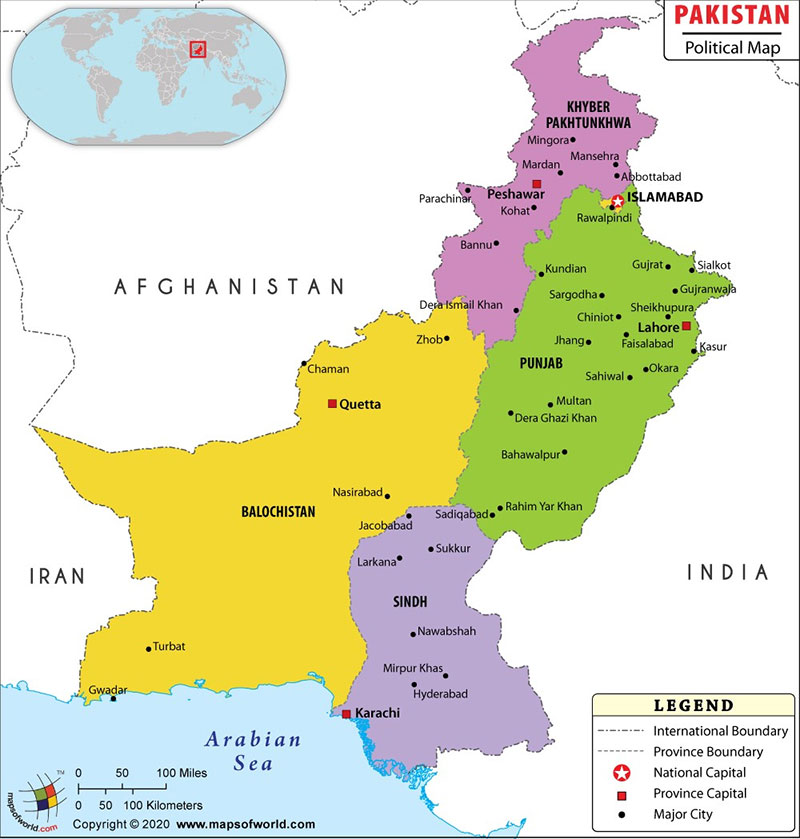
Pakistan is a South-Asian nuclear military power estimated to have 170 nuclear warhead weapons, making it the 6th most powerful nuclear power in the world. Global Firepower ranks Pakistan 14 of 145 nations in overall military strength and firepower. It currently has 650,000 personnel in its active armed forces.
According to Worldmeter, the 2026 population of Pakistan is just over 259 million, the fifth largest in the world. It ranks 33 in geographic size, being almost twice as large as California. It borders Iran, India, China, and Afghanistan. It also borders the Arabian Sea and Gulf of Oman and is thus a major player in the Indian Ocean.
Pakistan has been an important and invaluable channel for unofficial communications and negotiations between the United States and Iran. The key Pakistani leaders involved are Field Marshall Asim Munir, Chief of Defense; Pakistani President Asif Ali Zardar, Pakistani Prime Minister Shehbar Sharif, and Pakistani Foreign Minister and Deputy Prime Minister Mohammad Ishaq Dar.
Pakistan is a non-combatant ally of Iran, having opened six overland transit corridors linking its major ports—Karachi, Qasim, and Gwadar—to the Iranian border towns, Gabd and Taftan. These land corridors were activated following the U.S. naval blockade of the Strait of Hormuz and have facilitated continued third-country trade vital to Iran.
Pakistan is also an important economic and military ally of China. In addition, Pakistan has developed important economic and energy ties to the Russian Federation. Pakistan has no diplomatic ties with Israel and favors a Palestinian State. There is recent tension over alleged Israeli plans to assassinate Pakistani officials and diplomats associated with Iranian and American proposed peace negotiations. The U.S. views Pakistan as a vital regional influence in South Asia, and Pakistan’s largest export market is the U.S. and it views the U.S. as an important economic resource. Pakistan has a volatile relationship with India because of territorial disputes over Kashmir (Muslim vs. Hindu territorial dominance) and terrorist incidents. Pakistan has recently advocated regional security agreements linked to Saudi Arabia, Egypt, Qatar, and possibly Turkey. Pakistan and Turkey have maintained a high level of cooperation in military, industrial, economic, diplomatic, and cultural affairs. Qatar has also maintained close ties with Turkey, some of which involved Muslim Brotherhood aspirations in the Middle East and Persian Gulf.
Pakistan was split off from British India in 1947 to create an Islamic nation separate from predominantly Hindu India. The Islamic Republic of Pakistan has the second largest Muslim population in the world, second only to Indonesia. More than 96% of the population of Pakistan is Muslim with less than 2% Hindu and slightly more than 1% Christian. The vast majority of the Muslims in Pakistan are Sunnis, but a 10-15% minority is Shia Muslim. This is the second largest Shia Muslim population next to Iran. Iraq is 65-70% Shia Muslim, but ranks third in absolute numbers. Bangladesh, 175 million population, is over 91% Muslim, which is overwhelmingly Sunni. Bangladesh was a created from eastern British India in 1947.
Pakistan’s GDP-PPP (price adjusted) was $1.39 Trillion in 2024, per capita about $5,500. Pakistan recently severed statistical cooperation with Wikipedia.
Although Pakistan is overwhelmingly Muslim, it is multi-ethnic and multi-lingual. The largest ethnic groups are Punjabi with 45%, Pashtun with 15%, Sindhi with 14%, Saraki with 8%, Muhajirs with just under 8%, Balochi with 4%, and several others totaling 6%. Major languages are Punjabi with 39%, the Saraki dialect of Punjabi with 12%, Pashtun with 18%, Sindhi 15%, Urdu 7%, Balochi 3%, and several others totaling 6%. English and Urdu are recognized as official or lingua franca languages for doing business or government work. Urdu has about 100 million speakers worldwide and is closely related to Indian Hindi; in fact, it is considered mutually intelligible with Hindi.
The Pakistani diaspora, approximately 10.0 million, live abroad and use primarily the English language. Approximately 4.3 million reside in the Persian Gulf nations, including Saudi Arabia with 1.8 million and the UAE with 1.6 million. These are typically guest workers. Approximately 1.7 million reside in the UK. There are 684,000 in the U.S. and 303,000 in Canada. There are 46,000 in Norway. If another 2.2% of Pakistan’s population emigrated to Norway, Norway would be majority Pakistani and majority Muslim.
The Israeli “Elimination” Strategy
According to Le Monde, the practice of targeted assassination— “elimination” in the words of the Israeli Mossad Intelligence—has been a constant feature of Israeli strategy, going back even before the creation of the state of Israel in 1948. A Wikipedia article, List of Israeli Assassinations lists a few hundred of these from 1956 to the present. List of Israeli assassinations - Wikipedia.
The above article lists 35 “eliminations” of Iranian civilian and military leaders from June 13, 2025, to April 26, 2026. This does not include Lebanese or Gaza civilian leaders or 14 Iranian nuclear scientists killed in the Mossad/CIA orchestrated attempted revolutionary overthrow of the Iranian government on December 28, 2025. Since 2007, 25 Iranian nuclear scientists have been assassinated. Early assassinations, beginning with the establishment of Mossad in December 1949, were targeted by Mossad and executed by Mossad or IDF units, including helicopter gunships. Since about 2001, most Mossad targets have been eliminated by Israeli Air Force airstrikes. During the current Iran War, almost all Mossad targets have been eliminated by precision Israeli Air Force strikes.
Following the assassination of Ali Larijani, on March 17, 2026, Iranian philosopher and former Speaker of Parliament, Pakastani Intelligence shared with Iran a means given to them by the Chinese to identify and frustrate Mossad assassination efforts. There have been only 7 since then, and none since April 6, 2026.
However, there have been numerous unverifiable media reports in the last few days, that Mossad had plans to assassinate Pakistani Field Marshall Asim Munir and other Pakistani leaders and members of the negotiating team brokering the U.S. and Iran 14-Point Memorandum of Understanding, taking place in Switzerland. This has been “officially” denied by both Israel and Pakistan, but it is unlikely Pakistan would jeopardize its intelligence means and sources. Indian media has been particularly persistent in its coverage. There is apparently highly advanced Chinese communications and intelligence technology involved. Recall that suspected Chinese technology was able to identify, pinpoint, and nullify 34,000 of 40,000 Starlink communication units smuggled into Iran by Mossad and the CIA to coordinate the attempted December 2025 revolution.
According to Brazilian journalist Pepe Escobar, who seems to have highly placed sources in Pakistan and several Persian Gulf states, the story is essentially correct. Moreover, Escobar and several Indian media organizations assert that Pakistan has threatened Israel with extremely serious consequences if any Pakistani official or negotiator is harmed. Escobar’s recent journalist partner, former CIA and Homeland Security official, Larry Johnson, agrees that Pakistan now holds some very high intelligence cards and is becoming a formidable regional influence in southern and western Asia. Bing Videos 6-24-2026, 37-minute video.
About 38% of Pakistan’s comparatively young (average age 23) population is urban, and that urbanization is growing at 2.1% per year. This growth is centered on the Indus River and its tributaries, especially in Punjab Province (128 million people). The Pakistan Capital of Islamabad has a population of 1.1 million. However, its largest city is Karachi with 17.2 million, while Lahore in Punjab is not far behind with 14.0 million people. Faisalabad has 3.7 million, Gujranwala 2.4 million, and Peshawar 1.2 million.
Pakistan has limited petroleum resources but extensive natural gas resources, ranking 20th globally. Other resources are coal (5th largest reserves in world), iron ore, copper and limestone. Agriculture employs 43% of Pakistan’s labor force, which is one of the largest in the world. Pakistan ranks 5th globally in cotton production and 7th in wheat. It ranks 4th globally in milk production! Industry accounts for 20% of its GDP and 24% of its employment.
The Iranian Underground Missile Bases Strategy
Over at least three decades of planning and building, Iran has developed an asymmetric survival and retaliation strategy capable of defeating attacks by much larger and more powerful military powers. This places its most powerful offensive and defensive weapons underground. This is particularly appropriate for Iran because of its formidable granite mountain chains. Even its Persian Gulf coast is predominately a granite wall. Iran has also invested heavily in developing advanced mining, missile and drone technology. Its educational institutions have also developed substantial capabilities in supportive science, math, and engineering programs. Some tests rank Iranian students as having the sixth highest average intellectual capabilities in the world.
According to an article in MilitaryI (Military Intelligence) on March 4, 2026, by Oleksandr Yan, there are at least 31 major underground Iranian military bases housing missiles, drones, aircraft, reserve “mosquito” naval craft, and more. The largest are about 1,000 to 1,650 feet below solid granite mountains, far beyond the disturbance of even the largest conventional block-buster missiles and bombs. These complexes include extensive connecting tunnels 20 to 35 feet high and at least 20 feet wide. The approximate locations of about ten of these are known, but the Iranian IRGC has indicated there may be scores more. The tunnels include fast-rail connections and vertical or near vertical launching capability. The Iranians have also built numerous cleverly designed fake launch sites to decoy American bomber and missile targeting. Click below for article:
Iran's Underground Bases: From “Missile Cities” to Airbases and Reserve Fleets
Iranian state media has shown underground facilities containing road-mobile missile launchers on ready rails, pre-loaded with ballistic missiles. These facilities also include maintenance bays, fuel storage, command centers, and blast-resistant doors that allow launchers to drive out, fire, and return to recover in 10-15 minutes.
An excellent summary of the construction, capabilities, weaknesses, and counter-weakness solutions of Iran’s Missile Cities can be found in the imbedded MissileStrikes article dated August 20, 2025—only a 4-minute read:
Underground Missile Cities: 500m Deep — MissileStrikes.com
There is no credible indication that Iran has a shortage of missiles. They have demonstrated they can hit Israel with 500 missiles per week, probably for several months. It is fairly obvious, however, that Israel in running short of defensive missiles, and the U.S. is not in a position to replenish them quickly.
Moreover, according to MIT nuclear and missile expert Ted Postol, $4-million American Patriot missiles are much less effective at hitting ballistic missiles than claimed by their manufacturers—less than 5% versus more than 90%. This is very important to understand the direction of the Iran War and Israel’s jeopardy and dilemma. The video interview by LCol (ret) Daniel Davis is only 25 minutes and reveals some shocking data that approaches financial scandal. MIT Professor Ted Postol: Patriot Missile Capabilities
When dissembling propaganda is substituted for truth, a nation’s foundations are under siege. Truth is the only reliable road to wisdom.
"If it is possible, as far as it depends on you, live at peace with everyone"—Romans 12:18 NIV
 Mike Scruggs is the author of two books: The Un-Civil War: Shattering the Historical Myths; and Lessons from the Vietnam War: Truths the Media Never Told You, and over 600 articles on military history, national security, intelligent design, genealogical genetics, immigration, current political affairs, Islam, and the Middle East.