







Political and Military Tensions in West Asia
The population of Iran was 92.5 million in 2025. It has the 17th largest population among the nations of the world, and is also the 17th largest in geographical area. It was known as Persia until 1935. According to the Library of Congress, only 65 percent of its population is ethnically Persian. Some estimates have Iran at only 51 percent Persian. The principal minorities, according to the Library of Congress, are Azerbaijanis, 16 percent; Kurds, 7 percent; Lurs 6 percent; Arabs, 2 percent; and Balochis, 2 percent. Others include Turkic tribes, Armenians, Assyrians, and Georgians. There are also many Afghan refugees. Among the Armenians, Assyrians, and Georgians are between 250,000 and 370,000 Christians. However, the vast majority of all Iranians speak the Persian language.
Of immense importance is that 90 to 95 percent of Iranians belong to the Shia branch of Islam. Somewhere between 5 to 10 percent are Sunni Muslims. There are historical conflicts between Shia and Sunni Muslims that still sometimes create tension.
According to the International Monetary Fund (IMF) the GDP (PPP), which is adjusted for price parity, for Iran was $1.746 trillion in 2025, the 23rd largest of about 190 in the world. The GDP (PPP) per capita was about $21,000, 88th in the world. Iran has the third largest proven oil reserves in the world, and its principal export is oil. Iran’s economy is, however, surprisingly diversified with oil being only 10 to 15 percent of its GDP. It is the sixth largest oil producer supplying about 4 percent of total world oil usage. Its potential is much greater.
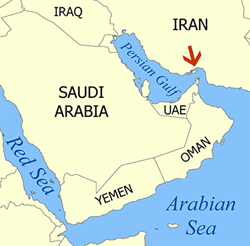
Moreover, Iran controls the Strait of Hormuz, the narrow body of water between Iran and Oman. The Persian Gulf lies between the coasts of Iran and the Arabian Peninsula and flows into the Oman and Arabian Sea. Somewhere close to 30 percent of seaborne global crude oil and LNG exports flow through the Strait of Hormuz, 24 miles wide at its narrowest point. Halting shipping traffic through Hormuz would be a global economic disaster, raising oil prices considerably.
Some historical background is important in understanding the present situation in Iran.
Iran as Persia in Biblical and Classical Greek History
Iranian civilization goes back to approximately 4395 BC and the building of the city of Susa in southwestern Iran. The Elamites mentioned in the Book of Job, were from southwestern Iran, the home of the Persians. The Medo-Persian Empire, also called the Achaemenid Empire began with Cyrus II (The Great) in 550 BC and ended with Persian defeat by Alexander the Great of Macedonia in 330 BC. Alexander died in Persian in 323 BC. Medo-Persian Kings important in Biblical history were Cyrus II (the Great), Darius I, Xerxes I (Ahasuerus in the Book of Esther), and Artaxerxes I. Darius I lost to the Greeks at Marathon. His son, Xerxes I, also fought the Greek coalition and Spartans at Thermopylae.
“The Great Game,” 19th and early 20th Century
In the 19th Century, The Russian Empire and the British Empire were engaged in what was sometimes called the “Great Game,” competing for dominance and influence. This included such events as the Crimean War in 1853, made famous by the “Charge of the Light Brigade,” immortalized in Tennyson’s poem. The British particularly feared Russian interest in India. The Persian Constitutional Revolution between 1905 and 1911 resulted in an Iranian Parliament, thus making Iran a parliamentary monarchy.
British Oil and Iranian Nationalism
In 1951, under Prime Minister Mohammad Mosaddegh, the Iranian parliament voted to nationalize the British-owned oil industry, Despite British pressure, including an economic blockade, nationalization continued. On August 19, a successful coup was headed by retired army general and former Prime Minister Fazlollah Zahedi, aided by the CIA and British MI6. The coup used “black propaganda,” misrepresenting and demonizing Mosaddegh and forcing him from office. Furthermore, Mosaddegh was arrested and tried for treason.
The Shaw and the Islamic Revolution
From that time until the Revolution, Iran was ruled as an autocracy under Shah Mohhamad Reza Pahlavi, with strong American support. Under the Shah, Iran initiated economic, social, agrarian, and administrative reforms to modernize the country, but many Islamic leaders criticized these initiatives and land reforms. By 1978, liberal media had undermined the Shah, because of his tough measures against opposition. Daily demonstrations destabilized the region, and the Shah instituted martial law to curb opposition. When hundreds of thousands of protestors persisted, security forces opened fire on the crowds in an incident that became known as Black Friday, when 64 protestors and 30 security police were killed. This led to the 1979 Islamic Revolution, which many Western liberal journalists thought would be a good thing. On November 4,1979, Iranian student followers of Ayatollah Khomeini occupied the American Embassy and detained 66 hostages there. Fifty-two of them were held until January 20, 1981. This was a factor in the election of Ronald Reagan President in 1980.
The Dilemma of the Islamic Doctrines of Jihad and Supremacy
The three foundations of Islamic doctrine are the Quran, the Hadiths (recorded sayings of Muhammad), and the Sira (history of Muhammad’s actions). These are comparable to Christian and Jewish Scripture in forming Islamic theology and practice. These are reflected in condensed form in Islamic Law (Sharia). The Quran, revealed initially to Muhammad and proclaimed by him, is only 14 percent of Islamic Doctrine. The other 86 percent is all about Muhammad. Islam is chiefly about Muhammad, and 31 percent of the Quran-Hadith-Sira trilogy is about Jihad. Jihad is Holy War against any who deny the Supremacy of Islam. What we call “radical” Islam is essentially fundamentalist Islam, which has historically wreaked violence on Jews, Christians, Hindus, and any who resist it. Sharia Law is very fundamentalist. The Jihadic doctrinal character of Islam and its experienced modern expression underlie Israeli concerns about Iran’s strong fundamentalist Islamic connections. Actually, far more Hindus and Christians have been the victims of fundamentalist Islamic Jihad than Jews. This underlies the legitimate concern Israel has about Islam and Iran.
Current Religious Currents in Iran
However, many cultural, modernist, or secularized Muslims are not dedicated to Jihad or imposing Sharia Law. This includes many of our important allies in the Middle East and elsewhere. This inclination to moderation is undoubtedly true of many Iranians.
Following the Islamic Revolution in 1979, the official name for Iran became the Islamic Republic of Iran, which suggests a dominant prevalence of radical Islam. However, 46 years have passed. There are signs that the fanaticism of 1979 has eased under the rule of Ayatollah Ali Khamenei, who was chosen to rule by an Expert Committee in 1989. Khamenei’s Iran is not the Taliban’s Afghanistan.
Surprisingly, there are three religions besides Islam in Iran that have official recognition: Christianity, Judaism, and Zoroastrianism. Fundamentalist Islam would allow none but Islam.
Although there are about 600 Christian Churches in Iran, Open Doors World Watch List names Iran as the 9th worst persecutors of Christians.
The Current Political Situation
On December 28, under increasing strain of many U.S. economic sanctions on Iran, the Iranian currency, the Rial collapsed. I have read several explanations for this, including a Wall Street Journal article attributing the collapse to a single obscure bank. However, according to a January 15 YouTube interview by retired Army LCol Daniel Davis of Dr. John J. Mearsheimer, one of the most respected foreign policy scholars in the U.S. and Europe, CIA regime change operations usually start with economic sanctions designed to hurt the ordinary people and businesses of a target nation in order to turn them against their leaders, thus fomenting protest and dissatisfaction, setting up a regime change. But this is common knowledge to those who have studied close to 100 CIA regime change attempts. According to Larry C. Johnson, former CIA agent and anti-terrorism consultant, on a January 15, YouTube interview, Iran’s currency crash was orchestrated by the CIA and Israel’s Mossad Intelligence Service.
Mearsheimer lists the four basic CIA play book steps.
First, Sanctions. These may be augmented by corporations and allied nations using whatever pressure that can be applied.
Second, Foment massive protests. In the case of Iran, 40,000 Starlink terminals were smuggled into Iran to organize the protests. We know from an X tweet by former U.S. Secretary of State and CIA Director Mike Pompeo that both Mossad and the CIA were involved. We can probably assume British MI6 was also involved. NGOs (Non-government organizations) are typically used for ground work, organization, and recruitment. Persuasion may be by payment, lies, bribes, blackmail, or threats. In this case, either Russian or Chinese technology was used to identify, pinpoint, and nullify about 34,000 of these Starlink units. Communications were not only cut off, but thousands of anti-government agents were identified.
Third is a massive disinformation campaign. This demonizes the target leaders and publishes by multiple channels, media, and means exaggerated, false, and absolute reversals of the truth. This frequently includes false flag operations. This disinformation is by no means distributed only in the target country and its potential allies. Extensive disinformation is disseminated to influence American media, influential businesses, education, and cultural institutions, but especially American voters to convince them regime change is good—supposedly needed for saving democracy or punishing great evil. Facts like the number of people killed or who killed them and why can be completely distorted. Reuters, which is British and anti-Iran, initially reported just over 2,000 deaths. The U.S. media was quickly claiming through NGO sources in Washington and London that 20,000 to 28,000 deaths had occurred This was pure disinformationaal propaganda. The initial violence was perpetrated by “protestors” attacking police and security forces. At least 100 were killed. It is difficult to find any major American media that tells the real truth—they are getting their “truth” from the CIA and other supporters of regime change. At this point the mass protest seems to have failed, but the propaganda is continuing, and the danger of war, including nuclear war, is extraordinarily high.
Fourth, providing steps 1 through 3 are successful, is the application of U.S. military power to complete the action and make sure the “right” people are in control of the target nation’s future. According to Mearsheimer, the full goal is to destroy Iran and break it into weak and exploitable parts.
A good example of a CIA regime change is the 2014 Maidan Revolution and coup in Ukraine that ousted pro-neutral President Viktor Yanukovych elected in 2010. It has now resulted in the near destruction of Ukraine. This has been aggravated by the Zelensky Ukrainian regime’s 91-drone attack near a Putin residence close to Novgorod on December 30, 2025, interpreted by Putin as a decapitation attempt at regime change. As a consequence, Putin has substantially hardened his stance on Ukraine and NATO. This has probably also increased his resolve to stand by Iran. Putin, however, advised the Iranians to back off retribution against about 800 protest organizers. In the last 2 days, Putin has indirectly insinuated that Trump’s position on Greenland indicated a “Might Makes Right” imperialist foreign policy.
Russian Mediation Efforts
On January 16, Russian President Vladimir Putin talked by phone with Israeli Prime Minister Benjamin Netanyahu about mediating a peace with Iran. He may also have talked with Iranian President Masoud Pezeshkian or other Iranian parliamentary leaders. According to the Jerusalem Post, some Iranian leaders are trying to set up Pezeshkian as the scape goat for Iran’s economic problems.
American Public Polling on Trump Foreign Policy
A Quinnipiac University Poll released January 14 helps to evaluate the political impact of President Trumps recent foreign policy moves and statements. Trump’s overall approval rating according to the poll was near a low of 40 percent with disapprovals running to 54 percent. This was based on 1,133 polling interviews, so the standard error is close to 4 percent. Moreover, I have always thought that the Quinnipiac polls had the common liberal bias of about 5 percent against Trump, Republicans, or conservatives. I generally use the more conservative (and in my opinion more accurate) Rasmussen daily poll to apply my own correction. Sure enough, the Rasmussen Poll on January 15 was 5 percent better with 45 percent approval but very close to Quinnipiac with 53 percent disapproval. Use your own judgment, but the Quinnipiac results for several foreign policy issues were pretty decisive.
Seventy percent of those polled by Quinnipiac opposed U.S. military intervention in the present Iranian demonstrations against the leadership of Iranian Supreme Leader Ayatollah Khamenei. This opposition was true of a whopping 80 percent of independents, 79 percent of Democrats, and 53 percent of Republicans.
Moreover, 86 percent of the poll respondents opposed military force to take over Greenland. Only 9 percent approve of it. Fifty-five percent were opposed even to buying Greenland with only 37 percent favoring it. Even Republican House Speaker Mike Johnson has backed away from the issue.
Forty-seven percent, however, supported Trump’s removal of Venezuelan President Madura. This was only a narrow margin over 45 percent who opposed it. Fifty-seven percent are opposed to the U.S. running Venezuela.
Lessons from the June 2025 12-Day Iran-Israel War
The war began on June 13 with a surprise Israeli bombing attack on Iranian nuclear, military, and air defense facilities. It continued with Israeli assassinations of prominent Iranian military and political officials and nuclear scientists. The “Iron Dome” Israeli air and missile defense worked well for a few days, but started to fail as huge numbers of Iranian missiles, drones, and decoys overwhelmed the Israeli defense system, and the number of Israeli defense missiles became depleted. Then Iranian missiles were able to inflict increasing damage to Israeli military and civilian infrastructure. Israel was in clear danger of being annihilated. There was also a danger that Israel would use its nuclear weapons to avoid annihilation. On June 22, American bombers and missiles hit three principal Iranian nuclear sites and other targets. On June 24, Iran and Israel agreed to a cease fire under U.S. pressure.
Iran’s ballistic and cruise missile capabilities are by far the largest in the Middle East. According Weapons of the World, they have at least 3,000 SRBMs and MRBMs. They are in the top ten countries in drone production and probably ballistic missile production as well. They manufacture top quality drones and probably have tens of thousands in inventory for use in massive missile attacks.. They also have hypersonic missiles that cannot by present technology be stopped. Neither Israel nor the United States are yet near having these. In addition, the Russians have recently supplied Iran with advanced S-400 long-range defensive missile systems. The U.S. is limited by slow production rates in replacing Israeli anti-missile systems. Attacking Iran again has a high probability of resulting in the destruction of Israel or nuclear war.
Trump needs to make some changes in the CIA. Their present agenda could destroy him and result in colossal damage to American interests and painful consequences for American government and the American people. He needs to pull away from jingoistic war cheerleaders in the Senate. He needs to reflect that true winning is doing the right thing with practical economy despite difficulties, opposition, or fears. He needs to admit mistakes and correct them rather than blustering braggadocio. We ought to pray for his wisdom and success in making America truly great again, a light of truth, justice, and nobility to the nations.
"Whoever conceals their sins will not prosper, but whoever confesses and forsakes them will obtain mercy"—Proverbs 28:13.
“If any of you lacks wisdom, you should ask God, who gives generously to all without finding fault, and it will be given to you.”—James 1:5
 Mike Scruggs is the author of two books: The Un-Civil War: Shattering the Historical Myths; and Lessons from the Vietnam War: Truths the Media Never Told You, and over 600 articles on military history, national security, intelligent design, genealogical genetics, immigration, current political affairs, Islam, and the Middle East.