












Four announced contenders make their case as undecided voters remain a decisive factor
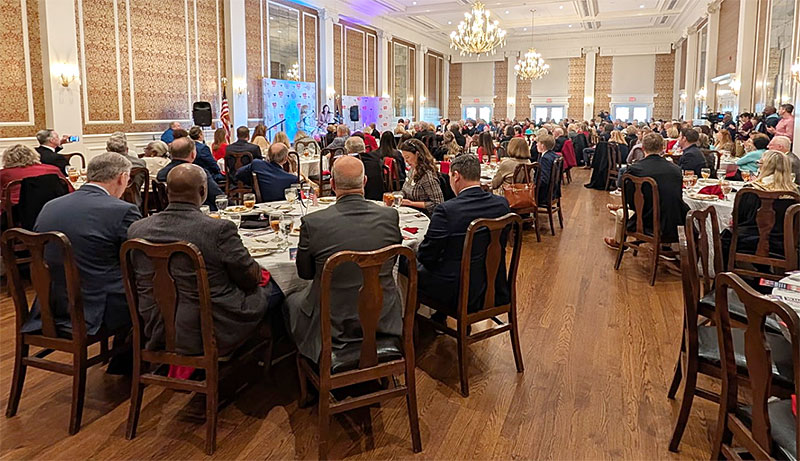
Photo by Terry M. Thacker
The Upstate Republican Women’s Club and Fourth Republican District Club hosted a South Carolina Republican gubernatorial forum on February 23, 2026, bringing together party activists and voters for a structured discussion of leadership priorities ahead of the June primary.
Veteran broadcaster Jane Robelot served as moderator, emphasizing the responsibility of informed voting and encouraging attendees to evaluate not just policy positions but governing temperament. Each candidate was given time for opening remarks, policy questions, and a closing statement. Audience participation from the floor was not permitted.
The wide-open nature of the race was reflected in recent statewide polling. A January through February survey of likely Republican primary voters conducted by the South Carolina Policy Council found that roughly 43 percent remain undecided in the governor’s race, with no single candidate breaking away from the field. The numbers suggest that while early positioning is underway, a significant portion of the electorate is still weighing experience, ideology, and governing style.
Four candidates appeared: Lt. Gov. Pamela Evette, State Sen. Josh Kimbrell, U.S. Rep. Ralph Norman, and S.C. Attorney General Alan Wilson. U.S. Rep. Nancy Mace did not attend and sent her apologies, stating she had a meeting in Washington to attend.
SC Lt. Governor Pamela Evette
Executive Continuity and Tax Elimination
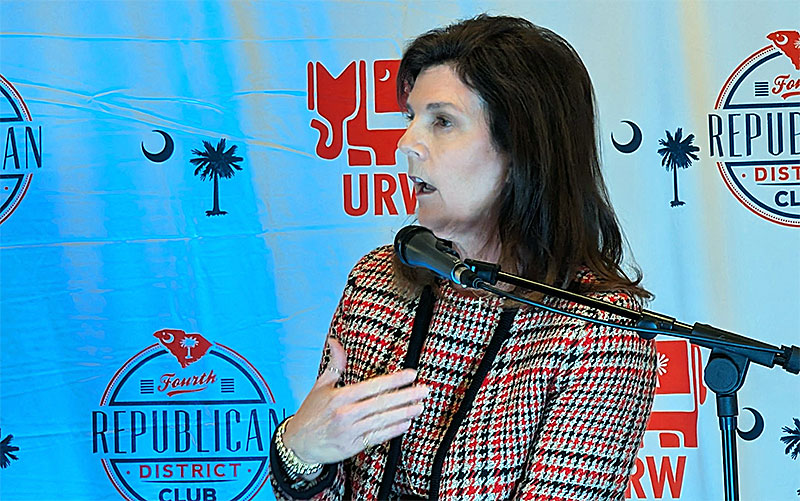
Photo by Terry M. Thacker
Evette opened by emphasizing her business background and eight years of service alongside Gov. Henry McMaster. She described building a company from her home into a national enterprise, aligned herself with what she called America First policies, and was an early supporter of President Trump. She framed her candidacy around executive readiness and continuity of conservative governance.
Why Are You Running for Governor?
Evette said she believes South Carolina’s best days are ahead, but require steady leadership. She pointed to her experience in the executive branch and private sector as preparation to step into the governor’s office on day one.
How Would You Shape Your First 100 Days?
Evette stated that eliminating the state income tax would be her top priority. She argued that taxpayers can spend their money more effectively than government and tied income tax elimination directly to economic competitiveness. Regulatory reduction for small businesses navigating permitting and compliance hurdles would also be central to her early agenda.
How Would You Raise Wages Without Driving Jobs Away?
Evette said education is central to wage growth. She pointed to South Carolina’s technical college system, calling it one of the best in the world based on her own review and experience. She argued that educating K-12 students for the jobs of the future is essential to increasing earning potential.
She also emphasized attracting industry tied to high-paying sectors. Referencing the recent SC Bio conference in Charleston, she noted the opportunities within life sciences and research fields, suggesting the state should continue diversifying beyond advanced manufacturing into industries that provide higher wage career paths.
What Accomplishments Demonstrate You Are Ready to Lead?
Evette cited her tenure as lieutenant governor and the expanded role the office assumed when it began running on a joint ticket with the governor. She pointed to launching the YES Initiative (Youth Employment Site), also known as the Empowering Youth Initiative, focused on connecting young people to workforce opportunities and on improving workplace-readiness skills.
She also emphasized her work with Children’s Trust and the Nurse-Family Partnership program, securing state funding to support mothers who choose to keep their children. Evette framed these efforts as examples of relationship-building within the General Assembly and of delivering results through collaboration.
How Would You Balance Recruiting Large Employers While Supporting Small Businesses?
Evette said the state has managed that balance well, noting that 99.4 percent of businesses in South Carolina are small businesses. She said her travels across all 46 counties reinforced that small business owners primarily need workforce support and clearer communication about available opportunities.
She tied the YES Initiative to helping small businesses post job openings and connect with potential employees. Evette also stressed improving outreach through the Department of Commerce to ensure small businesses feel included alongside large corporate recruits. While defending the role of major economic development projects, she maintained that small businesses remain the backbone of the state’s economy.
How Would You Work with Legislative Leadership if There Is Resistance?
Evette emphasized consensus-building and open dialogue. She said durable reform requires persuasion and communication rather than confrontation.
Final Comments
In closing, Evette stressed continuity and experience. She said she is prepared to keep South Carolina moving forward and argued that stable executive leadership is essential as the state continues to grow.
SC Senator Josh Kimbrell
Legislative Strategy and Structural Reform
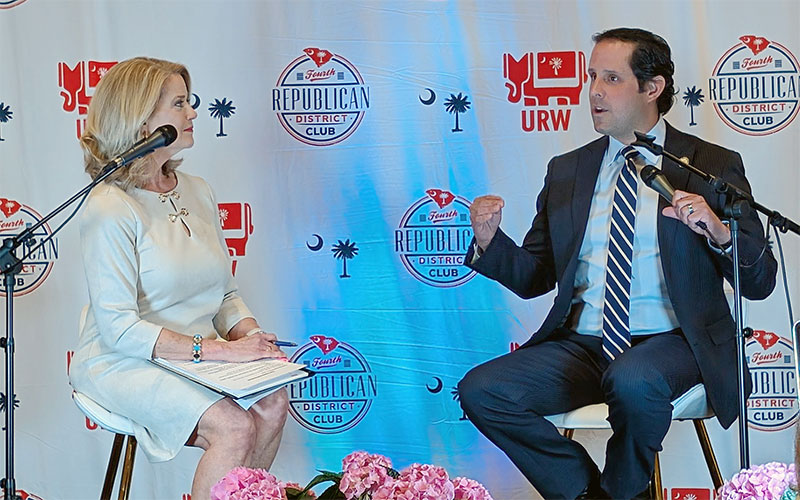
Photo by Terry M. Thacker
Kimbrell emphasized that South Carolina is a legislatively dominant state and argued that effective leadership requires understanding how to work within that structure. He pointed to his Senate experience as preparation for advancing conservative reforms through negotiation and coalition building.
Why Are You Running for Governor, and What Separates You?
Kimbrell said South Carolina has achieved significant conservative reforms in recent years but argued that more work remains. He emphasized that what separates him from other candidates is his direct legislative experience and understanding of how to move policy through a legislatively dominant system.
He contrasted two executive approaches: confrontation without results or passive approval without leadership. Instead, he described the governor as a “quarterback” who calls the plays, builds consensus, and advances meaningful reform. Referencing the governing dynamics during the Sanford administration and his own experience in the Senate, he argued that lasting conservative victories require working from the inside out rather than simply opposing the system from the outside.
What Law Have You Helped Shape That You Would Not Change as Governor?
Kimbrell cited his work on the state’s income tax reduction package, describing it as the largest tax cut in state history. He also referenced sponsorship of the Heartbeat Bill, noting that abortion rates have significantly declined since its passage.
At the same time, he acknowledged one vote he would not repeat, stating he would not support another Scout Motors electric vehicle incentive package in Blythewood, commonly referred to legislatively as Project Scout. He suggested the state should reconsider large, targeted incentive packages in favor of broader tax relief.
How Will You Keep Energy Affordable and Reliable?
As a member of the Senate Judiciary Committee, Kimbrell argued that government involvement in power generation creates inefficiencies and said deregulation and expanded public-private options should be considered. He questioned whether citizens want the government to run power utilities the same way it runs other bureaucratic agencies.
He also referenced improvements following recent storm events, noting that outage response times in Spartanburg County were significantly improved during a recent ice storm compared to earlier weather disruptions.
Is Legislative Experience an Advantage or a Liability?
Responding to concerns about insider status, Kimbrell said anyone elected immediately becomes part of the governing system. The question, he argued, is not whether someone is an insider, but whether they intend to preserve the status quo or disrupt it through reform.
He maintained that legislative experience is an advantage because most policy decisions originate in the General Assembly. He warned against an approach that “burns the house down,” arguing that reform must be advanced strategically through coalition building rather than symbolic confrontation.
What Regulatory Burden Would You Eliminate First?
Kimbrell pointed to the Small Business Regulatory Act, which would require reviewing thousands of state regulations and implementing a two for one repeal process when new rules are proposed. He said South Carolina has more than 5,000 regulations and tens of thousands of related rules, many of which are outdated.
He cited examples of obsolete requirements to illustrate the need for systematic review and argued that regulations should not remain indefinitely without periodic reassessment.
How Would You Balance Economic Growth With Environmental Concerns?
Kimbrell said South Carolina’s natural resources must be protected but cautioned against policies that unnecessarily restrict development. He drew a distinction between conservation and what he characterized as excessive environmental regulation.
He argued that economic development and environmental stewardship are not mutually exclusive but said common sense must guide decisions to prevent economic stagnation.
Final Comments
In his closing remarks, Kimbrell emphasized that governing requires advancing legislation rather than merely opposing policies. He highlighted his record of defeating a Democratic incumbent in Spartanburg County and consolidating Republican strength in the region.
He described himself as both a fiscal and social conservative, arguing that strong cultural values and economic growth reinforce one another. While reaffirming his support for tax reduction and regulatory reform, he reiterated that successful leadership requires working from the inside out to achieve durable conservative victories.
US Representative Ralph Norman
Fiscal Discipline and Institutional Reform
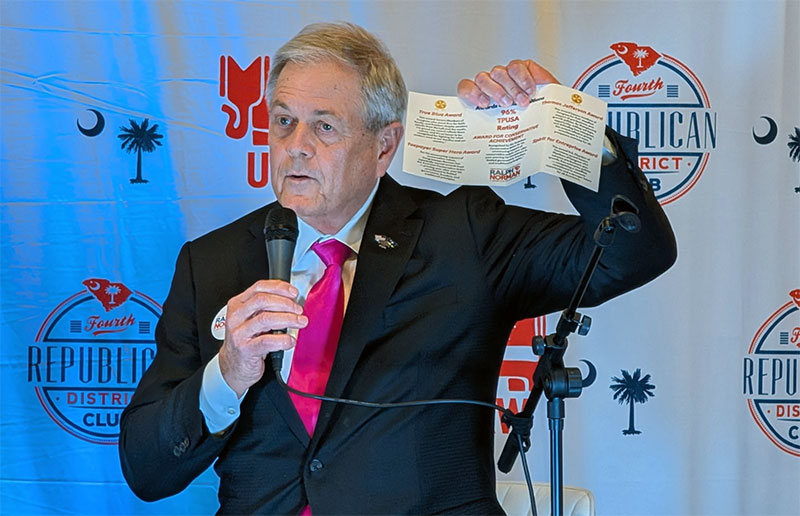
Photo by Terry M. Thacker
Norman emphasized his background in business and his time in Congress, describing himself as someone who has seen firsthand what regulation and government growth do to both small and large businesses. He said his experience navigating both success and setback in the private sector shaped his approach to fiscal responsibility and risk.
Why Are You Running for Governor?
Norman said he entered politics after spending three decades in the family real estate business. He described his congressional service as one of the most rewarding chapters of his career and pointed to his fiscal record, including high ratings from taxpayer advocacy groups, as evidence of consistency.
He said that on “day one” as governor, he would focus on cleaning up what he characterized as corruption in Columbia, conducting extensive audits of state agencies, pursuing term limits legislation, reforming judicial selection, and addressing infrastructure. He said he is the only candidate in the race who started and operated a business in South Carolina, emphasizing his experience both making and losing money in the private sector. His argument is that private sector experience is essential to executive leadership.
Where Is State Government Overspending?
Norman argued that state government has grown dramatically over the past decade, citing a budget increase from approximately $23 billion to more than $42 billion in 10 years. He said a Republican supermajority should not coincide with rapid expansion of government.
He pledged to examine spending line by line and said he would push for structural reforms, including judicial election reform and infrastructure prioritization. He also stated that he would not support additional funding for the Scout Motors incentive project, arguing that such packages should not have been approved.
What Lessons From Washington Would You Bring to Columbia, and What Would You Leave Behind?
Norman described Washington as dominated by what he called crony capitalism and warned against similar patterns developing in South Carolina. He said bold leadership is required to call out entrenched interests.
He cautioned that poor leadership over an extended period could shift South Carolina’s trajectory in negative ways, referencing other states that have experienced crime and economic decline. He said he would bring a willingness to confront institutional problems directly while leaving behind what he described as dysfunction and complacency.
How Would Your Business Experience Translate Into Effective Leadership?
Norman said business experience teaches discipline, negotiation, and return on investment analysis. He emphasized that economic growth must be evaluated based on measurable benefit to the state rather than headline job numbers alone.
He said he would apply stricter standards to incentive packages and corporate recruitment deals, asking what tangible return South Carolina receives. He framed his approach as pro-growth but selective and accountable.
How Would You Reduce Reliance on Federal Funding?
Norman noted the nation’s rising debt and warned that excessive federal dependence is unsustainable. He said he would scrutinize federal funding streams and reject those that come with restrictive conditions inconsistent with state priorities.
He emphasized that growth must be rooted in state-driven economic strength rather than federal transfers.
What Conservative Principle Should Not Be Compromised?
Norman said fiscal discipline should not be sacrificed for political convenience. He argued that infrastructure reform, judicial accountability, and budget restraint are foundational and should not be traded for short-term political advantage.
He said that as governor, he would use the veto, the bully pulpit, and direct appeals to voters if necessary to advance reform.
Final Comments
In his closing remarks, Norman said voters are selecting a chief executive for the next eight years and should evaluate candidates based on record rather than rhetoric. He compared the choice to selecting a surgeon, arguing that experience and demonstrated results matter.
He pledged to cut bureaucracy, focus on infrastructure and cost-of-living issues, recruit business-minded leaders to boards and commissions, and bring what he described as courage to difficult fiscal decisions. He concluded by saying South Carolina can become what he called a “shining city on the hill” if disciplined leadership is applied.
SC Attorney General Alan Wilson
Law Enforcement, Constitutional Defense, and Executive Courage
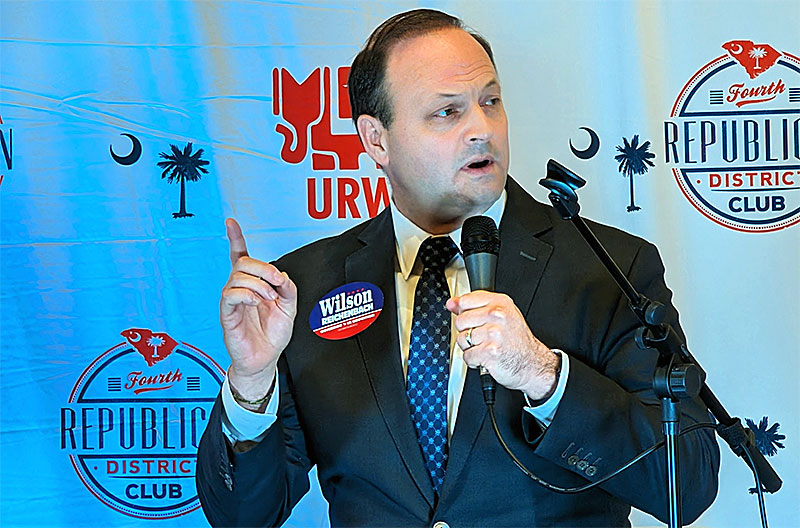
Photo by Terry M. Thacker
Wilson emphasized his tenure as attorney general and framed his candidacy around leadership proven in both the courtroom and military service. He said his career has been defined by fighting for constitutional principles and standing up for victims.
Why Are You Running for Governor?
Wilson said he first ran for attorney general after prosecuting a case involving abuse of a child, an experience he described as formative in shaping his commitment to public service. Since taking office in 2011, he said he has led reforms targeting human trafficking, internet crimes against children, domestic violence, and DUI enforcement.
He also emphasized having brought hundreds of legal actions against the Obama and Biden administrations and defending constitutional rights in state and federal courts, including before the United States Supreme Court. A 30-year combat veteran, Wilson said leadership requires not only believing the right things but having the courage to act on them, even under sustained criticism.
What Federal Policy Would You Not Challenge as Governor?
Wilson said that while he generally supports state-level decision-making, he would maintain federal prohibition on marijuana and push for enforcement of existing federal law. He expressed concern about what he described as correlations between marijuana legalization and crime, mental health issues, and public safety challenges in other states.
He said that although federal enforcement has been inconsistent, he would support maintaining national standards rather than allowing a patchwork approach.
What Concrete Policy Would You Implement to Reduce Crime Long Term?
Wilson pointed to judicial selection reform, bond reform, and mandatory minimum sentences for repeat online sex offenders as priorities. He noted that South Carolina is currently at what he described as a 30-year low in violent crime, crediting collaboration between his office, prosecutors, sheriffs, and police departments.
He said he would continue expanding public safety partnerships and strengthening accountability in the judicial system, arguing that holding violent offenders accountable is key to long-term crime reduction.
How Has Your Tenure Prepared You to Lead Beyond Litigation?
Wilson rejected the notion that attorneys general are reactive rather than executive leaders. He described his office as managing more than 300 employees and thousands of active cases, recovering significant funds for the state, and proactively launching initiatives such as the human trafficking task force.
He also cited his military leadership experience, saying he has made decisions in high-pressure environments and believes executive leadership requires the ability to act decisively when consequences are significant.
How Would You Decide Whether to Sign or Veto a Bill You Disagree With?
Wilson said that as a constitutional officer, he views himself as a trustee of the office and ultimately accountable to voters. However, he said there are moments when leaders must make decisions based on constitutional and moral grounds, even if they are politically unpopular.
He described frequent criticism from both sides during his tenure as attorney general and said he has consistently chosen to do what he believes is legally and ethically correct, regardless of political consequences.
What Is One Decision That Cost You Politically But You Would Make Again?
Wilson cited his support for President Donald Trump’s election integrity lawsuit involving Pennsylvania in 2020. He said the decision resulted in ethics complaints and personal expenses defending his law license, but he maintained that he acted based on constitutional concerns and would make the same decision again.
He also referenced his consistent support for Trump in legal and political disputes, arguing that he has demonstrated a willingness to act despite controversy.
Final Comments
In his closing remarks, Wilson urged Republican voters to avoid internal division during the primary and asked those undecided to give him the opportunity to earn their trust. He emphasized income tax elimination, property tax reform, education reform with parental rights protections, infrastructure improvement, and continued support for law enforcement.
He described his leadership style as transformational rather than transitional and said he intends to bring a new generation of executive leadership to South Carolina.
US Representative Nancy Mace
Platform Positions

U.S. Rep. Nancy Mace, who had been scheduled to attend, informed organizers the day before the event that she would be unable to participate, sending her apologies and stating she had a meeting in Washington. Several attendees were expecting her to be present and were unaware of the change until the program began.
According to her campaign website and recent public statements, Mace has centered her gubernatorial bid on eliminating the state income tax, outlining a plan to phase it out over five years by freezing general fund spending and using revenue growth to reduce rates incrementally.
Her platform also emphasizes infrastructure improvements, stricter immigration enforcement, expanded school choice, energy reliability, and what she describes as protecting women’s rights and parental authority in education. Like other candidates in the race, she has framed tax reform and economic competitiveness as central to South Carolina’s future growth.
While she did not participate in the Upstate forum discussion, her publicly stated priorities align with many of the Republican themes raised during the luncheon, particularly income tax elimination and regulatory reform.
Emerging Themes
Despite stylistic differences, several themes were consistent across the forum:
- Reducing or eliminating the state income tax
- Addressing property tax burdens
- Regulatory reform for small businesses
- Workforce alignment with emerging industries
- Energy reliability amid rapid growth
- Emphasis on executive leadership style
- Judicial selection reform and accountability
- Corporate incentive scrutiny and return on investment
- Crime reduction and public safety reform
- Federal versus state authority tensions
- Governing strategy in a legislatively dominant state
As moderator Jane Robelot noted and polling suggests, a significant portion of Republican voters remain undecided, and the forum reflected that early-stage dynamic, with candidates defining themselves rather than directly attacking one another.
Although the forum itself remained measured and policy-focused, Wilson referenced ongoing “social media attacks,” a comment widely understood to refer to recent online criticism directed at him by U.S. Rep. Nancy Mace, who was not present at the event.
While the candidates on stage avoided direct confrontation, the remarks signaled that sharper contrasts are emerging outside formal forums as the primary season develops. Differences expressed during the luncheon over corporate incentives, tax strategy, executive style, and the role of government in economic development could, in the months ahead, evolve from tonal distinctions into more defined lines of contrast as candidates seek to differentiate themselves before undecided voters.
South Carolina’s Republican gubernatorial primary is scheduled for June 9, 2026. Additional forums are expected statewide as candidates sharpen contrasts and seek to consolidate support.
At this stage, the contest appears less about ideological differences, though they clearly exist, and more about governing style, executive experience, and which candidate voters trust to navigate a fast-growing state balancing economic opportunity with mounting structural strain. As the primary approaches and the field narrows, however, those underlying ideological distinctions could become more pronounced, a common pattern in competitive statewide races as candidates sharpen contrasts to consolidate support.
The early message from the Upstate audience was clear: Republican voters are listening, but many are still undecided. And as the primary draws nearer and distinctions grow sharper, it may not simply be the voters at forums who must listen and decide, but the candidates who first decide to listen.