








Lessons from Ukraine and the Middle East
Just as this article was about to be published on Sunday April 12, President Trump declared a U. S. Naval Blockade of the Iranian controlled Strait of Hormuz in the Persian Gulf. This immediately followed the failure of peace and cease-fire talks in Islamabad, Pakistan, to which Vice President J.D. Vance was to be the chief U.S. negotiator. Although I have confidence in Vance and was hopeful, the failure is exactly what I expected. The two sides are far apart and not inclined to reasonable compromise, so we are essentially left with escalating war. Moreover, Trump’s additional threat to have the U.S. Navy halt ships that have paid a toll to Iran was grievance enough for Iran to escalate its drone and missile warfare. In addition, Trumps’s threat to halt or board foreign ships in the Strait is waving a red flag in the face of China, which probably regards such an American move as piracy. There are several reports of increased Iranian drone attacks on Israel, but the fog and tension of war and inclinations to propaganda and censorship are blocking more news than usual. The escalation has already driven the price of West Texas Crude (WTC) up 8% to $104 per barrel. In stocks, the current Dow futures are down $383. Gasoline prices are moving back up.
Below is a brief introduction to Drone Warfare.
The Ukraine Proxy-War against Russia is the first war where drones have played a substantial and critical role. It has altogether changed the nature of warfare. The Russian Army is now far stronger than the Ukrainian Army but its geographical progress has been slowed considerably by Ukrainian use of drones. The traditional massing and rapid movement of troops has become extremely dangerous, because drone reconnaissance quickly communicates target data, and response from multiple weapons systems including artillery, aircraft, missiles, the reporting drone, and other drones can be swift and deadly accurate. Movements that could be done in a day may require a week or weeks. Tanks no longer lead rapidly advancing troops and other combat vehicles. Tanks are held at a distance and act as artillery until enemy drone coverage can be cleared.
Ukraine
The most used Ukrainian drone is the DJI Mavic 3. It is small, with 14 inch wing span and 11 inches long. Its top speed is 100 mph. It is equipped with a high quality camera and can carry a cargo or weapon payload of 1.1 to 1.5 pounds. Maximum flight time is about 46 minutes. Typical coat is $1,100 to $1,700. It can be operated as far as 6 miles away. It is used for both reconnaissance and attack against troops, vehicles, or tanks. The DJI Mavic 3 is also used by the U.S. armed forces.
Ukraine has a variety of military and naval drones. However, the second and third most used are the U.S. made Switchblade 300 and Switchblade 600. The Switchblade 300 weighs about 5.5 pounds and has a length of 20 inches. It can carry a 7 pound munitions package. The Switchblade 600 is 51 inches long and weighs 65 pounds including 33 pounds of armor-penetrating munitions. Both can be operated from about 6 miles away. Top speeds respectively are 100 mph and 115 mph. Maximum altitude is about 500 feet. Both are capable of loitering around targets with total flight time exceeding 40 minutes. The Switchblade 300 costs $6,000 to $10,000. The Switch Blade 600 Costs $70,000 to $90,000. These are both essentially kamikaze missiles equipped with electronic countermeasures, with maximum range of 18 and 25 miles respectively.
The Bayraktar TB2 is Ukraine’s largest and most expensive drone. It has a wingspan of 39 feet and length of 27 feet. Its takeoff weight is approximately 1,500 pounds and can carry nearly 350 pounds of munitions. Its speed range is from 80 to 150 mph. It has a cruising altitude of 18,000 feet and an endurance of 27 hours. It is designed for both reconnaissance and combat missions. It is equipped with electro-optical and infrared cameras, and laser target designators. Bayraktar TB2 drones are produced in Turkey and normally cost $2.0 to $5.0 million. Ukraine may have had as many as 100, but many have been destroyed, because the Russian Federation now has clear air supremacy.
Russian Federation
The Russians also use the DJI Mavic 3 on the battlefield, but have a half-dozen other battlefield alternatives. While Ukraine held the lead in battlefield drones for a while, the Russians have now taken over that lead.
The Russians are regularly making massive strikes on Ukrainian military and infrastructure targets three to four nights per week. Typically, the Russians may fire about 15 highly sophistical, powerful, and often hypersonic ballistic missiles during such a night raid, accompanied by as many as 400 drones. The number of drones helps to overwhelm Ukrainian Patriot and other defensive missile systems. Few Russian ballistic missiles are hit, and Russian hypersonic missiles coming in at Mach 10 and better are almost impossible to hit. Many Russian drones also do considerable damage. Moreover, Russian missile and drone production capabilities are far higher than Ukrainian, British, German, French, and American production combined. The Russians have a major supply and logistics advantage. Contrary to Ukrainian and U.S-CIA propaganda, the Russians have never suffered from artillery, drone, or missile shortages. The U.S and its allies are probably half-a decade away from having hypersonic ballistic missiles.
By far the most import drone in the Russian inventory is the Geran-2. This is an upgrade version of the Iranian Shahed-136 drone. The Russians first purchased their drones from Iran, which had a huge technological and volume lead on everybody else.
Iran
Iran has a wide variety of short (SRBM) and medium range ballistic missiles (MRBM), cruise missiles, and drones. In fact, Iran has 27 different types of ballistic and cruise missiles. At least 8 have a range of better than 2,000 miles. Iranian missiles and drones are manufactured and stored underground—440 meters deep (over 1,400 feet). This storage is typically under granite mountains. Granite is much harder to damage than concrete. Iranian missiles and drones may be fired from mobile launchers or rail facilities hidden near camouflaged surface positions. Many solid-fuel missiles can be fired within minutes.
Iran is believed to have at least 2,000 war-ready ballistic missiles and 45,000 war-ready drones. Iran can produce at least 800 to 1,200 drones per month. Most of these are the Shahed-136 drones.
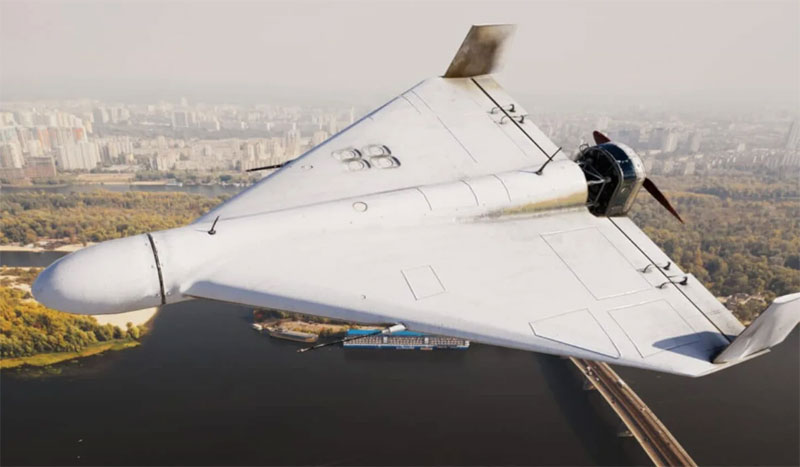
The Shahed-136—Iran’s principal war drone.
The Shahed-136 is a one-way kamikaze drone with a wingspan of 11 feet and length of 8 feet. It can carry a warhead of up to 110 pounds. It is capable of flying over 1,200 miles. Average production cost is about $30,000. It has both satellite and inertial navigation systems, and can be adjusted for rocket-assisted takeoff. Its MD-550 piston propeller engine gives it a maximum speed of 115 mph.
The Shahed-131 is a smaller version frequently used in cost-effective swarm attacks. It carries a warhead of up to 44 pounds and has a range of over 600 miles.
Some of the most formidable Iranian ballistic missiles are the Fattah-2, the Khorramshahr-2, and the Sejjil. The Fattah-2 MRBM has a range of over 900 miles, and has a solid fuel first stage. Its Warhead payload is unknown. The Khorramshahr-2 MRBM has a range of 1,800 miles, a 3,300 pound warhead, and hits within 70 feet of its target. The Sejjil MRBM has a 1,200 mile range, and a 1.600 pound warhead. A new ballistic missile with 80-cluster warheads has hit Tel Aviv several times in recent weeks, spreading many fires.
The Israelis are in a difficult situation. They are running low on defensive missiles, and their Patriot missiles have not done well. About 80 percent if Iranian ballistic missiles are breaking through the “Iron Dome” and hitting Israeli targets. The U.S. is also beginning to run low on defensive missiles and does not have the capability of replacing them quickly.
Iran’s missile and drone capabilities have forced U.S. aircraft carriers in the Indian Ocean and Mediterranean Sea to separate themselves by 1,000 kilometers (620 miles) from the Persian Gulf. The U.S. Navy is also aware that entering the Persian Gulf and Hormuz Strait would result in disastrous American losses. Neither are the British, French, and Germans willing to sacrifice their navies to a deadly trap. Moreover, only 7 percent of their oil needs come from the Persian Gulf. Norway can easily supply their additional needs for a higher but reasonable cost.
Iranian Shahed-136 drones and MRBMs have practically destroyed 13 American bases in the Gulf States. Shahed-136 drones destroyed at least three major U.S. radar installations costing $500 million to $1.0 billion dollars each.
Meanwhile, Israel is launching Patriot and other defensive missiles costing $1.0 million to over $3.0 million to knock down $30,000 drones, and Iranian drone numbers are multiplying faster than the U.S. and Israel can knock them down or destroy them on the ground—they are mostly underground.
Drone Countermeasure Systems
Small drones can be knocked down by ordinary rifle and machinegun fire or larger emplaced or mobile machinegun fire from ships, tanks, or armored vehicles. However, the time frame and opportunity for a hit can be small.
The Russians found early success in knocking down, confusing, and even capturing Ukrainian drones by radio frequency (RF) jamming and lasers. Some of these can be operated by a single soldier holding what looks like a large but light machine gun. The American Dedrone Defender V2 is an AI-powered smart-jammer for use in battlefield and urban settings. The newer and more expensive drones, however, have their own electronic countermeasure systems.
Interceptor Drones are also important in countering larger drones like the Iranian Shahed series. These highly sophisticated drones have autonomous navigation systems allowing automatic identification, chasing, and destroying drones. Its system works like an AI-fighter pilot equipped with the latest cameras, radar, and other target identification and destruction options.
Skywall Patrol is a handheld drone countermeasure that allows a trained operator to capture a drone in a specially designed net. GPS Spoofing is also used to confuse and capture enemy drones. The U.S. Army now has an optic system called Smash2000L that attaches to ordinary rifles to enhance the accuracy of anti-drone fire. There is also an AI-powered Lattice System and Sentry Tower that detects drone threats by radar and camera. The Swedish Mjolnir (Thor’s Hammer) system also disrupts drone electronic systems. Other new drone effectiveness killers include high-energy laser systems (HELWS) to target drone components. The Russians also have a system and specially trained military units of operators to detect the location of enemy drone operators and destroy them.
Drone technology, anti-drone technology, and anti-drone technology countermeasures are developing rapidly.
The most frequent causes of military defeat are underestimating your enemy and overestimating your own capabilities and preparedness. To properly evaluate a potential enemy, you must know their culture and history—know your enemy and know yourself. Inadequate or biased intelligence, hubris, and the politics of foolish partisan vanity often underlie significant military setbacks and defeats.
“Or what king, going out to encounter another king in war, will not sit down first and deliberate whether he is able with ten thousand to meet him who comes against him with twenty thousand?”—Jesus as quoted in Luke 14:31.
“Without counsel plans fail, but with many advisers they succeed.”—Proverbs 15:22 ES
 Mike Scruggs is the author of two books: The Un-Civil War: Shattering the Historical Myths; and Lessons from the Vietnam War: Truths the Media Never Told You, and over 600 articles on military history, national security, intelligent design, genealogical genetics, immigration, current political affairs, Islam, and the Middle East.