












Ranked choice voting has gained attention in recent years and has been adopted in several states and cities across the country, but it remains one of the most debated election reforms in modern American politics.
The issue even surfaced this week on the floor of the South Carolina House of Representatives during debate over redistricting legislation, where Democratic lawmakers introduced an amendment that would have implemented ranked choice voting in South Carolina. The proposal was ultimately rejected by the House.
While the amendment failed this time, the broader national push for ranked choice voting is not going away. Democratic activists and election reform advocates across the country continue pushing for the system through state legislatures and ballot initiatives, meaning South Carolina voters will likely hear the debate again in the future. That alone is reason enough for the public to understand exactly how the system works and why it remains so controversial.
Supporters portray ranked choice voting as a modern solution to polarization and “spoiler” candidates. Critics view it as an unnecessarily complicated system that changes the rules of elections and weakens the traditional concept of one person, one vote.
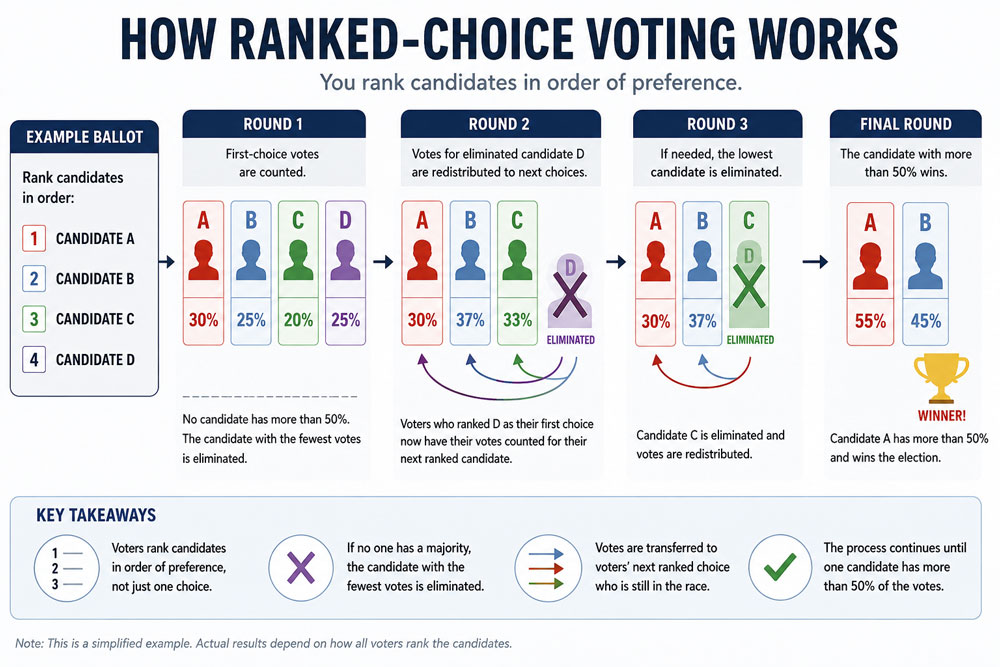
Under ranked choice voting, voters do not simply choose one candidate. Instead, they rank candidates in order of preference, such as first choice, second choice, and third choice.
Here is where the system changes from a traditional election.
If no candidate receives more than 50 percent of the first-choice votes, the candidate with the fewest votes is eliminated. Then the ballots from voters who selected that eliminated candidate are reviewed again. Their vote is transferred to whichever remaining candidate they marked as their next choice.
For example, if a voter selected Candidate Smith as their first choice and Smith is eliminated, that voter’s ballot is then reassigned to their second choice candidate. In effect, the voter who originally voted for Smith is now helping decide between the remaining candidates, even though their original first choice is no longer in the race.
That process continues round after round until one candidate reaches a majority of the remaining ballots.
Supporters argue that ranked choice voting encourages more civil campaigns because candidates are trying to become voters’ second or third choice instead of simply attacking opponents. Advocates also say it reduces the so-called “spoiler effect,” where a third-party or outsider candidate can split votes and change the outcome of a race.
Organizations promoting ranked choice voting argue it can produce candidates with broader support while reducing negative campaigning and expensive runoff elections. There are some real-world examples supporters point to. In states like Maine and Alaska, supporters claim the system has increased voter choice and allowed more independent-minded candidates to compete without automatically being labeled spoilers.
Some academic research has also suggested that certain theoretical problems critics raise do not frequently change final election outcomes in practice.
“Critics argue elections should be transparent and instantly understandable to the average voter, not dependent on lengthy explanations and tabulation charts.”
But critics argue those benefits come with major tradeoffs.
One of the biggest complaints is complexity. Traditional elections are simple. The candidate with the most votes wins. Ranked choice voting introduces multiple rounds of counting, vote transfers, and ballot exhaustion. Many voters do not fully understand how their ballot is ultimately counted. Critics argue elections should be transparent and instantly understandable to the average voter, not dependent on lengthy explanations and tabulation charts.
Another criticism is ballot exhaustion. This happens when a voter does not rank enough candidates, and all of their selected candidates are eliminated. At that point, their ballot no longer counts in later rounds. Critics argue this can result in a candidate “winning a majority” of remaining ballots while not actually winning a majority of all ballots originally cast.
Critics also argue the system tends to favor candidates viewed as broadly acceptable or “moderate” rather than candidates willing to take firm or principled positions on controversial issues. Because candidates are competing not only for first choice support but also second and third choice rankings, opponents argue the system can incentivize safer, less defined political positioning designed to offend the fewest voters possible.
There is also the issue that many voters instinctively understand even without knowing the technical arguments against ranked choice voting: people’s choices can change depending on who advances into a runoff.
Under a traditional runoff system, voters get a fresh election between the remaining candidates. They can reevaluate new information, campaign performances, endorsements, scandals, debates, or changing political conditions before casting a final vote. Ranked choice voting removes that second decision point by forcing voters to guess in advance how they might feel later in the race.
That criticism deserves more attention than it often receives.
A voter may strongly oppose Candidate A in November but prefer them over Candidate B after several weeks of additional campaigning, debates, or revelations. In a traditional runoff, that voter gets to make that decision in real time. Under ranked choice voting, that decision was already locked in weeks earlier on Election Day.
Critics argue that this fundamentally changes the nature of runoff elections. Instead of voters making an informed final choice after seeing the field narrow, they are asked to predict hypothetical future matchups before they happen.
“When voters are asked to make hypothetical future runoff decisions before the runoff ever exists, democracy no longer becomes clearer. It becomes more abstract.”
Opponents also argue that ranked choice voting can weaken confidence in elections because results often take longer to calculate and explain. In several high-profile races, final outcomes were not immediately known on election night, fueling public confusion and mistrust.
There are even mathematical criticisms of the system. Some political scientists note that ranked choice voting can still produce outcomes where the broadly preferred “consensus candidate” loses, depending on how rankings transfer. Research has also shown that the system is not immune to strategic voting or spoiler dynamics, despite how it is often marketed politically.
At its core, the debate over ranked choice voting is really a debate about trust and simplicity.
Supporters believe modern elections need structural reform to reduce polarization and give voters more choices. Critics believe elections work best when they remain straightforward, transparent, and easy for every voter to understand without requiring complicated redistribution formulas.
Personally, this author remains unconvinced that ranked choice voting improves elections enough to justify the confusion, delayed results, ballot exhaustion, and reduced clarity it introduces into the process. Americans already struggle to trust institutions and election systems. Creating more complicated voting methods may satisfy political reform activists, but it does not necessarily increase public confidence.
Sometimes the simplest system is still the best one.
And when voters are asked to make hypothetical future runoff decisions before the runoff ever exists, that no longer feels like democracy becoming clearer. It feels like democracy becoming more abstract.