










County Chairman Blount outlines growth challenges, while Attorney General candidate Pascoe explains his path from Republican to Democrat and back again, and Rep. Burns calls for closing primaries
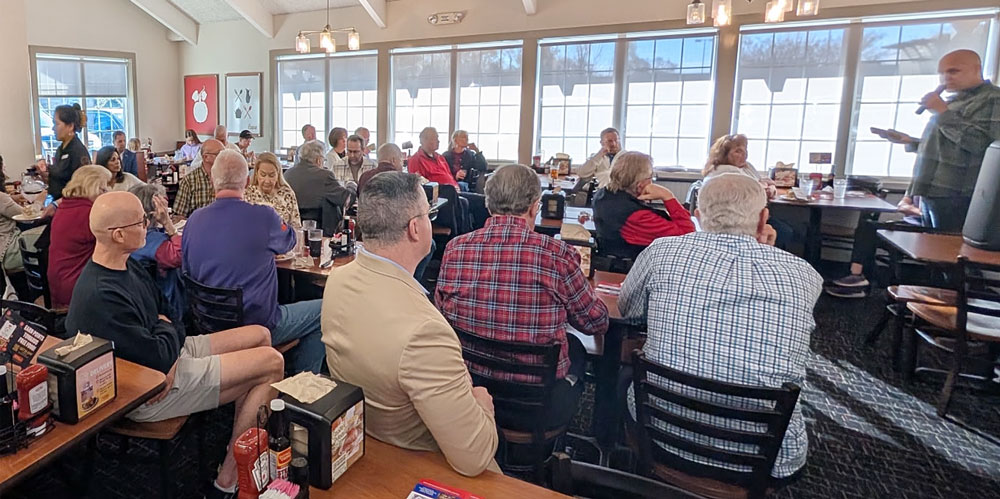
GREENVILLE COUNTY, SC — The latest Back-to-Basics Breakfast, hosted by the Palmetto Conservative Fund, served up a multi-layered look at the current state of governance in Greenville County and beyond, as local leadership, statewide candidates, and engaged citizens worked through a wide range of issues in real time. The format, which blends prepared remarks with open questioning, revealed not only policy priorities but also the underlying tensions that come with rapid growth, shifting political alignments, and competing expectations between government and the public.
Blount Serves Up County Realities and Growth Pressures
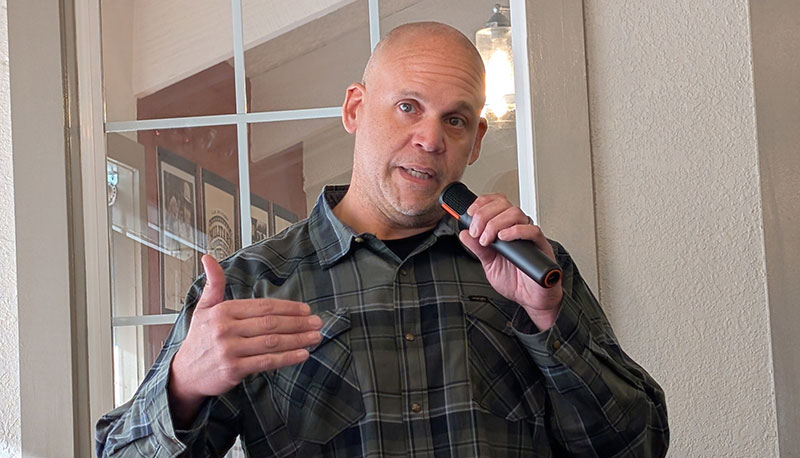
Greenville County Council Chairman Benton Blount opened the discussion by grounding the audience in the practical realities of county government. His remarks reflected both an effort to communicate recent accomplishments and an acknowledgment that many residents remain frustrated or confused about how county decisions affect their daily lives. Thanking the organizers and attendees, Blount emphasized the purpose of the event itself.
“This is a great event… I think it’s a great way to plug the public into what’s going on at all levels of government.”
County Budget and Property Rights
From there, Blount moved into the county budget, an area that consistently generates public scrutiny and, at times, hard-to-swallow conclusions for taxpayers. He described a balancing act that included modest tax relief alongside increased infrastructure investment, particularly in road funding. While the reduction in property taxes was limited, he framed it as part of a broader fiscal strategy.
“We did lower property taxes by about four million dollars, and at the same time, we were able to use some funding mechanisms through our Fee in Lieu of Taxes to increase our road payment revenue by over 20 million dollars.”
Blount described using “funding mechanisms through our fee and rule of taxes,” referring to adjustments in fees and millage structures.
Blount’s explanation highlighted a recurring challenge in local government communication. Even when the county reduces its portion of taxes, the overall bill may still rise due to other taxing authorities. He addressed that disconnect directly, noting that the county represents only a fraction of the total tax burden.
“The county portion is about 18% of that tax bill. It did actually go down, but you may have seen taxes go up in other areas.”
That distinction became a central theme as the discussion progressed. Much of the public frustration directed at county government, Blount suggested, stems from overlapping jurisdictions and a lack of clarity about which entity controls each portion of taxation or services, leaving many citizens unsure of who is serving what on their tax plate.
County Accountability, Transparency, and Website
Blount then shifted to internal accountability, an area he indicated had not received sufficient structural attention in prior years. The introduction of performance audits represents a move toward more systematic oversight of county departments, something he framed as both a management tool and a public accountability measure.
“There’s a half-million-dollar allocation specifically for performance audits… to make sure that they’re operating properly.”
In a similar vein, Blount acknowledged that even basic performance evaluations for top county staff had not been consistently formalized. His proposal to institutionalize annual reviews reflects an effort to align county operations more closely with private sector expectations.
“Up until this year, we have never had baked into our rules and policies any kind of performance evaluation for any of them."
"So, what I suggested recently is we just put that into process where every year we will do an official performance review.”
The conversation then moved into public access and transparency, where Blount identified the county website as a practical barrier between government and citizens. His description of the current system as difficult to navigate underscored a broader issue. Even when information is technically available, it is not always presented in a way that citizens can easily digest.
“It was about impossible to navigate the county website.”
A planned redesign, including dashboards and simplified navigation, is intended to make that information more digestible and accessible for residents trying to understand county operations.
Regulation, Food Trucks, and Agricultural Concerns
Blount also addressed regulatory updates, including a revised food truck ordinance. While seemingly a narrow issue, it served as an example of how local government attempts to balance flexibility for small businesses with fairness and safety standards.
“Not to really stop food trucks, but to make sure that they’re in compliance so that they’re at least operating the same way a normal brick-and-mortar business owner would have to.”
At the same time, he emphasized the growing pressure on rural areas of the county, particularly agricultural communities. The creation of an agricultural task force reflects recognition that development policies often have unintended consequences for those sectors that have long helped put food on the table for the region.
“We are desperately trying to help our rural parts because they’re feeling the pressure of development, no more so, than our farmers and our agricultural people who help us provide food and services.”
The Pause on Cluster Development
As the discussion turned more fully toward development, Blount’s tone shifted from reporting to concern. He described a system that, in his view, lacks cohesion and clarity, even among those responsible for administering it. The temporary pause on cluster development was presented as a corrective measure in response to perceived misuse.
“We have put a pause on cluster development because we feel like it was being used improperly.”
More broadly, Blount acknowledged uncertainty within the system itself.
“I think we’ve realized one of the big problems with our planning and development is that, honestly, I don’t know if anybody knows if we’re doing it right or not… ourselves as council, as staff, the planning commission, or even the public.”
Public Roundtable on Development Policy
The above-quoted statement captured a recurring theme throughout the morning. The issue is not simply disagreement over policy outcomes, but a deeper lack of shared understanding about how the system is supposed to function. Blount’s proposed public roundtable, which will lay out the full menu of planning laws and local practices, is intended to bring that process into the open.
“We’re going to get into a room publicly… find all the places where we’re not operating the way that state law requires us to… and going to flag those places, the public’s going to see it, and then we’re going to start to address it and fix it.”
Infrastructure Coordination
Closely related to development is the issue of infrastructure coordination, where Blount pointed to a breakdown in communication between agencies and service providers. The example of previously unknown utility impact fees illustrated how decisions affecting housing costs can occur without county awareness.
“… some of our utilities were essentially charging impact fees to the point where for every home, it was going up $5,000 or $6,000.”
The proposed coordination group would bring together multiple entities that currently operate in parallel rather than in coordination, with the goal of ensuring everyone is working from the same table instead of separate kitchens.
The Sheriff’s Office
Public safety funding introduced another layer of complexity. Blount addressed a significant salary increase request from the Sheriff’s Office, acknowledging both the need to support law enforcement and the challenge of sustaining such increases over time.
“He’s asking for a $12,000 increase across the board for every employee in the Sheriff’s Department, which is a pretty huge undertaking.”
His response reflected caution rather than opposition, raising the question of whether salary increases alone can address retention challenges or if the issue requires a more balanced approach.
“What’s going to happen in three years?… we’re going to be 31st again?”
Blount urged attendees to remain engaged in the budget process, noting that decisions in this area often become politically sensitive and are rarely as simple as they appear at first glance.
“We can’t just throw money at it when we know that’s not the solution.”
Cost of Living vs. Pay for Performance
Blount also addressed a question from State Representative Paul Wickensimer, a former Greenville County Councilman, who raised the issue of county employee compensation, particularly the balance between cost-of-living adjustments and performance-based pay. The topic has drawn increased attention as inflation continues to impact wages across both public and private sectors.
Blount indicated that while cost-of-living increases may be necessary in certain cases, he expressed a preference for compensation models that reward performance and accountability. He suggested that across-the-board increases, while simpler to implement, may not adequately reflect differences in productivity or effectiveness among employees.
His comments pointed to an ongoing discussion within county government about how best to structure compensation in a way that both retains employees and ensures taxpayer funds are allocated efficiently.
No Cooperation Between County and City
The audience portion of the discussion reinforced many of these themes. Questions about school taxes highlighted ongoing confusion about tax distribution, while inquiries about city-county coordination revealed structural gaps in regional planning.
Although Blount noted he has an open relationship with Mayor Knox White, Blount’s response to one such question was direct.
“What kind of cooperation… between the City Council and the County Council? Zero.”
The conversation also touched on broader public safety concerns, including jail capacity, increasing caseloads, and the downstream effects of population growth, all of which continue to add pressure to an already full plate.
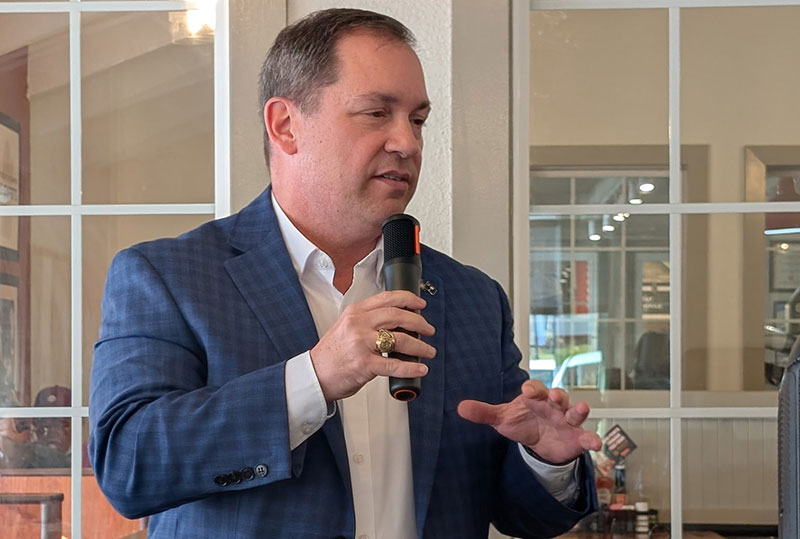
Pascoe Presents Anti-Corruption Agenda and Political Path
Attorney General candidate and current 1st Circuit Solicitor David Pascoe followed with remarks that shifted the focus from local governance to statewide legal and political issues.
Experience and Living the Dream
Drawing on his decades-long career as a prosecutor, Pascoe framed his candidacy around experience and a stated willingness to confront corruption head-on. Where Blount’s remarks centered on managing growth and structure at the county level, Pascoe’s comments pointed toward enforcement and accountability at the state level, particularly in areas where he believes existing systems have failed to act.
“For 33 years now, I’ve lived the dream doing the only thing I’ve ever wanted to do, be a prosecutor.”
His remarks centered heavily on past investigations and what he described as unfinished work, positioning corruption not as an isolated issue but as a persistent structural concern within state government.
“The swamp is the State House.”
Pascoe positioned himself as uniquely prepared to address systemic issues, referencing prosecutions that resulted in the removal of high-ranking officials.
“I convicted and removed from office the Speaker of the House, the President Pro Tem of the Senate, two majority leaders, and I sent to prison the Chairman of the House Judiciary because they were corrupt.”
From Republican to Democrat back to Republican?
During the question-and-answer session, Pascoe addressed questions about his political affiliation history, providing context for his transition from Republican to Democrat and back again. His explanation emphasized career opportunity and local political dynamics rather than ideological change, leaving the question of political consistency for voters to decide.
During the discussion, a reference was raised to a recent Facebook comment by Greenville County Republican Party Chairman Jeff Davis, who wrote, “David Pascoe was a 1989 Citadel Classmate of mine. We were both members of the Citadel College Republicans.”
Pascoe responded by noting that he does not recall meeting Davis during his time at The Citadel, stating he first met him in 2022, a response that appeared to place distance between himself and Davis’ account of their shared background. He said, “I never met him prior to that… he was in another battalion.” He did not dispute the broader point that he was a Republican during his Citadel years and stated that he was in charge of George H. W. Bush’s campaign at the time.
“I was a Republican at The Citadel. I was in charge of the Bush campaign back then. I always voted for the Republican.”
“I wanted to be the elected solicitor of the First Judicial Circuit. And the state Democratic Party approached me and asked if I would run in the early 2000s. And I said, I will do it, but I’m pro-life, and I’m pro-capital punishment.”
He stated that his policy positions remained consistent throughout that period, describing himself as pro-life, supportive of capital punishment, and generally conservative, regardless of party label. His comments suggested that prosecutorial priorities and legal philosophy carried more weight than party affiliation in shaping his career.
Pascoe also acknowledged what he described as a past political misstep, citing his support for Joe Biden during the presidential election cycle.
“I did commit one sin in 2016, which is very forgettable. Biden’s dementia is contagious, so I try to forget it… Okay? So, forgive me.”
While Pascoe referenced 2016 in his remarks, public records indicate that his endorsement of Joe Biden occurred during the 2020 presidential election, when Biden ran against then-President Donald Trump.
Judicial Reform and Future Political Plans
Pascoe also discussed the need for judicial reform in South Carolina, pointing to concerns about how judges are selected and the broader structure of the state’s judicial system. While not outlining a detailed plan during the event, he indicated that reform efforts would be necessary to improve public confidence and ensure greater accountability within the judiciary.
Pascoe also addressed questions about his long-term political intentions, stating that he has no plans to seek higher office beyond the Attorney General position. He indicated that his focus is on serving in that role and suggested that his political career would conclude there, emphasizing that he is not interested in running for governor in the future.
Broader Campaign Proposals and the Death Penalty
Pascoe’s broader campaign proposals focused on structural reforms, including changes to government contracting practices and increased enforcement of transparency laws, presenting them as measures aimed at cleaning up what he described as deeply rooted problems in state government operations.
“I will be signing an order firing every lawyer legislator from government contracts.”
Pascoe also addressed criminal justice policy, including his support for capital punishment and recent discussions surrounding execution methods in South Carolina. He indicated that he supports the death penalty and referenced prior public statements backing the use of the firing squad as a lawful option under state law, framing it as part of ensuring that sentences handed down by the courts are carried out.
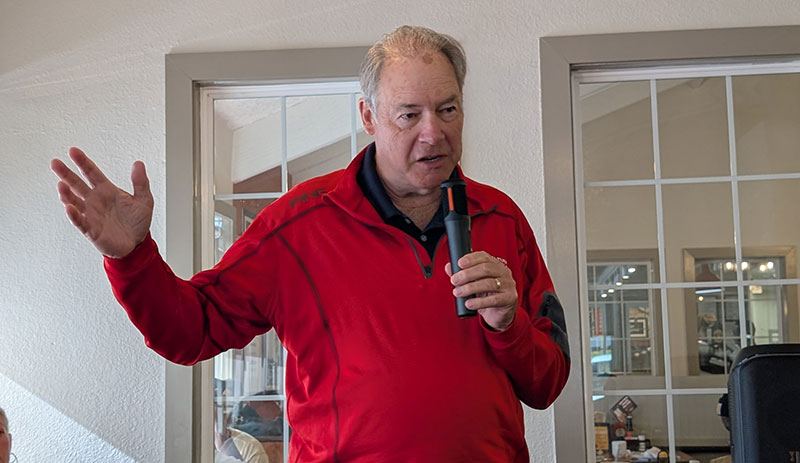
Burns Delivers Election Reform and Fiscal Accountability
State Representative Mike Burns concluded the program by turning attention to legislative processes and election structure, offering what could be described as the final course of the morning’s discussion. While Blount addressed local governance and Pascoe focused on legal enforcement, Burns concentrated on the mechanics of how laws are made and, in his view, why certain reforms struggle to advance within the General Assembly.
Closed Primaries
“Democrats elect Democrats and Republicans elect Republicans.”
Burns argued that allowing crossover voting undermines ideological consistency within the party and contributes to more moderate outcomes, a concern that has been debated within South Carolina Republican circles for several election cycles.
Burns suggested that this dynamic creates a disconnect between voter intent and legislative outcomes, particularly in primaries where crossover voting is allowed. In his view, election structures can shape results in ways that do not always reflect the preferences of a party’s core voters, reinforcing his argument that procedural reform is necessary before broader policy changes can take hold.
Burns also pointed to efforts beyond the State House to advance the issue, noting that former South Carolina Republican Party Chairman Chad Connelly has been traveling across the state advocating for closed primaries. He described those efforts as part of a broader movement within the party aimed at addressing what many view as a structural weakness in the current election system.
“When the primaries aren’t closed… the most moderate candidate gets elected.”
He described repeated legislative efforts to address the issue, along with the procedural obstacles that have prevented those efforts from advancing. His comments highlighted how State House internal rules and legislative customs can shape outcomes as much as policy positions themselves.
Burns also described what he sees as a structural bottleneck within the legislative process itself, noting that even widely supported proposals can stall before reaching full debate. He indicated that procedural rules and leadership control over the calendar often determine which bills advance, regardless of broader support among rank-and-file legislators. His comments reflected a frustration not just with outcomes, but with how decisions are filtered before they ever reach a vote.
“It takes one to object… and every day somebody objects.”
Fiscal Policy and Unnecessary Surplus Funds
Burns also addressed fiscal policy, criticizing what he described as a pattern of accumulating surplus funds without returning them to taxpayers. His remarks reflected a broader concern among some legislators that budget growth can occur even in periods of revenue surplus.
“We usually have a couple of billion dollars of extra money. And instead of giving it back in tax relief… (they) would rather have your tax money.”
He framed this approach as part of a broader budgeting philosophy, arguing that recurring surplus revenues should prompt structural tax relief rather than expanded spending commitments. Burns indicated that without changes to how surplus funds are handled, the pattern is likely to continue regardless of which party holds a majority.
Filet Mignon vs. Peanut Butter
In a moment that tied directly back to local commentary, Burns cited a Times Examiner article outlining differences between closed primary bills H.3310 and H.3643. He noted that the leading image and the article became “a hit in all the places across the state. I want to thank you for that. It was great.”
Click to Read: “If You’ve Never Had Filet Mignon, Peanut Butter Tastes Just Fine”
Burns’ catchy analogy underscored his argument that voter expectations are often shaped by experience, suggesting that without exposure to alternative policy approaches, incremental change may be accepted as sufficient.
State Surveillance and Conformity Delays
Additional discussion covered issues ranging from surveillance concerns to tax conformity delays, with Burns acknowledging the difficulty of advancing legislation under current conditions, particularly when procedural hurdles can stall proposals before they reach a full vote.
“We’re kind of boxed out of the process right now.”
Burns’ characterization of being “boxed out” pointed to what he described as a smaller group of decision-makers shaping legislative priorities behind the scenes. He suggested that this dynamic can limit the ability of individual lawmakers to advance proposals, even when those proposals align with the views of their constituents.
Final Course: A Full Plate of Policy and Decisions Ahead
As the event concluded, the discussion left attendees with a full serving of issues to consider. Whether addressing county development, state corruption, or legislative process, each topic pointed to gaps between policy intent and implementation, as well as ongoing challenges in aligning government action with public expectations.
The Back-to-Basics Breakfast, held on the last Saturday of each month, continues to provide a setting where those issues are not only presented, but openly examined, giving citizens an opportunity to see how decisions are prepared, debated, and ultimately served to the public.
In the end, the Back-to-Basics Breakfast offered more than just talk. It served a full plate of issues, leaving it up to voters to decide what they are willing to consume, and what they are no longer willing to swallow.