











Attorney General candidates outline sharply different priorities
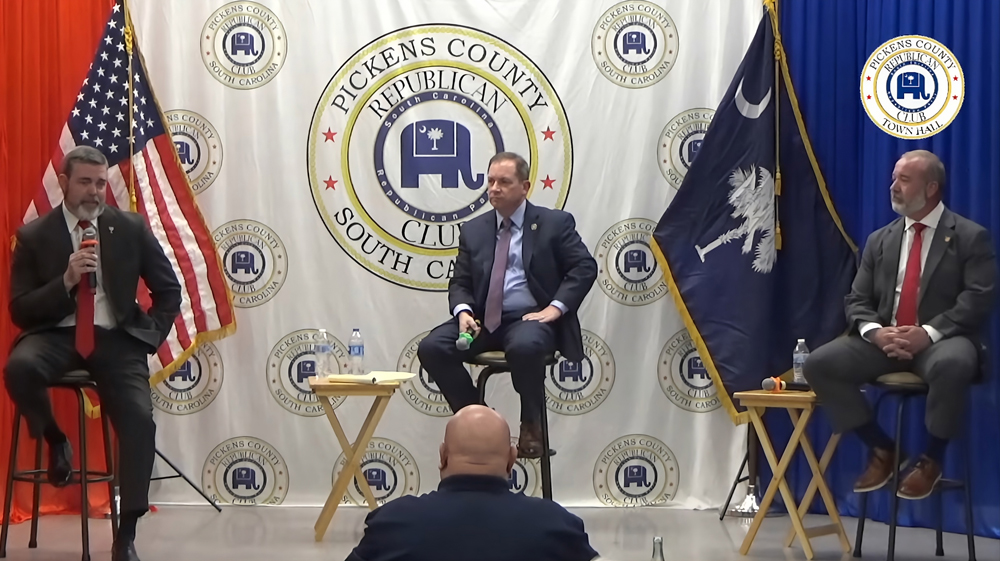
PICKENS COUNTY — Republican candidates for South Carolina Attorney General offered contrasting visions for the state’s top legal office during a debate in Pickens County, with discussions ranging from violent crime and child protection to government overreach, corruption, and the limits of prosecutorial authority.
The forum featured candidates including David Stumbo, David Pascoe, and Stephen Goldfinch, who fielded questions on law enforcement strategy, federal and state relations, and their qualifications to serve as the state’s chief prosecutor and legal officer.
While candidates aligned on several core Republican positions, the debate revealed meaningful differences in how each would approach and execute the responsibilities of the office.
Candidate Backgrounds Provide Context for Debate
The candidates brought varied professional and political backgrounds to the debate, shaping how each framed their views on the role of the State Attorney General.
David Stumbo, a current circuit solicitor, emphasized his career as a prosecutor, including prior work at the South Carolina Attorney General’s Office handling internet crimes against children and other serious offenses. He described a career focused on criminal prosecution and public safety, along with a consistent adherence to Republican conservative principles in his legal approach and public service.
David Pascoe, also a current circuit solicitor, pointed to his experience as a former statehouse prosecutor, where he led high-profile corruption cases involving members of the South Carolina Legislature. His campaign has centered on government accountability and anti-corruption enforcement.
Stephen Goldfinch, current State Senator, highlighted a more varied background, including military service, private law practice, and business experience. He also referenced his time serving in both the South Carolina House and Senate, along with his legal work challenging government agencies on behalf of clients.
These differing backgrounds informed the candidates’ perspectives throughout the debate, particularly in how each defined the scope and priorities of the Attorney General’s office.
Opening Statements Define Experience and Approach
Candidates quickly distinguished themselves through their backgrounds and framing of the Attorney General’s role.
David Stumbo emphasized prosecutorial experience and courtroom work.
“If you're going to be the chief prosecutor, as under our Constitution, the Attorney General is, you need to be a prosecutor.”
He described a career focused on criminal enforcement and conservative principles.
“If you don't remember anything else about me tonight, remember two things… one, I've been a crime-fighting prosecutor my entire career… and secondly, I'm a lifelong conservative Republican.”
David Pascoe centered his campaign on confronting government corruption.
“An attorney general's duty is to be where corruption needs an adversary, and that's where you're going to find me.”
Stephen Goldfinch emphasized experience beyond criminal prosecution.
“We can all prosecute crimes… but there's only one of us that has experience in the agency state… and that's me.”
Crime Policy: Agreement on Severity, Differences in Strategy
All candidates emphasized crime reduction, but diverged in how to achieve it.
Stumbo focused on enforcement, sentencing, and prosecutorial authority.
“We've got to be tough, so we need a tough prosecutor in this position to fight the fentanyl problem that was taking so many of our young lives here in South Carolina.”
“Lately, I've seen far too many pedophiles walking out with probation. That's not going to happen when I'm your attorney general.”
He also reinforced the structural role of the office.
“If you're going to be the chief prosecutor… you need to be a prosecutor.”
Pascoe focused on prosecution outcomes and structural changes within the system.
“There are some counties that have a single-digit conviction rate on child pornography.”
He did not cite specific counties but characterized those rates as significantly low, referring to cases where fewer than ten percent of prosecutions result in convictions.
He proposed shifting how certain prosecution resources are handled at the state level.
“I have a plan to take that state money, give it back to the local solicitors, and let them prosecute those cases.”
Pascoe did not specify the exact funding streams but indicated a preference for directing resources back to local solicitor offices rather than relying on centralized handling.
He also called for stronger penalties.
“We are not just going to talk about going for the death penalty on child rapists… we are going to seek the death penalty on child rapists…”
Goldfinch acknowledged the importance of prosecution while maintaining that the office extends beyond criminal enforcement.
Federal Authority, Immigration, and the “Agency State”
Goldfinch placed significant emphasis on government overreach and regulatory burden, referencing his experience in the private sector.
“The federal government… was in my way every single step of the way. They were not there as a stepping stone. They were there as a stumbling block.”
He framed that experience as part of a broader concern about how regulation affects businesses and individuals.
“The agency state is crushing them, literally crushing them.”
The term “agency state” is commonly used to describe government regulatory agencies at both the state and federal levels that create and enforce rules, often outside of direct legislative action. Critics argue these agencies can impose significant burdens on businesses and individuals through regulation, while supporters view them as necessary for oversight and public protection.
He framed the Attorney General’s role as one that must actively challenge federal authority.
“You've got to have an attorney general that's ready, willing, and able to go to the Supreme Court of the United States and defend our state's sovereignty…”
Stumbo also tied federal policy to crime within South Carolina.
“The supply of fentanyl was unbelievable because of Biden's open border policies…”
He further emphasized the need for political alignment in the office.
“You need a staunch Republican, lifelong conservative in that office to fight back.”
Pascoe addressed immigration in the context of criminal enforcement.
“Same with illegal immigrants. If they're arrested, they're already here illegally, so we're going to move to revoke their bond statewide so ICE can decide whether they need to be picked up.”
Corruption and Transparency
Pascoe made corruption and transparency a central theme of his campaign during the debate, tying it to both state and local government.
“Corruption in Columbia is just as bad or worse today than it was when I was your special prosecutor…”
“Corruption in Columbia… trickles down to every single municipality and government agency, county agency in this state…”
He also emphasized enforcement of public records laws.
“They blow off our Freedom of Information Act request… well, when I'm your attorney general, I'm going to sue on your behalf and I'm going to get those documents.”
Presidential Preference and Candidate Background Contrast
All candidates responded with the same answer when asked about their support.
“Donald Trump.”
Stumbo further emphasized his support.
“He's been one of the greatest presidents we've had because he's tough.”
Pascoe provided additional context regarding his past political relationships and endorsements with individuals who opposed Trump.
“I've known Joe Biden for almost 20 years. I did think Joe Biden was a friend of mine.”
He also described a shift in that relationship but did not provide specific details.
“He lied… and I left him when he picked Kamala Harris as his vice president.”
He also stated:
“I can put my hand on a Bible and say that I've never voted for a Democrat for president.”
“I agree with everything David Stumbo said about Donald Trump.”
Even though Pascoe stated he has not voted for a Democrat for president, he previously endorsed Joe Biden during the 2020 presidential election, which is widely known and remains undisputed.
Law Enforcement Endorsements Highlight Differences
Candidates differed in how they viewed the role of endorsements from sheriffs and solicitors, with some emphasizing institutional support from law enforcement and others downplaying its importance.
Goldfinch cited support from sheriffs.
“I think we're at 11 sheriffs… and maybe one or two solicitors.”
Stumbo reported broader backing.
“I have 18 sheriffs endorsing me and five solicitors, including… your sheriff here in Pickens County…”
Pascoe emphasized that he had not sought endorsements but could not recall specific numbers.
“I don't know. I think one to three… I have not called one sheriff or one legislator… I have not asked one sheriff for an endorsement.”
He added:
“I know there have been some sheriffs that have endorsed me. I can think of two or three, but I did not ask them for their endorsements.”
Differing Emphases on the Attorney General’s Role
While the candidates shared common ground on key issues such as crime reduction and protecting children, the debate highlighted clear differences in how each views the role of the Attorney General and how that authority should be used. Stumbo consistently framed the office as a prosecutorial position focused on enforcement and sentencing, while Pascoe emphasized investigating public corruption and enforcing transparency laws. Goldfinch described a broader role that includes civil litigation, regulatory challenges, and legal disputes involving state and federal agencies. These differing emphases reflect how each candidate would direct the office’s authority and resources.
The debate made one point clear: the next Attorney General will not lack authority, but the direction in which that authority is aimed will be the real decision before voters on who best fits the weight of the office.
---------------------------
FULL VIDEO OF ATTORNEY GENERAL DEBATE
Follow this link to full video of debate: https://youtu.be/tDyjdlx19ss?si=6eH92pgDWlWqfS55