








Plus Comments on Military and Economic Aspects of Iran War
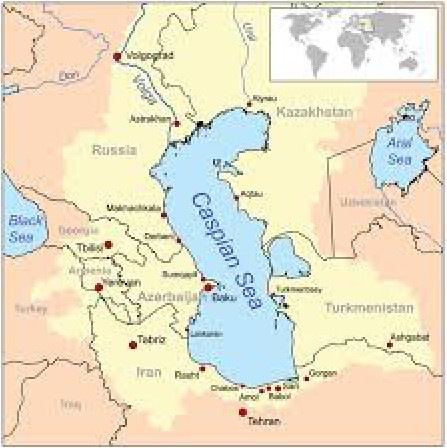
The Caspian Sea is the largest inland waterbody in the world. It is about the size Japan, almost as large as Norway, and larger than Germany. It stretches 750 miles from north to south, almost the distance between Charleston and Boston, and its average width is about 200 miles. It is about the size of Montana, our fourth-largest state, and larger than Georgia, North Carolina, and South Carolina combined. It is nearly five times as large as Lake Superior. Its main freshwater inflow (80%) is from the Russian Volga River, the longest river in Europe. The Volga also has transportational connections to the Russian Don River, the Black Sea, the Baltic Sea, the North Sea, and the White Sea in Northern Russia. The Ural River accounts for most of the other 20% freshwater inflow. The Caspian Sea’s surface is 89 feet below sea-level, and its salinity is about 1.3%, about one-third that of the seawater. Its depth varies, but there are northern and southern basins, with the deeper southern basin bottom at 3,356 feet below sea-level. This is the third deepest inland sea depth in the world. The shallowest area is where the Volga flows into the Caspian.
One may find three are four different weather systems simultaneously over the Caspian Sea, but it is navigable and the source of substantial present and potential petroleum wealth.
The Caspian Sea is situated between the European Caucus on its west and the central Asian steppe on the east. To its north are the fertile plains of southern Russian. To its south, is the mountainous Iranian Plateau. It is bound by Russia on its northwest, Russian allied Kazakhstan, on its northeast, Turkmenistan on its southeast, and Azerbaijan to its southwest.
The Kingdom of the Medes, mentioned in the Bible, centered near the southwestern shore of the Caspian Sea, was absorbed by the Persians under Cyrus the Great in 550 BC. It included northwestern Iran and Azerbaijan. The Median language was part of the Iranian subgroup of Indo-European languages.
Baku, on the western shore of the Caspian, is the capital of Azerbaijan and the largest port and city on the Caspian with a population of about 2.3 million. Baku was once a Russian Navy base with a Russian population of over 40%, but this has gradually declined and is now less than 3%. The population is now overwhelmingly Shia Muslim. Azeris are the largest minority in Iran with about 16% of its population. The Iranian language, Farsi, is an Indo-European language, but Azeri is a Turkic language. However, ethnically and culturally, Iranians and Azeri are much alike.
Both the Iranians and Azeri are Shia Muslim, and their genetic heritage is very close. Like most former empires, Iran has more genetic diversity than most West Asian and Mid-Eastern nations. But the J2 male YDNA branch (haplogroup) is strongest in both, Iran 23% and Azerbaijan 31%. The area between the western shore of the Caspian Sea and eastern edge of the Caucus is apparently the maximum global occurrence of J2. Running as high as 88%, it runs to 57% for Chechnya, part of the Russian Federation. Genetic haplogroup J2 is also the most common genetic signature in most Jewish groups, 19-25%, and is also high in Turkey, Greece, and southeastern Europe. Its especially high occurrence on the Mediterranean islands of Crete (35%) and Cyprus (32% for Greek Cypriots) is a historical mystery. Crete may have been the origin of the Biblical Philistines.
The Caspian Sea got its name from the ancient Caspi people, who have long since disappeared or been absorbed into the Iranian and Azeri populations.
The relationship between the Iranians and Azeris is currently important, because the CIA is engaged in covert operations and influence with two probable objectives—to pull Azerbaijan away from its past close association with Russia and to undermine the government of Iran.
Moreover, there is a complication with Armenia. Armenia is a Christian nation on Azerbaijan’s western border. Armenia has promised the U.S. that Armenian airfields could be used to attack Iran. However, relations between Armenia and Azerbaijan have been tense. In 1990, the Azeris began ethnic cleansing attacks against Armenian Christians that were a majority in the contested region of Nagorno-Karabakh. A brief war broke out over this in 2020. The Azeris launched another war in September 2023 making extensive use of drones. By January 2024, more than 100,000 ethnic Armenians were forced to flee to Armenia, and the Armenian enclave in Azerbaijan was effectively dissolved. President Trump helped arrange a peace treaty between Armenia and Azerbaijan in March 2025.
The Azeris also have strong geopolitical connections to the Turks. The western Caspian coast and the Azeri border with Armenia could become political and military flash points in the future.
There are at least three major oil and gas pipelines in the planning stage that could have considerable impact on future alternatives for shipping petroleum products by tanker trough the Persian Gulf and Strait of Hormuz. One is a Transcaspian Pipeline beneath the Caspian Sea, connecting Turkmenistan with Azerbaijan. Another would proceed from north of the Caspian through Russia and Ukraine with connections to Europe. The third would connect the Gulf States over the Arabian desert to Saudi Arabian ports on the Red Sea.
Another development planned in the United States but advantageous over the world would be to gradually replace petroleum-powered electrical power plants with more numerous small nuclear plants with new technology considerably reducing radiation dangers. This may be the strongest reason that Iran wants to keep its ability to refine uranium to sufficient levels to operate nuclear plants.
The Semi-Sham U. S Blockade of the Persian Gulf and Hormuz Strait.
According to International Relations Analyst Mark Sleboda and former CIA official Larry Johnson, based on research firms supporting Lloyd’s of London Shipping Insurance, 34 Iranian owned or flagged ships have gotten through the U.S. Navy blockade of the Hormuz Strait, and four have been stopped of which two have been boarded. This blockade is being enforced by about 16 U.S. Navy ships in the Gulf of Oman and Indian Ocean as of about Friday, April 24. According to Sleboda, all four interceptions occurred far away from the Persian Gulf and in the Indian Ocean. No U.S. Navy ship gets within 200 miles of the Iranian coast because they would be extremely vulnerable to sinking by Iranian short and medium range ballistic missiles, cruise missiles, and long-range drones such as Iran’s Shahed-136, with a range of over 1,200 miles and the slightly smaller Shahed-131 with a 600 mile range. The deadly accuracy of these have been proven by their recent destructive hits on UAE, Bahrein, Kuwait, and Qatar bases and numerous targets in Israel. Our aircraft carriers stay beyond 620 miles of any part of Iran.
Furthermore, Iranian tankers can hug the coasts of Pakistan and India and be confident the U.S. Navy will not risk creating a diplomatic incident offending India or Pakistan. Chinese bound ships are given a wide birth, and the Russians have promised they will not tolerate any incidents against Russian merchant or military ships. Larry Johnson believes the blockade in not more than 5-10% effective and being conducted at huge costs.
Blockades are considered an Act of War under established international law. Moreover, deliberate deception in peace negotiations is considered a war crime.
According to recent conservative Investor’s Business Daily (IBD) articles, the U.S. Armed Forces and thus also those of Israel and Ukraine, have serious missile logistical problems that threaten the outcome of American-backed operations in Ukraine and American-Israeli war operations against Iran. An April 24 article in IBD estimated we had already used more than half of the total inventory of Patriot Defense missiles. The same is true for THAAD interceptors and Precision Strike Missiles. The New Yorker reported that the Institute for Strategic Studies estimated that the U.S. used 850 Tomahawk missiles of a total inventory of less than 4,000 in just the first four weeks attacking Iran. At present production rates, it could take 3-5 years to replace what was so quickly used. Defensive missiles are also very expensive--$1-3 million for Patriots and over $15 million for THAADs. Iranian drones and SRBMs and MRBMs are comparatively cheap.
Both Larry Johnson and retired Army Colonel Douglas Macgregor have calculated the depletion may far exceed the IBD and Strategic Institute estimates. This is particularly true for Israeli inventories, which are believed to be nearly depleted. About 80% Iranian missiles now easily penetrate Israel’s “Iron Dome” and have made many precise hits on targets in Tel Aviv, Haifa, the Ben Gurion Airport, and other cities.
Iran War Related Energy Shortages, Rising Prices, and Blockades
Although the U.S. is theoretically energy independent and better off than most nations in the world, there are some troublesome problems in the detail. The U.S. has a refining capacity shortage that will take considerable investment and many years to correct. Therefore, we must import refined fuels. Currently the U.S. uses approximately 20 million barrels per day. Largely due to refining capacity decline, we must import 1.8 million barrels per day. This is predominantly for transportation needs.
Moreover, petroleum prices are principally affected by the global market. If global fuel shortages cause fuel prices to rise, U.S. prices will rise.
Furthermore, shortages and prices of petroleum byproducts can be profoundly impacted. The Persian Gulf is the source of about 20% of the global fuel supply, However, through Iran’s Houthi Yemeni allies, shipping through the Red Sea could also be cut off. This would mean another 12%, bringing the total shortage to nearly a third of the world supply.
Other important petroleum byproducts would have even greater impact. About 35% of the fertilizer supply comes from the Persian Gulf. This is vital for farmers. A 35% shortage for just a few months could bankrupt many farmers and cause widespread famine and starvation. Qatar, in the Persian Gulf, produces 32% of the world’s helium supply. Helium is an essential element in producing semi-conductors for computers, i-phones, etc.—a huge global economic impact.
Blockades are dangerous weapons increasing the chance of expanding global conflicts, but they are also extremely dangerous in their global economic impact. Blockades have historically had limited effectiveness, but more disastrously in this case, they take a lot of time to be effective if ever. Taking a lot of time, while fertilizers, fuels, and essential manufacturing elements are being withheld from needed and often essential human use is a formula for a bad recession and then a disastrous major depression lasting for years, and smashing the lives, health, and prosperity of millions globally and in our own country as well.
Iranian President Masoud Pezeshkian has stated than Iran will not send a delegation to negotiate with the United States while it is blockading his country.
“There is many a boy here today who looks on war as all glory, but boys, it is all hell.”
—Union General William T. Sherman, 1879. (15 years after the Civil War, to a group of military cadets in Ohio.)
“I hate war as only a soldier who has lived it can, only as one who has seen its brutality, its futility, its stupidity….Men acquainted with the battlefield will not be found among the numbers that glibly talk of another war.—President Dwight D. Eisenhower.
“In the councils of government, we must guard against the acquisition of unwarranted influence…by the military-industrial complex. The potential for the disastrous rise of misplaced power exists and will persist.”
—President Dwight D. Eisenhower, January 17, 1961, farewell address.
Former CIA briefer to the Reagan Cabinet, Ray McGovern, has rightly expanded the danger zone to the Military-Industrial-Congressional-Intelligence-Media-Academia-Thin-Tank complex. The corporate-controlled propagandizing Media has become the cornerstone of this complex. McGovern has rightly expanded the initials of the MIC to MICIMATT.
I will only add that the Industrial part of the complex has been immensely enhanced by Political Action Committee (PAC) financing and so-called Non-government organizations (NGOs) operating and influencing with U.S. government funds.
 Mike Scruggs is the author of two books: The Un-Civil War: Shattering the Historical Myths; and Lessons from the Vietnam War: Truths the Media Never Told You, and over 600 articles on military history, national security, intelligent design, genealogical genetics, immigration, current political affairs, Islam, and the Middle East.