







West Asia’s and Europe’s Most Formidable Military Power
In 2022, at the request of the Turkish government, the United Nations changed the English spelling of Turkey to Türkiye. This was to reflect the actual native pronunciation and avoid any inappropriate association with the large American bird. English does not have an umlauted ü as German does, so perhaps English speakers can be excused for spelling it Turkiye.
The vast majority of Turkiye’s territory, approximately 97%, lies in West Asia. The West Asian part or eastern part of Turkiye is historically known as Anatolia, which includes 85% of the population. The smaller 3% of western Turkiye lies in Europe in a region called East Thrace, bordering Greece and Bulgaria. The European portion of Turkiye includes part of Turkiye’s largest city, Istanbul, and thus a disproportionate part of the Turkish population at 15%. The Dardanelles Strait (also known as the Gallipoli Strait) leading from the Mediterranean Sea and the Aegean Sea to the Sea of Marmara, and the Bosporus Strait leading to the Black Sea are the border between Europe and Asia. A part of Istanbul lies across the Bosporus in Europe.
Starting from the North and moving clockwise, Turkiye borders the Black Sea, Georgia, Armenia, Azerbaijan, Iran, Iraq, Syria, the Mediterranean Sea, the Aegean Sea, Greece, and Bulgaria.
The population of Turkey in 2025 was 86 million. Istanbul is the largest city in Turkiye with 15.8 million people. Ankara, located in central Anatolia, is the Capital of Turkiye and its second largest city with 5.3 million people. Turkiye has over 20 cities with over one million people, but the third largest city, Izmir, is of particular historic interest and has a population of 4.5 million people. Izmir in on the Aegean Sea and until 1930 was called by its Greek name, Smyrna.
In addition to its 86 million people, the Turks have a huge ethnic diaspora in the European Union—estimated to be between 10 and 15 million. Germany is the largest with between 3 and 5 million. Large numbers of ethnic Turks now also reside in France, the Netherlands, Belgium, Switzerland, and Austria. The UK has about 500,000.
Smyrna was one of the Seven Churches of western Asia (Anatolia) mentioned in Chapters 2 and 3 of Revelation, the final book of the Bible. The other six churches were at Ephesus (also on the Aegean), Pergamum, Thyatira, Sardis, Philadelphia, and Laodicea. In Revelation Chapter 2 and 3, the seven churches are recorded in a roughly clockwise oval from Ephesus with Laodicea being the most distant and most inland at 114 miles. Smyrna is about 40 miles north of Ephesus. The Greek Island of Patmos, where the Apostle John recorded the Book of Revelation, is about 60 miles southwest from Ephesus.
Turkiye is the fourth most visited country in the world!
Turkey has the strongest military forces in Europe and West Asia.
Turkiye is a member of NATO and ranks 9th of 145 nations in global firepower. It has the second strongest armed forces in NATO, save only the United States. It has 480,000 active and 380,000 reserve military personnel. It has far and away the strongest military force in Western Asia, including Iran, Israel, and Pakistan. It has a huge fleet of modern main battle tanks, armored vehicles, and artillery pieces, and is experienced in asymmetrical warfare. Its Air Force would be dominant in West Asia with superior numbers of F-16s and its own precision targeted UAV drone systems. Its Naval forces have modern blue-water capable surface ships, submarines, and UAV attack carriers. It has developed a self-reliant industrial defense industry. Its F-35 program is currently delayed. Turkey hosts from 20-50 U.S. nuclear weapons at Incirlik Air Base, but does not have its own nuclear arsenal. The Turks have proved themselves extremely tough and determined fighters in many combat campaigns, for example the Korean War.
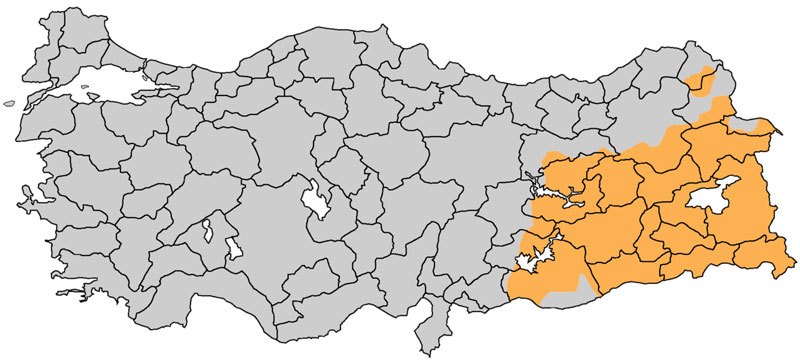
Turkiye is over 99% Muslim, and 90% are Sunni Muslims of the Hanafi School of Islamic scholarship. It is, however, ethnically more diverse. It is about 75% Turkish, 19% Kurdish, and 6% other. The Kurds, who are commonest in the eastern half of Anatolia, are troublesome because the Kurdish areas in Turkiye, Syria, Iraq, and Iran have ambitions to unite into nation of their own—Kurdistan, which would have over 35 million people. The Kurds are predominantly Sunni Muslim, but the Kurdish language belongs to the Indo-Iranian language group rather than the Turkish language group. The Kurds also have a distinctive history and culture. The Kurds are concentrated in southeastern Turkiye, where about a dozen provinces have significant Kurdish majorities.
The estimated 2024 GDP-PPP for Turkiye, which is adjusted for price parity, was $3.5 trillion, the 12th largest in the world. Per capita this was $40,283, the 54th largest in the world.
Turkiye’s most important natural resources are coal, iron ore, copper, chromium, borate, marble, and limestone. It is rich in arable land and agricultural products. It has significant hydropower resources and natural gas, but must import 30% of its natural gas. It must import more than 90% of its oil. Turkiye imports 70% of its oil from Russia.
The literacy rate is 98.3%, and 12 years of school are mandatory.
The Population of Turkiye is 99.8% Muslim, probably one of the highest in the world. In 1914, the Christian population in Turkiye was nearly 20%. At least three major Christian genocides occurred in the Turkish-Ottoman Empire from 1894 to 1923.
The most famous was the Armenian Genocide, a state action orchestrated by the “Young Turks” from 2015 to 2017. However, the 2015-2017 time frame hides massive genocidal tragedy both before and after. The massacres and murders had already begun in 2014. The larger time frame should also include the death toll from the Hamidian state sanctioned massacres from 1894 to 1896 under Sultan Abdulihamid II, in which more than 250,000 Armenian Christians were massacred or murdered. Moreover, the genocide of many of the survivors of the 2014 to 2017 period continued into 2023. In total, approximately 1.5 million Armenian Christians were killed. In southeastern Turkiye, the Kurdish minority participated in the massacre and murder of Armenians.
Fortunately, about half the Armenian population in Anatolia was able to flee, creating a diaspora growing to millions around the world, including the United States. The U.S. has the second or third largest Armenian Genocide diaspora estimated at between 800,000 to 1.5 million.
The Genocide of Greek Christians in Turkiye began with the Greek-Turkish War from 1919 to 1922 and extended into to 1923. In deaths, the Greek numbers are similar to the Armenian numbers. Approximately 1.5 million died. This included about 100,000 who died in the Great Smyrna Fire in 1922. In addition, about 50,000 young girls were sold into sex-slavery and mandatory conversion to Islam. Thousands of younger children were also sold as slaves to be raised as Muslims. About 1.5 million Greeks fled or were rescued by the Greek, American, British, Italian, and French navies. Most of those were welcomed to Greece.
About 300,000 Assyrian Christians were massacred or murdered by Ottoman Turks and Kurdish tribes from 1914 to 1923.
“Democide” scholar Dr. Rudolph Rummel estimates that from 1900 to 1923 various Turkish regimes killed from 3.5 to 4.3 million Armenian, Greek, Assyrian, and other Christians.
The genocides ended with the establishment of the Republic of Turkiye on October 29, 2023, and the rule of its first President Mustafa Kamal Ataturk, who died in office in 1938. Of course, the Christian population of Turkiye had already been exterminated, forced to convert to Islam, or driven out. However the Turkish Republic has no official religion, but religious and secular trends have fluctuated in recent Turkish history. Turkiye has continued to modernize, and secularism is visibly prevalent, but during the reign of President Recep Tayyip Erdogan, religious traditions have become more important politically, and Erdogan tends to identify himself as a leader supporting the Muslim Brotherhood and being the strongest leader in the Sunni Muslim world. In terms of military power, he may be correct. His recent aggression against Syria made it a Turkish vassal state, but it has made it a radical Islamic vassal state extremely dangerous to the dwindling Christian population and moderate Alawite Shia Muslims. However, he generally maintains good relations with the United States and NATO. Israel considers Turkiye a more formidable enemy than Iran.
Turkiye has a strong interest in Iran not having nuclear weapons, but an equally strong interest that Iran does not fall into American and Israeli created chaos. It has joined Pakistan in trying to steer both Iran and the United States into a peaceful settlement or at least a peaceful standoff.
However, Israel has given indications that once Iran is crushed—which no longer looks like a realistic possibility—the next pre-emptive war should be against Turkiye. This seems insane, when Israel’s Iron Dome Missile Defense has proved incapable of stopping most Iranian missiles, and Israel is taking considerable missile damage to its largest cities. Moreover, both Israel and the U.S. are running low on both defensive Patriot 3 missiles and offensive missiles like the Tomahawk. According to MIT professor and missile and nuclear expert Dr. Ted Postol, the Patriot 3 is effective against aircraft and drones, but shockingly ineffective against Iranian missiles and completely useless against hypersonic missiles.
Perhaps Israel has in mind using the Kurds to chop off part of Turkiye and cause economic chaos and military degradation in Ankara, removing them as a significant threat to Israel. Or can AIPAC funding and influence in the U.S. Congress make Turkiye the new priority enemy?
Renowned International Relations professor, author, and speaker Dr. John Mearsheimer remarked yesterday on an article in the Jerusalem Post, which indicates Israel seems to be picking a fight with Turkiye. This is at the same time that President Trump is in Turkiye calling President Erdogan a “great friend” and speaking favorably about getting F-35s to the Turkish Air Force.
Turkiye is probably a greater potential threat to Israel than Iran, but Israel is in no position to be provoking the foremost military power in both NATO and West Asia. “Sufficient for the day is its own trouble.”—Matthew 6:34c
Here is applicable Biblical advice for sensible strategic and logistical planning, diplomatic tact, and foreign policy.
"Or what king, going out to encounter another king in war, will not sit down first and deliberate whether he is able with ten thousand to meet him who comes against him with twenty thousand?”—Luke 14;31
 Mike Scruggs is the author of two books: The Un-Civil War: Shattering the Historical Myths; and Lessons from the Vietnam War: Truths the Media Never Told You, and over 600 articles on military history, national security, intelligent design, genealogical genetics, immigration, current political affairs, Islam, and the Middle East.