







- Ten Toes In: Why Trump Accounts Make Sense for North Carolina's Small Businesses
- Remnant Called -
- Former Moms for Liberty Chairs in South Carolina Address Massive Departure from Organization
- Same Job. Two Résumés. Graham and Norman Make Their Case for the US Senate
- Greenville County Holding Public Meetings on 1% Transportation Sales Tax Referendum
- Beyond the Monuments - Finding the Forgotten Grave of Dicey Langston
- The Myth of Voting for the Lesser of Two Evils
- AIPAC Lobbyists Grip on Congress
- Hunting Island's Lighthouse Was Built to Outsmart the Atlantic's Shifting Shoreline
- South Carolina Gas Tax Climbs From Near Bottom Nationally to 30th in 2026
- Equipping the Persecuted: Weekend Terror Alert Helped Avert Wider Massacre as Slaughter of Christians Continues to Ravage Nigeria Unchecked by Government
- Thurmond and Murkowski Won as Write-Ins. Is This Year’s Senate Race Really the Same?
- Briefing Notes from the Ukraine and Persian Gulf Wars
- Crime Stoppers Luncheon Remembers Greenville’s Fallen While Honoring Those Who Continue to Serve
- Trump Administration Announces $167 Million to Build Rural Care Sites, Upgrade Health Technology, and Strengthen Prevention Across South Carolina
What’s on Putin’s Mind?
- Details
- By Mike Scruggs
- Category: Mike Scruggs' Column
Ultimatums to United States and NATO

On July 12, 2021, Russian Federation President Vladimir Putin published a 6,900-word article in an online Russian government Presidential News Events release entitled “On the Historical Unity of Russians and Ukrainians.”
Russia now has over 120,000 troops on the Ukrainian border and on December 17, the Russian Foreign Ministry gave the U.S. and NATO what are essentially “non-negotiable” ultimatums regarding Ukraine and the provocative anti-Russian NATO membership of 14 East European nations. Sweden and Finland were given stern warnings that joining or aiding NATO could have serious consequences. Talks were held with the U.S. in Geneva on January 10, 2022, and with a gathering of NATO, U.S. and Ukrainian officials in Brussels on January 12. At this point, nothing has been resolved, and Russian news releases are not comforting,

New Russian Threat against NATO and U.S.
- Details
- By Mike Scruggs
- Category: Mike Scruggs' Column
Consequences of the Feckless Biden Administration
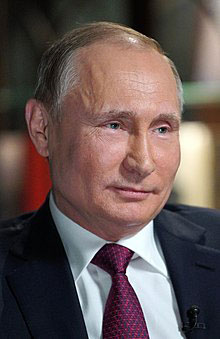
As I write on January 7, 2022, it is Christmas Day in Russia, which observes Christmas according to the calendar of the Russian Orthodox Church. The Russian Federation is a far different country from the Union of Soviet Socialist Republics (USSR) that fall apart in 1991. Russian Federation President Vladimir Putin has been either president or prime minister since 1999. He is not a communist. He has been an economic reformer and strongly favors private enterprise as the road to Russian prosperity and greatness. Russia and its people have prospered considerably under his rule. His leadership style, however, is autocratic by most Western standards. However, despite its great resources, Russia lags the U.S. and other major European and Asian powers in economic development and influence. Unlike the strongly anti-Christian Marxists that preceded the notably more tolerant and perhaps Christian leaning Mikhail Gorbachev, who dominated Soviet leadership from 1988 to 1991, Putin identifies as Russian Orthodox and has favored the growth of the Russian Orthodox Church, which has grown and continues to grow at an astonishingly rapid pace. According to a Pew Survey in 2017, 73 percent of Russian adults now identify as Christians. Many Russian musicians and performers seen on entertainment and social media wear Christian crosses. A similar Pew Survey of the U.S. in 2019 showed that Christian identity had dropped to 65 percent.

Lessons from the Civil War
- Details
- By Mike Scruggs
- Category: Mike Scruggs' Column
The Menace of Sectionalist Politics and Protective Tariffs
Part 8 of 8 on the Morrill Tariff
Protectionist tariffs are a general menace to economic prosperity. Near the beginning of the Great Depression, one of the highest tariff bills in U.S. history, the Smoot-Hawley Tariff Act, was passed on June 17, 1930, by Congress and signed by Republican President Herbert Hoover, who had strongly opposed the bill. Its purpose was to protect suffering American workers, farmers, and businesses from foreign competition. Up until then, exporters were faring well and remained one of the relative strengths in the economy. The House passed the bill 264 to 147, with 244 Republicans and 20 Democrats voting for it. The Senate passed it 44 to 42, with 39 Republicans and 5 Democrats voting for it. As could have been predicted by historical experience, exports soon suffered, dropping 61 percent with even Canada introducing a retaliatory tariff against U.S. goods. Unemployment was at 7.8 percent when Smoot-Hawley passed and jumped to 16.3 percent in 1931 and peaked at 25.1 percent in 1933.62
Mark Thornton and Robert B. Ekelund Jr. in their 2004 book on the economics of the Civil War, summarize some of their general economic conclusions: Protective tariffs benefit some commercial or regional interests in the short to intermediate term, but they do more harm than good to the overall economy. Obviously, some interests are injured. Tariffs are essentially a redistribution of wealth through political means. Protected economic interests often become non-innovative drags on the economy and taxpayers.63

The Tariff Road to Secession and War
- Details
- By Mike Scruggs
- Category: Mike Scruggs' Column
Protectionism versus Free Trade
Part 7 of 8 of a Series on the Morrill Tariff
Whig leaders in congress were again able to pass protectionist legislation in the Tariff of 1842, also known as the “Black Tariff.” This tariff primarily benefited the iron industry, nearly doubling the rates for both raw and manufactured iron goods. It also raised the percentage of dutiable items from about 50 percent to over 85 percent of all imported items. By 1843, imports had dropped by half, thus actually reducing total tariff revenues. Exports dropped approximately 20 percent. This was replaced by the 1846 Walker Tariff that lowered tariff rates to pre-1842 levels after the Whigs lost the presidency and Congress in the 1844 elections.50
The 1857 “Free-Trade” Tariff was passed by a nonpartisan coalition dominated by conservative Southern Democrats and reduced tariff rates to almost free-trade levels. This was strongly opposed by Northern industry and Northern industrial workers. When a financial panic caused by loose banking practices resulted in a Northern recession in 1857, the Republicans blamed it on free trade and the 1857 Tariff Law. By 1858, the Republicans had submitted new tariff legislation, the Morrill Tariff, to the House Ways and Means Committee.51
Like many modern legislative attempts to conceal the purposes, costs, and political and economic benefits and injuries of a bad bill, the title of the Morrill Tariff commences with deceptive obfuscation:

The Nullification Crisis of 1832-1833
- Details
- By Mike Scruggs
- Category: Mike Scruggs' Column
Preview of Coming Sectionalist Disaster in 1860-1861
Part 6 of 8 of a Series on the Morrill Tariff
 In 1832, another tariff bill was introduced, supposedly to correct some of the injustices of the 1828 Tariff of Abominations and to give some relief to the South. The 1828 Tariff had also produced a surplus of government income that many wanted to correct. However, the Northern beneficiaries of high tariffs succeeded in a bill that did not diminish their profit margins. Some of the abominations of the 1828 Tariff were relieved, notably the troubling “minimum” provisions, which caused unjust aberrations in the duties and invited fraud. The average dutiable rate was about 33 percent. The net relief to the South, however, was negligible, and many Southern Congressmen felt they had been betrayed and exploited by Northern political interests again.41
 Mike Scruggs is the author of two books: The Un-Civil War: Shattering the Historical Myths; and Lessons from the Vietnam War: Truths the Media Never Told You, and over 600 articles on military history, national security, intelligent design, genealogical genetics, immigration, current political affairs, Islam, and the Middle East.
He holds a BS degree from the University of Georgia and an MBA from Stanford University. A former USAF intelligence officer and Air Commando, he is a decorated combat veteran of the Vietnam War, and holds the Distinguished Flying Cross, Purple Heart, and Air Medal. He is a retired First Vice President for a major national financial services firm and former Chairman of the Board of a classical Christian school.
Click the website below to order books. http://www.universalmediainc.org/books.htm.
Browse by the Top Tags ...