












Long before "mobile" became a word associated with modern technology, South Carolina had a 19th-century lighthouse engineered to be mobile without losing its purpose.

A lighthouse is supposed to be a fixed thing. The sea moves. The tides move. Ships move. Sand shifts beneath the waves, storms reshape the coast, and generations of people come and go. But the lighthouse remains, planted on the edge of the continent as a declaration that at least one thing knows exactly where it belongs and exactly what it is there to do.
That is the familiar picture, but Hunting Island Lighthouse complicates it.
Rising above the maritime forest near Beaufort, with the Atlantic stretching out before it, the black-and-white tower is one of South Carolina's most recognizable landmarks at the state's most visited state park. Visitors approaching it today see something that looks permanent. Its iron walls appear massive. Its foundation appears settled. Its purpose seems almost self-explanatory. One of South Carolina’s tallest lighthouses was built where it was needed, and there it stayed.
Except this lighthouse didn't.
Hunting Island Lighthouse was built to stand firm. But unlike most silent monuments, this was a working sentinel, built not merely to be seen, but to warn, guide and protect. And part of its strength was that it was designed to be mobile.
Not mobile in the way we use the word today, of course. There was nothing electronic about it. But the underlying idea is surprisingly familiar. Its designers created a massive structure whose essential components could be separated, transferred to another location, and reassembled much like enormous LEGO blocks without destroying the identity or function of the original.
In other words, Hunting Island’s lighthouse is a movable marvel of 19th-century engineering.
And once you understand that, the story of the lighthouse itself begins to take on a character and personality of its own. Its history did not simply happen in one place either. It crossed periods of war, erosion and technological change, while movement remained a recurring part of its survival. The story of Hunting Island Lighthouse is, in many ways, a story about movement and mobility.
A Lighthouse Lost to War
The lighthouse visitors climb today is not the first tower to stand watch over Hunting Island. An earlier lighthouse stood there before the Civil War, part of a growing federal network intended to guide vessels along a dangerous coastline. In fact, South Carolina merchants, planters and vessel owners had petitioned the federal government in 1853 for additional navigational aids, including a lighthouse on the northern end of Hunting Island. Congress appropriated money the following year, and the new light was finally illuminated on July 1, 1859.
Then war came to South Carolina.
The first Hunting Island lighthouse was destroyed by Confederate forces in 1861 to hinder the approach of the Union fleet before the Battle of Port Royal. The tower that had been erected to guide ships along the coast had survived only about two years. When the nation eventually returned to the business of rebuilding its aids to navigation, Hunting Island would need another lighthouse.
But rebuilding did not mean simply recreating what had been there before. Something important had happened to the island in the meantime. It had moved.
They Knew the Ground Could Not Be Trusted
In 1872, Congress appropriated $30,000 to begin construction of a replacement lighthouse on government-owned land. But when the district engineer surveyed the northern end of Hunting Island that year, he found something alarming.
According to the Lighthouse Board's contemporary report, the shoreline had receded approximately half a mile from its position on an 1869 Coast Survey chart. Where dry land had existed only a few years earlier, there was now deep water. The Board concluded that a lighthouse at the northern end of Hunting Island might eventually have to be removed and specifically proposed an iron structure for that reason. It requested another $50,000, and Congress appropriated the additional money in 1873.
That changes the way we should understand the lighthouse standing there today. Mobility wasn't merely an accidental benefit of the design discovered years later. Mobility was part of the plan.
Before the present lighthouse existed, its engineers already knew the ground beneath it could not be trusted to stay put.
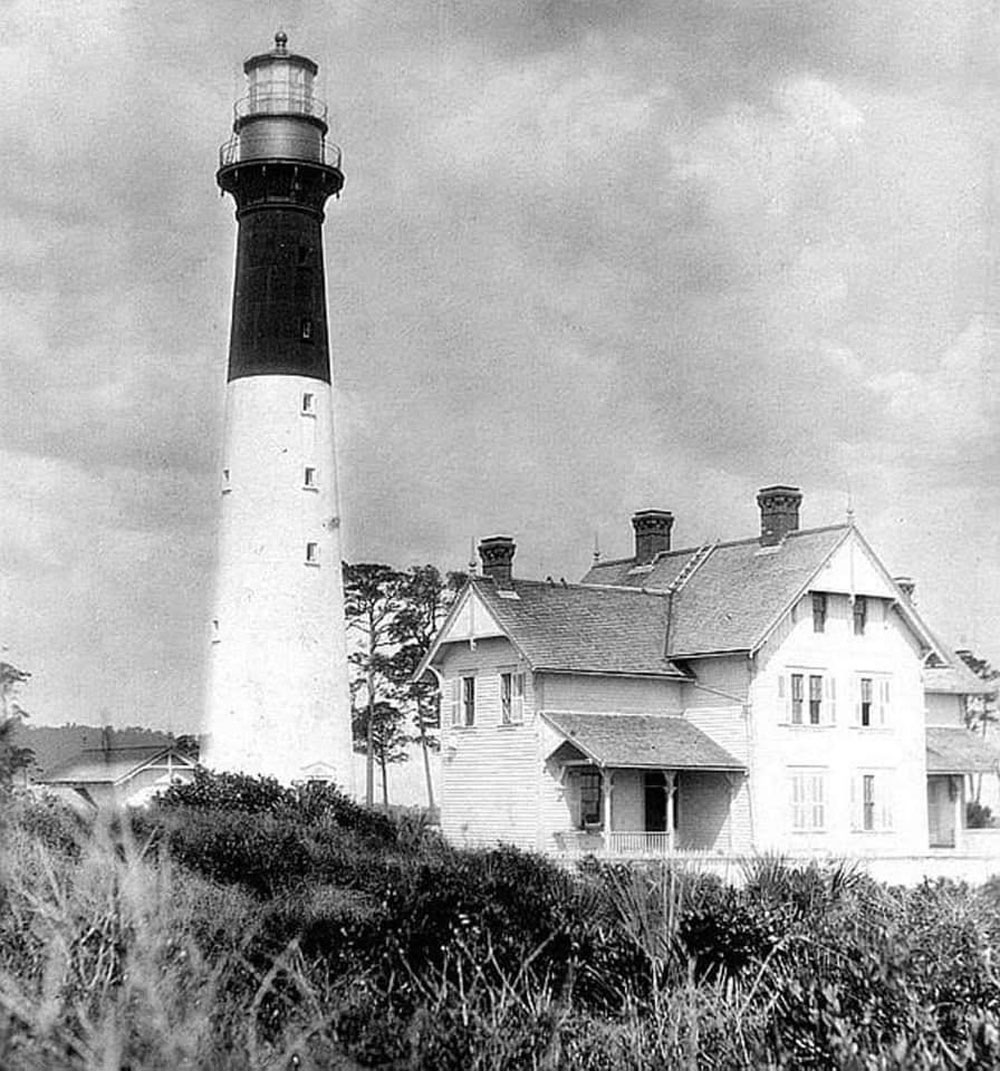
The new tower, completed in 1875, therefore represented a very different kind of construction. From the outside, it resembles masonry. Yet beneath that familiar lighthouse silhouette is something much more interesting.
In fact, the 1875 tower is essentially a giant iron kit.
Its structural system was made from prefabricated cast-iron sections that could be assembled, taken apart and assembled again. The National Park Service describes this type of lighthouse construction as prefabricated curved cast-iron panels bolted together and specifically identifies Hunting Island as an example of a design that could be moved.
In modern language, we might call the concept modular. The tower was massive, but its construction made it mobile.
The metallic shell was manufactured by Phoenix Iron Works of Philadelphia, then lined with brick. Construction itself had to be interrupted during the warmer months because of what contemporary accounts called the "unhealthiness of the climate." The new light was finally exhibited on July 1, 1875, exactly sixteen years to the day after Hunting Island's first lighthouse had been illuminated, with its white light flashing every 30 seconds from a second-order Fresnel lens.
At that point the lighthouse had a simple assignment. Stand there and shine. Warn ships away from danger, and for a while, that was enough.
Then the Land Moved
What happened next may be the pivotal moment in the story because the lighthouse itself had not failed. Neither had the foresight of the engineers who designed it. The shoreline began doing exactly what they had feared it might do.
A lighthouse can be engineered to withstand wind. It can be strengthened against storms. Iron can be bolted together, foundations can be made substantial, lenses can be protected and machinery maintained. But what happens when the coastline itself refuses to remain where men put the lighthouse?
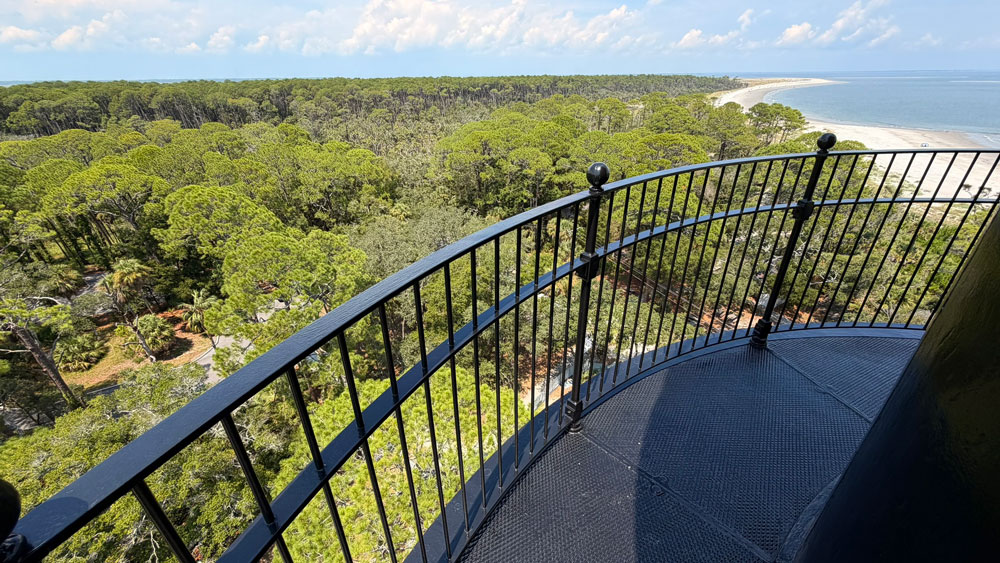
Hunting Island is a barrier island. Barrier islands are shifting foundations by nature. They are dynamic landscapes shaped by waves, tides, storms, currents and the movement of sand. What appears permanent on a human timetable can become temporary on the timetable of an ocean.
The government knew erosion was a threat. It tried to fight it.
In 1886, a stone jetty was constructed near the lighthouse station using a $5,000 congressional appropriation. For a time, it worked. Then an August 1887 storm swept most of it away. According to the historical account, the ocean was left only 60 feet from the keeper's dwelling and 152 feet from the tower. The Lighthouse Board urgently requested $51,000 to buy another site and move the station, and Congress supplied the money in April 1888.
Even then, engineers tried to buy time. A 200-foot sheet-pile revetment was built to protect the old site until relocation could take place.
Eventually the question was no longer whether the lighthouse had been built strongly enough. The question was whether the ground beneath it would remain.
The shoreline kept advancing. The engineers had anticipated that possibility, and now their foresight was being put to the test.
The lighthouse would have to do what it had been designed to do. It would have to move.
Its designers had given a massive iron structure an extraordinary capability for its time: it could be dismantled, relocated, and reassembled without losing its identity or its purpose.
The Night the Lighthouse Shook
Three years before the great relocation, nature had already tested the tower in another way.
At 9:50 p.m. on August 31, 1886, the great Charleston earthquake reached Hunting Island. We know the time with unusual precision because, according to the historical account, the tremor stopped the lighthouse clock.
The first shock reportedly lasted about four minutes. A bucket half-filled with water near the top of the tower was nearly emptied by the motion. Two assistant keepers atop the tower could not remain standing without holding onto something, while one assistant outside on the gallery was thrown back and forth between the railing and tower.
The earth moved, and the tower moved with it. The clock stopped, and the lighthouse didn't.
That distinction would become a recurring pattern in the life of Hunting Island Lighthouse. Movement did not necessarily mean failure. The tower could sway without falling. It could be dismantled without being destroyed. It could change locations without losing its identity.
A Building Constructed to Stand Still, Engineered to Be Mobile
Think about the oddity of moving a tall lighthouse. A lighthouse is among the most stationary structures human beings build. Its usefulness depends upon mariners knowing where it is. Its entire identity is connected to location. Yet Hunting Island Lighthouse's survival depended upon its ability to leave that location.
Before dismantling the main tower, a temporary tower equipped with a smaller temporary lighthouse lens was put into service on February 1, 1889. Even while the great lighthouse was being taken apart, the navigational system still had to function. The light could not simply disappear because construction crews were moving its tower.
Then workers began dismantling the lighthouse. This was not the construction of another replacement tower. The 1875 lighthouse itself was coming apart. The iron components that had formed one enormous structure became pieces again. According to the historical account, those pieces were transported along a tramway and reassembled approximately 1¼ miles farther inland. The main light was relit on October 1, 1889.
This wasn't merely a lighthouse being moved. The station itself had become mobile.
The keeper's dwelling was also dismantled and its pieces moved. Workers returned to reconstruct it and erect a new oil house, with the station reported complete again by March 22, 1890. The relocation cost $51,000, reportedly exactly half what construction had cost fourteen years earlier.
The engineers could not guarantee permanence of place, so they designed for permanence of purpose. They made permanence portable. The engineers could not stop the Atlantic from moving, so they built a lighthouse that could.
In our digital age, we are accustomed to the idea that something can migrate from one location to another without ceasing to be what it is. The concept seems modern. At Hunting Island, engineers were applying something surprisingly similar in iron and brick more than a century ago.
Move the components. Reassemble the system. Preserve the function. The location changed. The lighthouse remained the lighthouse.
The Sea Came Looking for the Lighthouse
The great relocation did not end Hunting Island's encounters with the Atlantic.
During the hurricane of 1893, the 272-foot steamship City of Savannah grounded on shoals off Hunting Island. The interpretive exhibit at the lighthouse describes men lashing themselves to the mast while women and children were placed into lifeboats and brought through the surf. After reaching the island, they still had to make their way through waist-deep water before finding refuge at the lighthouse. Historical accounts report that the men remaining aboard endured roughly 36 hours before rescue.
There is something almost circular about that episode. For years, men had worked to save the lighthouse from the sea so the lighthouse could continue warning people about the sea. Then people endangered by that sea came looking for the lighthouse. The tower had moved inland. Its purpose had not.
Management Moved from Federal to Local
Technology changed lighthouse work across the country. Tasks that once required constant human presence could increasingly be performed in other ways, and the occupation that had shaped generations of lighthouse families gradually diminished.
At Hunting Island, the end came in 1933. A lighted whistle buoy was placed offshore, and the lighthouse was deactivated as part of an economy plan for the district. In 1937, the U.S. Senate passed legislation transferring the lighthouse reservation to Beaufort County for use as a park or game preserve, and South Carolina acquired the island the following year for development as a state park.
The keeper's dwelling did not survive. According to the historical account, it burned in 1938 while being used to house workers improving access to the island. Its foundation was uncovered decades later and marked so visitors could again see the footprint of the home where lighthouse families once lived.
Progress solved problems. But it also closed a chapter.
The lighthouse was never really one object. It was a network of people and things constantly moving toward one purpose: keep the light burning.
And the Shoreline Is Still Moving
More than a century after the great relocation, the irony has not disappeared.
Hunting Island remains a barrier island. The Atlantic has not agreed to stay where 19th-century engineers left it.
Lighthousefriends.com currently places the tower about 400 feet from the shoreline at high tide and notes that continued erosion could someday raise the question of relocation again. No government plan to move the lighthouse again is being suggested here, but the continuing erosion makes the historical parallel difficult to miss.
But the larger point requires no speculation. The lighthouse moved once because the shoreline moved toward it.
The shoreline is still moving. That fact makes the decisions of those 19th-century engineers look even more remarkable. They were not trying to conquer a changing island by pretending it would stop changing. They designed for change. They built mobility into permanence.
Climbing and Moving through History
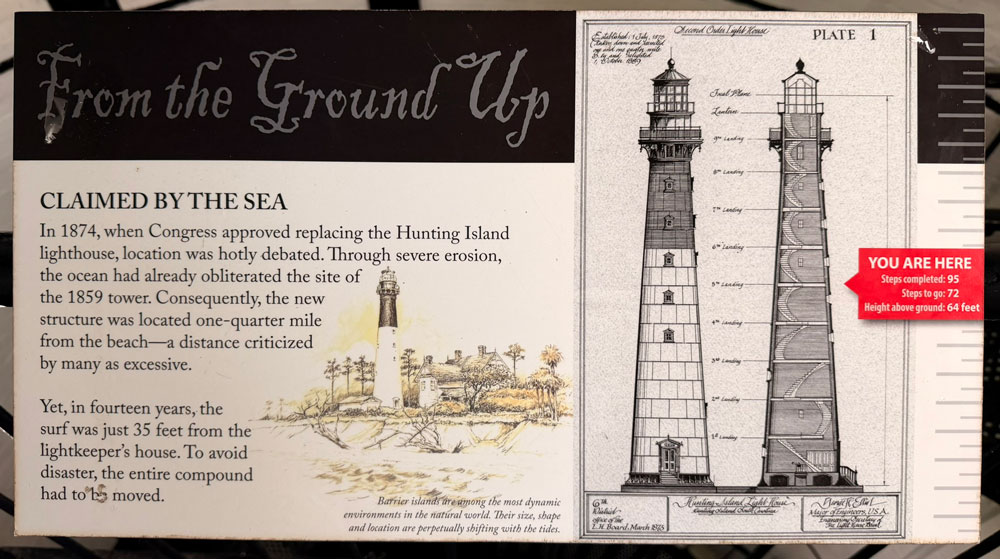
Following a recent $4.75 million restoration, Hunting Island Lighthouse reopened to the public in May 2026, once again allowing visitors to make the 167-step climb to the top. But it is what makes that climb different once you know the story. You are not simply gaining elevation. You are passing through layers of work and through a history that was itself remarkably mobile.
A keeper once climbed these stairs because something at the top required him. Oil moved upward. Tools moved upward. Men moved upward. Light moved outward. Today visitors reverse the relationship. We climb upward because the history draws us there.
Along the way up, small markers tell climbers where they are: YOU ARE HERE.
It is the sort of sign we normally ignore. Of course we are here. We are standing in front of it. But inside Hunting Island Lighthouse, those words begin to acquire another meaning.
The keeper climbed because he needed to reach the light. We climb because we want to reach the past.
Nearly a century and a half later, Hunting Island Lighthouse is still standing. Not because the shoreline stood still. It didn't. Not because history left it alone. It didn't. War destroyed its predecessor. The earth shook beneath it. Hurricanes battered the island. The Atlantic came for it. Its keepers disappeared, its working light went dark, and even the ground it once stood upon was surrendered to the sea.
Yet there it stands.
Maybe that is why the most interesting thing about Hunting Island Lighthouse is not its height, its 167 steps, or even the view waiting at the top. It is the contradiction built into its iron bones. It was constructed to stand firm, but designed to move. It was permanent because, when necessary, it was mobile.
The engineers could not command the Atlantic to stay where they put it. They could not make the shoreline permanent. So instead of demanding permanence from the world around their lighthouse, they built adaptability into the lighthouse itself.
And perhaps that is why, after everything around it moved, the lighthouse didn't disappear. It simply moved with history until history finally came looking for it.
Today, we are the ones climbing those 167 steps. And on the way up, the little red signs keep telling us:
YOU ARE HERE.
The remarkable thing about Hunting Island Lighthouse is that after nearly 150 years of war, storms, erosion, earthquakes, changing technology and a shifting shoreline ... so is it.
And after everything that tried to move it, everything that did move it, and everything that moved on without it, perhaps we can finally answer those little red signs by turning the words back toward South Carolina's remarkably mobile old lighthouse itself:
“You are STILL here.”