










The ballot gave Greenville voters names. Candidates who spoke plainly and neighbors who shared what they learned helped voters see where those candidates stood. Greenville paid attention and changed the balance of its school board.
Despite the blue Senate race, Greenville did have some major wins. On November 3, Greenville voters gave South Carolina’s largest school district its strongest conservative school board lineup in years. The voters paid attention to races near the bottom of the ballot, where a few hundred votes can change who helps decide what more than 75,000 students learn and how the district spends nearly a billion dollars a year from its general fund.
Two years ago, Greenville voters added four conservative voices to County Council by electing Kelly Long, Curt McGahhey, Frank Farmer and Garey Collins. This year, they returned Joe Dill to the council, elected fiscal conservative Daniel Rumfelt and reelected Chairman Benton Blount. Conservative Kyle Long led by 22 votes in District 28, a race flagged for a recount. The shift reached the school board, too.
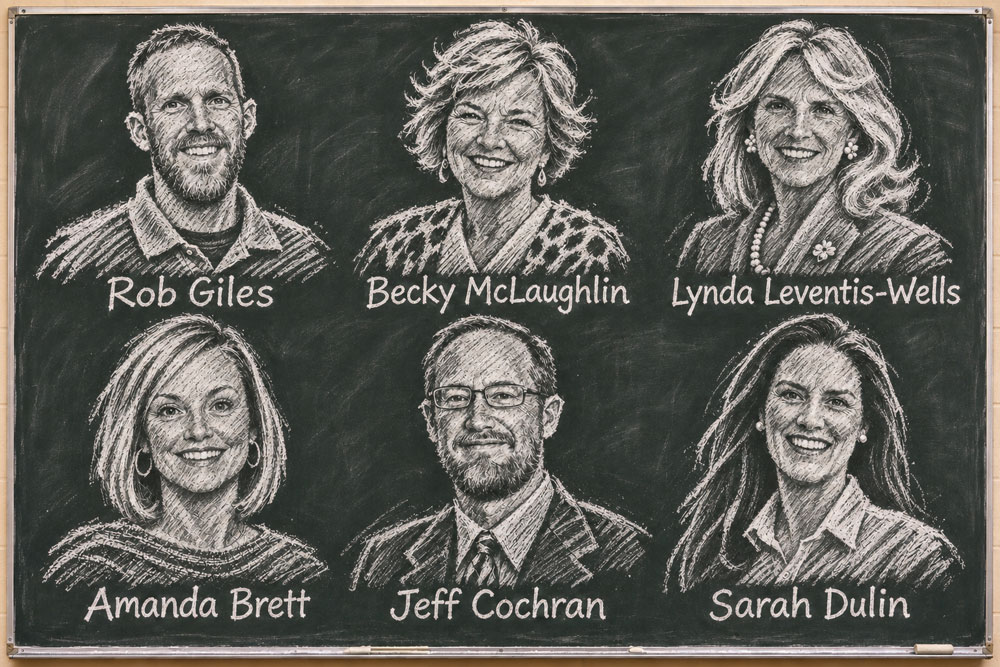
Six of the board’s 12 seats were on the ballot. In all four contested races, the candidate recommended by The Times Examiner contributor Evert Headley in “Evert’s Electables - 2026 General Election” won. Two challengers defeated sitting trustees, and two conservative incumbents held their seats against opposition. A third conservative incumbent, Jeff Cochran, won reelection without a challenger. With Sarah Dulin continuing to serve in Area 27, we count four sitting trustees who have made a conservative case through their campaigns or their votes. That number will rise to six when Rob Giles and Becky McLaughlin take office.
How Rob Giles ended a 24-year tenure
Chuck Saylors first won the Area 20 seat in 2002 and went on to serve as president of both the National PTA and the South Carolina School Boards Association. He ran on his experience, pointing to gains in teacher pay, school safety and career education. Giles, a classroom teacher with 17 years of experience, asked how much of the district’s spending was reaching teachers and students. He called for closer scrutiny of administrative costs and more emphasis on traditional math and phonics.
Giles won Area 20 with 4,836 votes to Saylors’ 4,430, a margin of 406. Bennie R. Cantrell drew 1,891 votes. The Greenville County Republican Party’s voter guide backed Saylors. In “Evert’s Electables - 2026 General Election,” Evert Headley recommended Giles, and The Times Examiner agreed.
Before the election, The Times Examiner reported that M.B. Kahn Construction received a $12.9 million contract for work at J.L. Mann High School in 2015 while Saylors was a company vice president. The district said administrators awarded the contract and that Saylors was absent when the board approved the facilities plan that included the project. The next board should make clear who makes those spending decisions and what safeguards apply when a trustee has a business connection.
In a forthcoming investigative report, The Times Examiner will examine how Greenville County Schools financed construction through its BEST program, how Institutional Resources was selected to manage the work, and what the records reveal about the school board’s oversight.
Voters chose new voices and kept proven ones
In Area 18, Becky McLaughlin unseated Ann Marie Middleton. She led 4,584 to 4,057 in Greenville County’s certified count and took about 54% in the reported districtwide tally, which includes part of Spartanburg County. Her win will bring another educator to the board. McLaughlin taught in public schools for more than 30 years and spent five years as a Christian school administrator. She campaigned on strengthening early reading and math skills and preparing students for the workplace.
Area 22 reelected Lynda Leventis-Wells with 6,849 votes to Leslie Fatum’s 5,390, a margin of 1,459, the widest of the four contested races. A former chair of the Greenville County School Board, Leventis-Wells ran in the 2022 Republican primary for state superintendent of education. This year, the South Carolina School Boards Association recognized her for 20 years of board service. She also received the Order of the Palmetto, South Carolina’s highest civilian honor, from Gov. Nikki Haley in 2012.
In Area 26, Amanda Brett held her seat by 181 votes, 3,398 to Stephanie Meek’s 3,217. A self-described conservative, Brett emphasized listening to parents and strengthening support for students with disabilities. In Area 28, Jeff Cochran ran unopposed and received 10,509 votes in Greenville County’s certified count. A retired math teacher, Cochran has called for giving parents a clearer view of what their children are taught. Anne Pressley also won unopposed in Area 24.
What changes at the board table
In June 2024, the board voted 8-4 to pass a budget that raised the operating tax rate by 1.5 mills. Sarah Dulin, who won reelection in Area 27 that fall, voted against it alongside Brett, Cochran and Leventis-Wells. Chair Carolyn Styles, Vice Chair Angie Mosley and Michelle Goodwin-Calwile joined Saylors in voting yes. The next two budgets passed unanimously without raising that rate. The latest general fund budget totals about $981.7 million.
Saylors’ departure also means the board will lose its Advocacy Committee chair. Five of the eight trustees who backed the 2024 budget will remain, along with all four who opposed it. If Giles and McLaughlin join those four in opposing a similar proposal, they would have six votes, enough to block it when all 12 trustees vote. That gives Styles and Mosley a reason to work with trustees who want tighter spending. We’ll be watching what they propose and how they and Goodwin-Calwile vote.
Candidates should tell us where they stand
That 2024 roll call is the kind of record voters can use to judge a candidate. It takes work to dig up votes like that, compare answers from candidate forums and explain what the differences could mean for the next school budget. Greenville’s parents, volunteers and local activists helped get that information to neighbors who might otherwise have seen the candidates’ names for the first time on a sample ballot.
I understand why the word partisan makes people uneasy when the subject is their children’s education. But a nonpartisan ballot makes it easier for a candidate to speak in generalities and harder for the people doing that homework to show voters what is at stake. In a county like Greenville, where conservative support matters, a candidate whose positions could cost votes has an incentive to let people assume they agree. It takes one sentence to say you stand with parents. It can take hours for a volunteer to find the votes or public statements that show what the candidate means by it.
That is why Greenville should elect its school trustees in partisan races. Putting a party’s name beside its nominee gives voters a starting point for comparing candidates and talking with their neighbors. The candidate asking for the seat should be the first to tell voters who they stand with and what principles will guide their decisions.
This past January, Reps. Stephen Frank, Mike Burns, Chris Huff and Alan Morgan introduced H. 4664 to make Greenville’s school board elections partisan. Candidates nominated through a party primary or convention would appear on the general election ballot under their party’s name. Independent candidates could qualify for the same ballot by petition and run without a party label.
H. 4664 would have changed the state law governing school board elections in Greenville County alone. The House referred it to its Greenville County delegation on January 13, the last action listed in the bill’s official history. If lawmakers bring the proposal back in the next General Assembly, it would likely be filed as a statewide bill. In 2022, Gov. Henry McMaster vetoed a similar bill for Lancaster County and urged lawmakers to address the issue statewide.
Greenville conservatives should support those sponsors and ask their state representative and senator to help bring forward a bill that removes this nonpartisan disguise from the school board ballot.
And again, thank you, Greenville, for paying attention all the way down the ballot. It’s easy to mark straight-ticket Republican at the top and think you’re done while the nonpartisan school board races sit blank at the bottom. State lawmakers can give voters more to go on by putting partisan identification on ballots, and candidates still owe us straight answers about where they stand.
The best time to find out where a candidate stands is before they take a seat.
---------------------------------
Sources
- Greenville County’s certified November 3, 2026, election results
- Reported Area 18 results for Greenville and Spartanburg counties combined
- Evert Headley, Evert’s Electables - 2026 General Election
- Greenville County Republican Party’s 2026 voter guide
- Greenville County Schools’ record of the 8-4 vote on the FY 2025 budget
- South Carolina House Bill 4664 and its legislative history
- James Spurck, School Construction Contract Raises Questions Ahead of Greenville County School Board Election
- James Spurck, Greenville County Council Ushers in a New Era of Conservative Leadership
- Greenville Local Today’s report on the County Council District 28 recount
- Greenville County Schools’ board agenda listing Lynda Leventis-Wells’ recognition for 20 years of service
- South Carolina’s official list of Order of the Palmetto recipients
- SC Election Commission guidance on straight-ticket voting
- Greenville County Schools’ FY 2027 general fund budget
- The district’s 2026-27 enrollment projection, reported by Greenville Journal
- Henry McMaster’s 2022 veto message on the Lancaster County school board bill
- Greenville County Schools’ unanimous approval of the FY 2026 general fund budget