








Escalation to Horrific Human and Economic Disasters
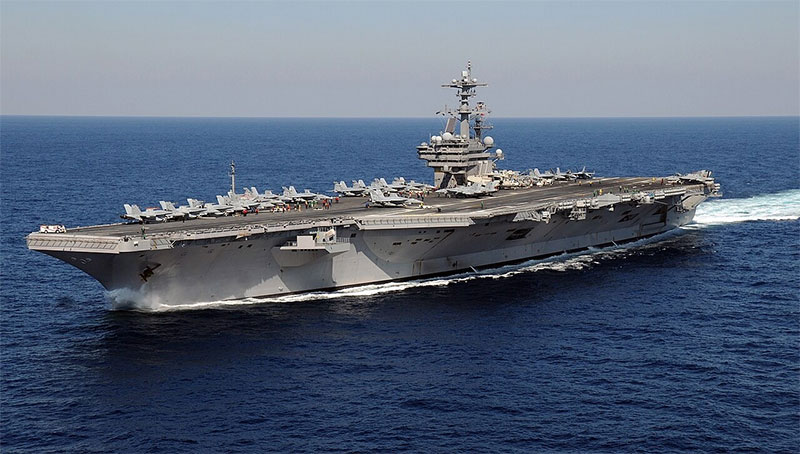
The United States now has three aircraft carriers situated in proximity to Iran. They are CVN-71, the Theodore Roosevelt (1986); CVN-73, the George Washinton (1992); and CVN-77, the George H. W. Bush (2009, $6.2 billion). These are all Nimitz Class nuclear super-carriers
The newest, the H.W. Bush, carries 90 fixed wing aircraft plus helicopters. It has a Ship’s Company of 2,552 personnel and an Air Wing of 2,480 personnel, bringing the total compliment to 6,032. It is 1,092-feet long, with two nuclear reactors and four steam turbines. Its speed is listed at 30 knots or 35 mph. Its primary attack aircraft are F/A-18 Hornets and the FC-35 Lightning II. It has an unlimited range and needs to be refueled only once every 20 years. It is also packed with the latest defensive weapons and electronic warfare systems.
The three super-carriers have a total of 270 fixed wing aircraft with naval and air compliments totaling 17,732 personnel. In addition to the three super-carriers, there are also at least two US Cruisers and 16 destroyers in the vicinity of Iran. All these US Navy combat ships and other support ships and vessels must keep a safe distance from underground Iranian ballistic and cruise missile sites in southern Iran. The aircraft carriers are presently holding 600 miles from possible Iranian ballistic missile attacks from southern Iran.
Some US estimates put Iranian ballistic missile inventory at 2,500, but this is a cautious political guess. If anything, the number is larger. Iran has both short and medium range ballistic missiles. Several medium-range Iranian missiles have a range of over 1,500 miles. They are precise and very difficult to shoot down. Some Iranian cruise missiles have ranges of over 2,500 miles, but they are slower and more vulnerable to interception. According to a Russian source, the Iranians may have more than 4,000 larger prop and turbo-prop drones. At least 80% of these are one-way attack drones, most of which are of the Shahed Class. The most numerous is the Shahed-136 with a range of over 1,500 miles. Since almost all Iranian ballistic missiles, cruise missiles, and larger drones are stored 500 to 1500 feet under granite mountains and fired from camouflaged positions beneath the surface, they are extremely difficult to destroy. Iran has at least 31 under-granite missile and drone manufacturing, maintenance, and storage fortresses. They have become expert in sub-surface drilling, excavation, and fortification. See Iran-Watch for nearly 30 types and ranges of Iranian drones.
Table of Iran's Drone Fleet | Iran Watch
The advantage of having three super-carriers within striking range of Iran is that they can bomb Iran 24-hours a day for several days. However, they are having to stay at least 600 miles from Iranian missile launching capabilities, which means they will require USAF KC-135 refueling both to their targets and returning to the carrier. Refueling is also a vulnerable time period.
The Theodore Roosevelt just took its place on station Saturday. Having three major aircraft carriers in the Iranian theater of operations is a signal that President Trump is considering a major attack on Iran within the next few days or weeks. Such a major aircraft carrier attack on Iran would certainly be accompanied by major USAF bomber and Naval submarine Tomahawk missile attacks.
Highly respected military analyst and former Trump Defense Department official. US Army Col. Douglas Macgregor (ret) currently believes Trump will launch a major attack on Iran from November 18 to 24, and that a US false flag might be used to claim that Iran provoked the attack. See this Macgregor interview by LCol Danny Davis: Dirty Nuke Bomb Unlikely in Washington, But Risk is Real | Ted Postol
Let us hope Macgregor is wrong and that Trump is merely trying to make a show of force to intimidate Iran or somehow increase his standing with donors or voters—unlikely in view of November 3 election results. However, few knowledgeable analysts believe there is any chance Iran will surrender, and there is little chance they can now be intimidated. They seem to have a major advantage in the number and accuracy offensive missiles. Also, it now appears firm that Russia and China intend to assist Iran if under severe attack. They could be joined by Pakistan, a nuclear power, if the US or Israel uses nuclear weapons.
Most people unacquainted with war believe that firepower and the raw courage of troops are what wins wars. However, it is usually logistics that wins or loses wars. Firepower and manpower have to be sustained by supply lines supported by adequate military industrial production for long periods. The United States is at a 7,000 to 9,000-mile supply line disadvantage. Nuclear aircraft carriers make a difference, but they also must be sustained by maintenance, ammunition, food, and considerable other supply needs. Many analysts also fear that both the US and Israel are low on both offensive and defensive missiles and related industrial support. This is certainly true of Israel, and its suspected that the US is dangerously low on conventional offensive missiles and defensive missiles, such as Patriot-3. According to MIT missile and nuclear expert, Ted Postol, the Patriot-3 currently has less than 5% effectiveness against Iranian ballistic missiles. The same is probably true in Ukraine, where Ukrainian air and missile defense have been rendered minimal by overwhelming Russian missile, drone, and air supremacy.
Again, Iran’s primary military targets are 500 to 1,500 feet below granite mountains. So far, bombing has not made much of a dent in them. At least, there is no certain sign of significant damage to them. Most of the targets the US can hit are surface infrastructure like oil refineries, power plants, bridges, roads, railroads, and water salinization plants. However, Iran has only low dependence on water salinization plants, and Iranian reprisal on the Gulf States would be a ruinous disaster for Saudi Arabia, the UAE, and Kuwait.
Here is an interesting statistic from Alexander Mercouris, a highly respected and widely viewed military and foreign policy analyst in London: Ukraine has managed to hit or damage 107 Russian refinery and infrastructure targets in Russia of a total of more than 6,000. This is mostly light damage to 1.8% of possible targets, many of which are not within reasonable reach. Ukrainian strikes on Russia have been a political and propaganda success in the West, especially in raising money, but the military success is minimal. The European Union recently announced a 90 billion Euro interest-free loan to Ukraine (about $100 billion US). Neither will the “loan” have to be paid back. It is simply EU budget deficit spending. Meanwhile, Ukraine is being destroyed. Five gold propaganda stars for Zelensky and the CIA!
There has been some threating talk of the US using tactical nuclear weapons to wipe out Iranian underground missile fortresses. According to studies by MIT nuclear and missile expert Dr. Ted Postol, US War games have demonstrated that the use of small tactical nuclear weapons escalates to retaliation and larger nuclear weapons within 48-72 hours. Within a week, it escalates to full nuclear war. If you think tactical nuclear weapons or even threatening their use is an acceptable idea, you need to see Postol’s latest discussion of this, including casualties and effects. He details the principal casualty and destruction factors of nuclear weapons: the extraordinary effects of light and heat temperatures greater than the surface of the sun, 200 MPH-wind blast effects, and intense and lingering radiation effects. It is criminal insanity that cannot be limited in consequence. Check this YouTube video: Theodore Postol: Striving for Nuclear Armageddon
Trump’s intelligence on Iran has been predominantly influenced by Israeli Mossad Intelligence and Israeli Prime Minister Benjamin Netanayahu. Recent elections in Israel indicate Netanyahu is probably out. This intelligence has frequently been in contrast to US intelligence agencies. Trump is also under heavy influence from American-Israeli PAC donors.
Yet a major attack on Iran may do tremendous damage to largely civilian infrastructure in Iran and could be costly in Ukrainian lives, but it is unlikely to result in anything but more intense and spreading war that is a severe threat to the US and Western European economies. It might also collapse what is left of the Republican Party. If tactical nuclear weapons are used, we are risking civilization.
“My people are destroyed by a lack of knowledge…”—Hosea 4:6
 Mike Scruggs is the author of two books: The Un-Civil War: Shattering the Historical Myths; and Lessons from the Vietnam War: Truths the Media Never Told You, and over 600 articles on military history, national security, intelligent design, genealogical genetics, immigration, current political affairs, Islam, and the Middle East.