







- Ten Toes In: Why Trump Accounts Make Sense for North Carolina's Small Businesses
- Remnant Called -
- Former Moms for Liberty Chairs in South Carolina Address Massive Departure from Organization
- Same Job. Two Résumés. Graham and Norman Make Their Case for the US Senate
- Greenville County Holding Public Meetings on 1% Transportation Sales Tax Referendum
- Beyond the Monuments - Finding the Forgotten Grave of Dicey Langston
- The Myth of Voting for the Lesser of Two Evils
- AIPAC Lobbyists Grip on Congress
- Hunting Island's Lighthouse Was Built to Outsmart the Atlantic's Shifting Shoreline
- South Carolina Gas Tax Climbs From Near Bottom Nationally to 30th in 2026
- Equipping the Persecuted: Weekend Terror Alert Helped Avert Wider Massacre as Slaughter of Christians Continues to Ravage Nigeria Unchecked by Government
- Thurmond and Murkowski Won as Write-Ins. Is This Year’s Senate Race Really the Same?
- Briefing Notes from the Ukraine and Persian Gulf Wars
- Crime Stoppers Luncheon Remembers Greenville’s Fallen While Honoring Those Who Continue to Serve
- Trump Administration Announces $167 Million to Build Rural Care Sites, Upgrade Health Technology, and Strengthen Prevention Across South Carolina
Lessons from the 1828 Tariff of Abominations
- Details
- By Mike Scruggs
- Category: Mike Scruggs' Column
Foreshadows of the Morrill Tariff
Part 5 of 8 of a Series on the Morrill Tariff
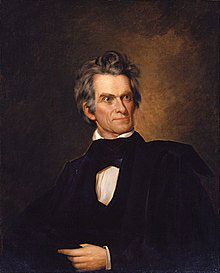
The passage of the 1828 Tariff resulted in the defeat of John Quincy Adams in the 1828 presidential election by Andrew Jackson of Tennessee, who opposed the Tariff. His Vice President, John C. Calhoun of South Carolina, had become a relentless opponent of protective tariffs, and was one of strongest advocates for States Rights in the nation. Calhoun was a brilliant intellectual, elegant speaker, and consummate political organizer. Jackson, a fellow Southerner, had similar views but was not as committed to expeditious correction of the evils perpetrated by the tariff. Understandably, Jackson believed that materials important to military defense should be protected. But he also believed that the tariff should not be reduced until the national debt was paid off. This thinking must have alarmed Calhoun, since Southern States paid most of the tariff revenues, while the Northern States received a disproportionate share of the benefits to spend on Northern “internal improvements.” This meant that the South would be called upon to pay off most of a national debt caused by over expenditures on mostly Northern internal improvements—an outrageous injustice. U.S. tariff policy debates—arguing free trade and low tariffs versus protectionism and high tariffs—thus remained heated.

Henry Clay and His American System
- Details
- By Mike Scruggs
- Category: Mike Scruggs' Column
Foreshadows of the Morrill Tariff
Part 4 of 8 of a Series on the Morrill Tariff
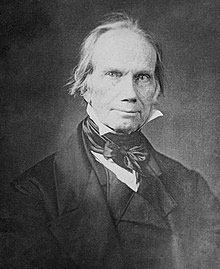
In 1816, many prominent Southerners and New Englanders felt that they would benefit enough from the nation’s overall growth from increased industrialization to compensate for their immediate disadvantage from higher tariffs. Even James Madison, Thomas Jefferson, and John C. Calhoun approved of the compromise. This compromise, however, bore the seeds of Northern addiction to protectionist tariffs. First advocated by Alexander Hamilton and his Federalist Party, high tariffs reduced foreign competition and allowed American manufacturers to raise their prices. The resulting increases in profitability (at consumer expense) raised their appetite for still more. In less than a decade, the continuous Northern cry for protectionist policies would give birth to Kentucky Representative Henry Clay’s “American System.” Clay, like Hamilton, favored protective tariffs, industrial subsidies, and a centralized national bank. These policies were later adopted by Clay’s Whig Party and then the new Republican Party in 1856. This also led to the growth of legislative logrolling (I’ll help you roll your log if you help me roll my log.). Logrolling increased legislative support for bills by expanding them to include mutual agreements beyond their central purpose. In the end, the 1816 Tariff had some legislative support in every state except North Carolina and Delaware. Of course, the moral problem with all this is that it amounts to ganging up to pass legislation that will benefit the most powerful interest groups at the expense of the overall national interest and less powerful commercial or regional interests. As a rule of thumb for the era, tariffs of 15 to 20 percent were seen as tolerable revenue tariffs, while tariffs of 20 percent or more were seen as protectionism that led to big profits for some and economic harm to others.

Abraham Lincoln and the Morrill Tariff
- Details
- By Mike Scruggs
- Category: Mike Scruggs' Column
Forty-year Background of Sectional Tariff Conflicts
Part 3 of 8 of a Series on the Morrill Tariff
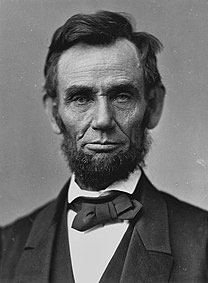
Abraham Lincoln strongly endorsed the newly passed Morrill Tariff during his inaugural speech, and though most of his speech was conciliatory on slavery, he promised to enforce collection of the tariff whether or not the Southern States remained in the Union. After promising that his objective was only to defend and maintain the Union, he added:
“In doing this there needs to be no bloodshed or violence, and there shall be none unless it is forced upon the national authority. The power confided to me will be used to hold, occupy, and possess the property and places belonging to the Government and to collect the duties and imposts; but beyond what may be necessary for these objects, there will be no invasion, no use of force against or among the people anywhere…” (Italic emphasis added.).20
In other words, there would be no Federal violence against Southern states except to collect the tariff and to secure control of the places where it might be collected, for example, Fort Sumter in Charleston Harbor. It is obvious from his inaugural speech that Lincoln’s conciliatory words on slavery contrasted with his hard line on tariffs. Raising the tariff was by far his most important objective.

The Morrill Tariff
- Details
- By Mike Scruggs
- Category: Mike Scruggs' Column
Furious National Debate over Protectionism vs. Free Trade – Part 2
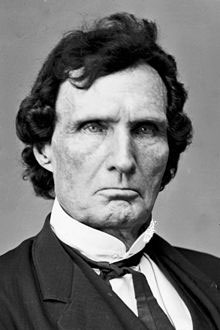
As South Carolina statesman and political philosopher John C. Calhoun frequently pointed out, any tax measure that has a disparate and damaging effect on different regional or commercial interests is inherently unconstitutional. Article I, Section 8 of the U.S. Constitution provides that:
“…all duties, imports, and excises shall be uniform throughout the United States.”
Article 5, Section 9 ordains that:
“No tax, or duty, shall be laid upon articles exported from any State. No preference shall be given, by any regulation of commerce or revenue, to the ports of one State, over those of another.”
The clearly manifest spirit of these Constitutional provisions is not that duties should be uniform in rate, but that they should be uniform in effect. The intent of these measures is to prohibit any legislation that gives preference to special commercial interests, geographic regions, states, or ports. Surely, it prohibits any tariff that damages other commercial interests or geographic regions for the benefit of another. The Confederate Constitution, recognizing the injustice and turmoil caused by much of the tariff legislation of the past 40 years, allowed for low-rate revenue tariffs but prohibited protective tariffs.

The Morrill Tariff
- Details
- By Mike Scruggs
- Category: Mike Scruggs' Column
Provocation to Southern Secession and Northern War – Part 1
Most Americans now believe that the U.S. “Civil War” was just about slavery. They have to an enormous degree been miseducated. Since the early 1960s, powerful academic and political interests have been straining every nerve to sustain the myth that the war was a glorious moral crusade against slavery. How to manage the multi-faceted problem of slavery was often a divisive issue but not in the overly-simplified moral sense that lives in postwar and modern propaganda. But had there been no Morrill Tariff in 1861, the major cotton-exporting states would not have been so strongly compelled to secede, and there might never have been a war. The conflict that cost the lives of over 750,000 Union and Confederate soldiers and at least 50,000 Southern civilians and impoverished many millions for generations might never have been.1
Before the Morrill Tariff, there had been nearly 40 years of political tariff wars between Northern industrial Whig/Republicans favoring high-tariff protectionism and Southern agricultural low-tariff free-trade advocates. The sharply increased rates and sectional bias of the 1824 Tariff benefited the North at Southern expense and was the first tariff to create substantial Southern distrust of Northern political dominance.

 Mike Scruggs is the author of two books: The Un-Civil War: Shattering the Historical Myths; and Lessons from the Vietnam War: Truths the Media Never Told You, and over 600 articles on military history, national security, intelligent design, genealogical genetics, immigration, current political affairs, Islam, and the Middle East.
He holds a BS degree from the University of Georgia and an MBA from Stanford University. A former USAF intelligence officer and Air Commando, he is a decorated combat veteran of the Vietnam War, and holds the Distinguished Flying Cross, Purple Heart, and Air Medal. He is a retired First Vice President for a major national financial services firm and former Chairman of the Board of a classical Christian school.
Click the website below to order books. http://www.universalmediainc.org/books.htm.
Browse by the Top Tags ...