










A green leaf, a handful of dust and a four-letter code tell a story the Bible told first.
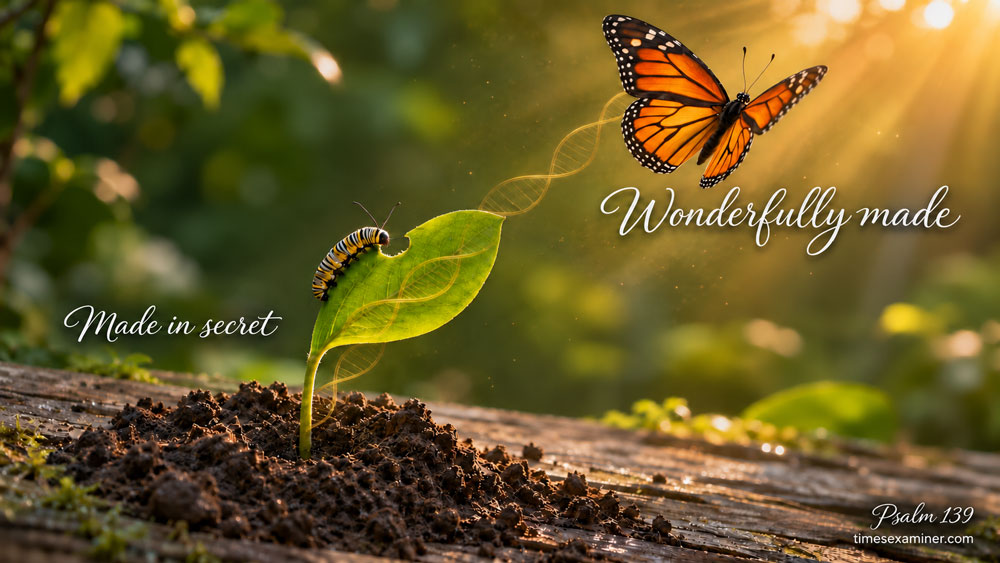
A nature documentary can preach a sermon without saying a word. The camera follows a caterpillar as it chews through leaf after leaf, with nothing but green going in. Weeks later, out of a dull brown chrysalis, comes a butterfly painted in orange, black, gold and blue.
Where did the green go? And where did all that color come from?
The green never became anything. The caterpillar digests the leaf completely, chlorophyll and all, breaking it down into basic building blocks such as amino acids and sugars. Inside the chrysalis, much of its body dissolves into a cellular soup. Small clusters of cells, carried since the day it hatched, then use those same raw materials to build wings, legs and eyes.
The colors are made new. Melanin produces the blacks and browns. Ommochromes, built from the amino acid tryptophan, produce many of the reds and oranges. Pterins produce many of the yellows and whites. The shimmering blue of the Morpho butterfly is not a pigment at all. It comes from microscopic ridges on each wing scale, spaced so precisely that they reflect only blue light. Grind that wing to powder and the blue vanishes into dull brown.
Formed From the Dust
Follow the trail back one more step. The leaf itself was built by a plant that drew water, nitrogen, phosphorus, potassium, calcium and trace minerals up out of the soil, then joined them with carbon pulled from the air. The butterfly is reworked ground, passed through a plant and then a caterpillar.
The same is true of the one watching the documentary. Nearly every element in the human body, from the carbon in its cells to the calcium in its bones and the iron in its blood, is found in ordinary dirt.
Scripture said so long before any laboratory did. "And the LORD God formed man of the dust of the ground, and breathed into his nostrils the breath of life; and man became a living soul" (Genesis 2:7). The Hebrew carries a wordplay lost in English: the word for man, adam, echoes adamah, the word for ground. The first man is, in a sense, named "earthling," the one taken from the soil. After the fall, the sentence closes the circle: "for dust thou art, and unto dust shalt thou return" (Genesis 3:19).
The rest of creation shares the same origin. "Let the earth bring forth grass" (Genesis 1:11). "Let the earth bring forth the living creature after his kind" (Genesis 1:24). Only a few dozen elements make up every living thing, yet from them come a cedar tree, a human eye and a butterfly's wing. The material is humble. The wonder lies in how it is arranged.
Written in a Book
Dust supplies the material, but material alone builds nothing. Another player in this creative drama is DNA, the natural programming language that instructs the cells of these few materials and produces such a diverse creation.
We are told that it’s alphabet has only four letters: A, T, C and G. The cell reads them in three-letter words called codons. Each codon calls for one of about 20 amino acids, or signals the cell to stop. Strung together, those amino acids become the proteins that build a wing scale, a leaf or a beating heart. Nearly every living thing runs on this same code. Four characters, and the output is all of life.
The Bible never names DNA in particular, and no honest reading should force a modern lab term into ancient scripture. Yet one psalm comes remarkably close to describing a body assembled from a written plan:
"My substance was not hid from thee, when I was made in secret, and curiously wrought in the lowest parts of the earth. Thine eyes did see my substance, yet being unperfect; and in thy book all my members were written, which in continuance were fashioned, when as yet there was none of them." (Psalm 139:15–16)
Every member written in a book before any of them existed, then fashioned over time. "Curiously wrought" carries the sense of something skillfully woven or embroidered at the cellular level. And it was wrought "in the lowest parts of the earth," an echo of the dust from which the first man was formed.
Other passages point the same way. Job marveled, "Thou hast clothed me with skin and flesh, and hast fenced me with bones and sinews" (Job 10:11). Genesis repeats that every plant and creature reproduces "after his kind," a description of faithful inheritance passed from parent to offspring. And Paul observed that "all flesh is not the same flesh: but there is one kind of flesh of men, another flesh of beasts, another of fishes, and another of birds" (1 Corinthians 15:39). Same coding program, DNA, but endless variety.
The Second Version, Waiting to Run
The caterpillar holds one final surprise. It and the butterfly carry exactly the same DNA. Not one letter of the code changes inside the chrysalis. What changes is which parts of the code are executed.
Genes that lay dormant through the caterpillar's whole crawling life switch on and begin building wings, scales and pigments. The instructions for chewing leaves shut off. Same source code, two completely different creatures, and the second version was written in from the beginning, waiting to run.
Christians have long seen the butterfly as a picture of resurrection, and the biology only deepens the image. Paul described the body this way: "It is sown in corruption; it is raised in incorruption... It is sown a natural body; it is raised a spiritual body" (1 Corinthians 15:42–44). The glory to come is not an afterthought. It was in the Maker's plan before the first leaf was eaten.
Dust, a written code and a Designer who knew every member before any existed: that is the story told by a caterpillar on a green leaf. The psalmist summed it up best. "I will praise thee; for I am fearfully and wonderfully made: marvellous are thy works" (Psalm 139:14).