











A Thanksgiving Reflection for an American Society Growing Restless with Its Foundations
Picture an ordinary evening. The television is playing. Your phone is charging on the counter. The refrigerator hums in the kitchen. You scroll past one more argument and wonder whether there is anything worth watching.
Then the power goes out.
Suddenly, the refrigerator matters. So does the furnace. You check the phone battery and start figuring how long the milk will keep. Things that couldn't hold your attention five minutes ago are now the only things you can think about.
Nothing about their value changed. Your awareness did.
Could the same thing happen to a country? Could a people grow so accustomed to freedom, stability and inherited moral standards that they stop noticing what those things provide; until the lights flicker?
Perhaps part of America's trouble is the boredom of being blessed.
Thanksgiving holds up a mirror. We can spend all morning getting dinner on the table and give God about thirty seconds once it gets there. By the time the plates are cleared, we may already be talking about what to buy on Friday. If we can hurry past our blessings on the one day set aside to count them, how often do we do it the rest of the year?
That Friday shopping list is a good place to start, because the trouble usually begins with wanting something new.
When Different Starts Looking Like Better
Most parents have met the toy that was supposed to change everything. For nearly a year, the child points it out on every trip to the store. It appears on the Christmas list, comes up at supper and somehow finds its way into conversations about completely unrelated things.
Finally, the parent gives in. Christmas morning brings squeals of delight. The parent watches and thinks, "Well, that ought to keep you entertained for a good long while." By New Year's, the toy is under the bed.
The child is back at the store, pleading for something else with exactly the same urgency. Apparently, a year of asking has purchased about a week of satisfaction.
We laugh because we recognize it. The uncomfortable question is how much of that child still lives in us. The toy still does everything it promised. What disappeared was the thrill of getting it. And getting something new is always easier than learning to appreciate something familiar.
Adults carry that same appetite into far weightier decisions. We scroll past a hundred things looking for the next one, then wonder why nothing holds our attention. What happens when we start judging a marriage, a faith or a country by how recently it excited us?
A faithful spouse can start looking predictable, no matter how great or good-looking they are. Just ask the rich and famous. An honest job can seem unimpressive. A moral boundary can feel restrictive simply because it has always been there.
C. S. Lewis saw this temptation clearly. In Letter XXV of The Screwtape Letters, his fictional senior devil, Screwtape, coaches a junior tempter to exploit humanity's "horror of the Same Old Thing." Screwtape counts it among hell's most useful tools, a steady source of heresy in religion, folly in counsel, infidelity in marriage and inconstancy in friendship.
Lewis was exposing a temptation through satire. His point was that the ordinary enjoyment of change can be twisted into an appetite so insatiable that familiar good things can no longer satisfy it. Notice how closely his list matches ours: a faith, a marriage, the counsel that guides a nation.
Think about Christmas. We welcome the same songs, the familiar food and the people we love. Their familiarity is part of their value. Yet in public life, calling something "old-fashioned" is often treated as though it settles the argument.
Old does not automatically mean wise. New does not automatically mean better. Both deserve examination.
Scripture shows how far this appetite can carry us. In Numbers 11, Israel grew tired of the manna God sent every morning and began to reminisce: "We remember the fish, which we did eat in Egypt freely" (Numbers 11:5). Freely. They had been slaves in Egypt. Yet what they remembered was the menu, not the chains. The bread from heaven had become the Same Old Thing.
That is what happens when we measure only what we lack. I've long appreciated a saying that takes the old half-full, half-empty question one step further:
"A man with a glass that is half empty should always be thankful that it is half full. Yet, it doesn't matter if the glass is half empty or half full. Be grateful that you have a glass, and there is something in it."
We can become so absorbed in measuring what is missing that we stop noticing what remains. Gratitude leaves room to improve our circumstances. It simply asks us to recognize what we already have before dismissing it as inadequate.
Strangely enough, the Bible's first lesson on that subject comes from a man who had nearly everything.
A Garden Full of Blessings and One Empty Place
Long before a child abandoned a Christmas toy, there was a man standing in a garden full of blessings who still lacked something profoundly important.
I believe there is a reason God arranged the events in Genesis 2:18–25 in the order He did.
First, God points out what Adam lacks. "It is not good that the man should be alone," He says. Then He makes a promise: "I will make him an help meet for him" (Genesis 2:18).
What happens next has always caught my attention. God brings the animals to Adam to see what he will call them. As Adam gives them names, I can picture him noticing that every creature around him had a companion of its own kind. Who was there like him?
Then comes that little word but. After telling us that Adam named the animals, verse 20 brings us right back to where God began: "But for Adam there was not found an help meet for him."
God had already said that Adam was alone. I believe the time spent naming the animals gave Adam a chance to see for himself what God had seen from the beginning. He could name every creature God brought before him, and still there was no one beside him to turn to and say, "Well, what do you think?"
Then God created Eve and brought her to Adam.
Listen to how Adam begins: "This is now bone of my bones, and flesh of my flesh" (Genesis 2:23, KJV). That word now stands out to me. There had been no one like him in all the garden. Now there was someone with whom he could share his life.
I believe God gave Adam time to feel the absence so he could better appreciate the gift. We usually learn that lesson in reverse. Like the child with the toy, we receive the blessing, grow accustomed to it and discover what it meant only when it is gone — the same way we discover the refrigerator when the power fails.
Think about the person sitting across the table from you this Thursday. The familiar voice. The little habits. The story you have heard often enough to finish yourself.
Now imagine the chair empty and the house quiet. How much would you give to hear that story one more time?
We should not need an empty chair to teach us the value of the person who still sits in it.
Most of us know that. The trouble is that the days have a way of crowding it out.
The Clock and the Compass
You can go from one thing to the next on a schedule all day and still go to bed bored. A full calendar can keep you occupied for hours while leaving you wondering what any of it amounted to. And when the day feels that way, the promise of something new can be enough to get your attention.
Acts 17:21 describes the Athenians as people who spent their time in nothing else "but either to tell, or to hear some new thing." It is the same horror of the Same Old Thing that Screwtape prized, nearly two thousand years earlier. We should think of that verse when we reach for our phone again, already bored with whatever held our attention a minute ago. There's an old saying that an idle mind is the devil's workshop. But maybe the devil doesn't need an idle mind. A crowded one makes just as good a workshop.
That restlessness can follow us right through the church door. Think of someone who joins the choir, excited to learn the music and help with the Christmas program. A year later, the same rehearsal comes up on the calendar, and his first thought is how much time of the evening it will take.
Or consider the Sunday school teacher who once prayed eagerly over a lesson and now watches the clock while preparing it. The children still need teaching. The opportunity still matters. But somewhere along the way, a privilege has begun to feel like an interruption.
"I get to serve" has quietly become "I have to go." It's the Christmas toy all over again, only this time it's sitting in the choir loft.
Sometimes we're simply tired and need someone to share the work. Sometimes what has worn thin is our affection for the work itself. Christ commended the Ephesian church for its works, labour and patience, yet told them, "thou hast left thy first love" (Revelation 2:2–4). They were still busy and doing the work. Christ called them to remember what had once made that work dear to them.
That brings me back to a saying I've used before: "The grass isn’t greener on the other side of the fence. It’s greener where you water it." Before we decide another church, another ministry or another political cause will restore our enthusiasm, we ought to ask what we have stopped tending where we are. When did we last pray for the people we serve, learn their names or stop long enough to see who was helped by the work that has become a daily routine to us?
Galatians 6:9 urges us not to be "weary in well doing." Sometimes the desire to keep going returns when we remember who depends on us. That's as true around the family table and down the street as it is in the church.
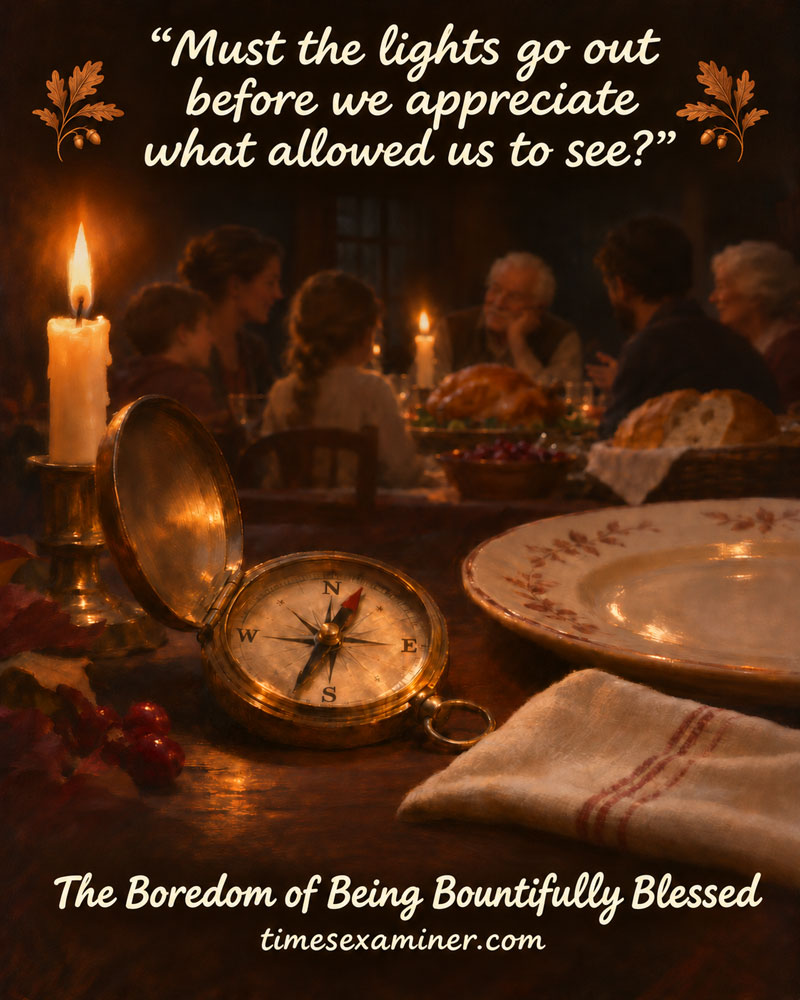
Picture an ordinary battery clock ticking on the wall. Take it down, turn it over and pull out the battery. The clock has become useless and no longer reliable.
Now pick up a compass. There's no battery to pull out. Turn it any direction, and the needle naturally swings back to north. It still works, because it never depended on its own power. It points to something fixed.
That is the difference between staying busy and staying on course. A clock can only measure how busy we've been. A compass shows where we're headed. One keeps track of what we're doing. The other reminds us why we're doing it. When our priorities drift, more energy won't fix it. We need to find north again.
When the ticking stops, do we still know where we're going?
That question isn't only for choir members and Sunday school teachers. A whole nation has to answer it, too.
When a Country Loses Its Compass
A country can lose its sense of direction the same way a choir member does. The work that once felt like a privilege begins to feel like an obligation. We get used to the freedom to speak, worship and vote. Like the toy under the bed, the people and principles that helped preserve those freedoms start to look old-fashioned. And when someone comes along promising to shake things up, the prospect of a little excitement can be enough to send us to the polls just to cure our boredom.
There are people who know exactly how to exploit that kind of restlessness, and they have not been shy about writing down how it is done. Saul Alinsky's Rules for Radicals remains a handbook for activists who want to tear down what generations built, and it states the strategy plainly: "The first step in community organization is community disorganization." Alinsky also instructed organizers to "stir up dissatisfaction and discontent." That is not a cure for a nation's boredom. It is a plan to profit from it.
Some grievances deserve our attention. A neighbor who asks the school board to fix a problem can usually tell you what a fix would look like. But when an organizer can tell you exactly whom to blame and never what would count as putting things right, it's worth asking what he gains by keeping you angry.
That's where the boredom of being blessed leaves a country vulnerable. Once we forget why our freedoms and institutions are worth tending, someone else can hand us a cause, an enemy and somewhere to be on Saturday. There's a certain excitement in tearing something down, especially when you've forgotten what it was built to protect. It's a little like throwing the main breaker because you've forgotten what the refrigerator was keeping cold.
It would be comfortable to stop there and point across the aisle. But the boredom of being blessed doesn't check party registration.
Why Do We Wait Until We Lose?
Most often, Conservatives fall into the same complacency. When elections go our way, it's easy to assume somebody else will keep an eye on the school board, show up at the county meeting or remind the neighbors that there's a primary on Tuesday.
Then an election goes south, and suddenly people who could barely find time to vote are asking when the next meeting is. Often, they are also the first to complain about how things turned out, as though the outcome had nothing to do with the meetings or the election they skipped.
That's the power outage again. We notice what we had only after it's gone.
I believe God can use a disappointment like that to wake us up. An election loss can make us take a hard look at responsibilities we set aside while things were going well. The test comes when we start winning again. Will we still show up when the urgency has passed?
Moses warned Israel about that very danger. He pictured a people who had eaten well, built good houses and watched their possessions multiply. That, he said, was exactly when to remember: "When thou hast eaten and art full, then thou shalt bless the LORD thy God" (Deuteronomy 8:10). And in the very next breath came the warning: "Beware that thou forget not the LORD thy God" (Deuteronomy 8:11).
Notice when the danger comes. Not in the wilderness, when the manna was new, but at the full table. It's easy to remember what's at stake the morning after a defeat. Can we remember it on an ordinary Tuesday when things are going well and the polls are open?
Before the Lights Go Out
Go back over every story in this column, and you'll find the same thing. The child's toy still worked. The manna still fell every morning. Adam's garden was still good. The Ephesian church was still busy. The freedoms we inherited still stand. In every case, the blessing didn't fade. Our attention did.
That's why Thanksgiving matters more than the turkey. It's one day a year set aside to turn the compass over in our hands and let the needle find north again.
So this Thursday, when you bow your head, give God more than thirty seconds. Thank Him for something so familiar you seldom mention it. Then look across the table. If there's someone you've been meaning to thank, tell them while they're still there to hear it.
The refrigerator was serving us before the outage. The lights were valuable before the room went dark.
We can recognize our blessings while they are still here.
Must the lights go out before we appreciate what allowed us to see?