








The debate over whether humans should be categorized as 'apes' involves more than just biological classification. It sits at the intersection of taxonomics, linguistics, philosophy, and worldview framing. The following overview outlines the scientific rationale behind the classification, the primary arguments against it, and an analysis of how the terminology is used rhetorically in broader cultural discussions.
You will often hear the phrase 'humans are just apes' tossed around in scientific discussions, but the claim actually carries a lot of nuance depending on who you ask. Here is a breakdown of the technical arguments for the claim, the objections raised against it, and a look at why the phrasing itself holds such strong rhetorical weight in public debates.
The assertion that 'Humans are Apes' is often presented as a straightforward scientific fact, but it functions simultaneously as a semantic choice and a powerful narrative tool. Here is a detailed breakdown examining the scientific basis for the claim, the scientific and worldview arguments against it, and the strategic propaganda value the phrase holds in debates over origins.
I. Reasons for the Claim That Humans Are Apes
Proponents rely on modern biological, taxonomic, and genetic evidence to justify the claim. For example, they will point to genetic and other similarities. They have done this for over 100 years, claiming that we evolved from apes. However, they have changed the language, going from claiming that we evolved from apes to actually claiming that we are apes.
This is a change that has way more propaganda value than it does scientific value. When you examine such claims closely such a designation does not really add up. Even assuming that we actually evolved from apes and have any common ancestors with chimpanzees. We have a lot of distinctions to make calling humans apes Scientifically ridiculous, while still being great propaganda.
1. Cladistics and Monophyly
Modern biological classification (cladistics) groups organisms based on the idea of shared ancestry. The superfamily Hominoidae (hominoids) encompasses humans and all great and lesser apes. Because humans are thought to share a common ancestor with chimpanzees, gorillas, and orangutans, cladistically excluding humans from the "ape" clade makes "ape" a paraphyletic group (a group that leaves out one of its descendant branches). To keep the group taxonomically valid (monophyletic), humans are included.
This is 100% based on the presupposition of common descent. In other words, there's no evidence, no objective basis but is based on the presupposition of common ancestry. We are now basing the classification of organisms on the presupposition of universal common descent. Furthermore, when you take away the lines that are drawn based upon the presupposition of common descent and alleged ancestors, they have no real evidence for it, you just get different organisms consistent with monkeys, apes and humans.
In fact, when you completely remove even your evolutionary order. You basically get three groups: monkeys, apes, and humans. In other words, this claim boils down to: evolutionists control the official classification system; therefore, they are perfectly happy to use it as propaganda.
2. Genetic Similarity:
The claim is commonly made that humans share roughly 99% of their DNA sequence with chimpanzees and bonobos, including shared “pseudogenes,” “endogenous retroviruses," and specific chromosomal alignments such as human chromosome 2, which matches a fusion of two ape chromosomes found in other primates. The actual figure, percentage-wise, is 98.8% with chimpanzees, 98.4% with gorillas, and 96.8% with orangutans, based on straightforward substitutions in easily aligned regions.
Pseudogenes are segments of DNA that are structurally similar to functional genes but appear to lack the ability to produce a functional protein. Historically referred to as "molecular fossils" or "junk DNA." While classical evolutionary biology viewed pseudogenes as neutral, decaying evolutionary leftovers, recent discoveries in functional genomics (such as the ENCODE project) have revealed that many pseudogenes are transcribed into RNA. Some act as microRNA decoys, regulate the expression of their associated genes, or produce short regulatory peptides. However, a significant portion are still considered by mainstream geneticists to be non-functional remnants of evolutionary history.
Endogenous retroviruses (ERVs) are genomic sequences that resemble viral infections that are thought to have integrated into the germline of host organisms (sperm or egg cells) and were subsequently inherited across generations. They now make up roughly 8% of the human genome. In mainstream evolutionary biology, shared ERVs found at the exact same chromosomal loci in different species are considered one of the strongest lines of evidence for common descent. For instance, if humans and chimpanzees share identical ERV insertions at specific locations, standard evolutionary theory concludes they inherited them from a shared ancestor that was infected by the virus before lineage divergence.
The human chromosome 2 fusion theory is a major pillar of evolutionary genetics used to explain a key chromosomal difference between humans and great apes. While humans have 23 pairs of chromosomes (46 total), all extant great apes (chimpanzees, bonobos, gorillas, and orangutans) have 24 pairs (48 total). To resolve this discrepancy under common descent, evolutionary biologists proposed that human chromosome 2 was formed by the head-to-head fusion of two separate ancestral chromosomes that still exist as separate entities in modern apes, corresponding to chimpanzee chromosomes 12 and 13. It needs to be noted, however, that this is an evolutionary necessity, and those doing the research were desperate to claim something as the fusion point.
Telomeres are the protective caps at the ends of normal chromosomes, characterized by repeated DNA sequences (TTAGGG). In the middle of human chromosome 2, researchers discovered a region containing multiple inverted repeats of these telomeric sequences; they claim it points to an ancient fusion site.
Chromosomes require a centromere for proper cell division. While human chromosome 2 has a functional primary centromere, a second, a claimed vestigial, inactive centromere sequence corresponding to the centromere of the second ancestral ape chromosome has been identified on the long arm.
It is claimed that if you align the genes of human chromosome 2, the upper half matches one ape chromosome, and the lower half matches another, demonstrating strict conservation of gene order (synteny) outside of the fusion point.
Most people who quote the 98.8% figure have never actually read the paper from which it comes. They assume that they come from simply aligning the two genomes side by side. But this is not the case; this figure only includes direct substitutions, but they do not include indels. Indels are segments of DNA that are present in one genome but not the other. When these are taken into consideration, human-chimpanzee similarity immediately drops to 95.5%, with a gorilla it becomes 94.5%, and just 92% for an orangutan. But it gets even worse, because even though these figures include significant portions, they do not include segments that could not be aligned.
When these unalignable sections are taken into consideration, the drop is huge. The similarity between humans and chimpanzees drops to only 86%, between humans and gorillas it drops to 85%, and humans and orangutans drop to 81%. You very seldom see these figures in places pushing universal common descent because after all 99% has much better propaganda value
From a Biblical creationist and intelligent design framework, pseudogenes are interpreted through a different lens regarding origins, function, and genome history. The label of "pseudogene" is based on the evolutionary assumption that large portions of the genome are useless junk. Research has increasingly shown that many transcribed pseudogenes play vital regulatory roles in the cell. Creationists predict that as genomic research advances, more of these sequences will be found to have specific, integrated biological functions. These functional genetic elements are evidence of a common designer, with the Creator utilizing efficient, molecular genomic building blocks and regulatory networks across similar biological kinds. Genomes were created perfectly and have experienced degradation due to the accumulation of uncorrected mutations since the Fall. Some sequences may have lost their original function by degrading over time; they originated as purposeful designs rather than random evolutionary experiments.
The primary presupposition in the evolutionary model is that the insertion of viruses has always been random. They may be random today, but if God had created them for a purpose, they would have tended to target specific places in a genome, making the odds of finding them in the same section of DNA more likely. However, because these genetic elements have demonstrated some very important functions, the evidence supports them having been created as part of the original genomes. Furthermore, due to mutation accumulation, some of these elements may have gone rogue, explaining the origin of viruses, something that evolutionists have a hard time really explaining because all viruses require a host. So, these so-called ERV labels are based on evolutionary presuppositions, but they were designed for specific purposes, and they were placed in genomes where needed to perform their function. Sometimes, due to genetic deterioration, they may have become rogue viruses. This easily explains the origins of viruses.
The case for chromosome 2 fusion Is nowhere near as strong as it is made out to be. First, it needs to be noted that even if a chromosome 2 fusion were proven correct, they do not prove common descent. It would just mean that a chromosome fusion event occurred somewhere in the past of humans, possibly in the fall. As a result, creationists can be objective about it. Evolutionists, on the other hand, desperately need it for universal common descent to even have a chance. One of the major problems right off the bat with this idea is that the chimpanzee chromosomes 12 and 13, when combined, are significantly longer than the human chromosome 2. Also, they don't look anything like human chromosome 2.
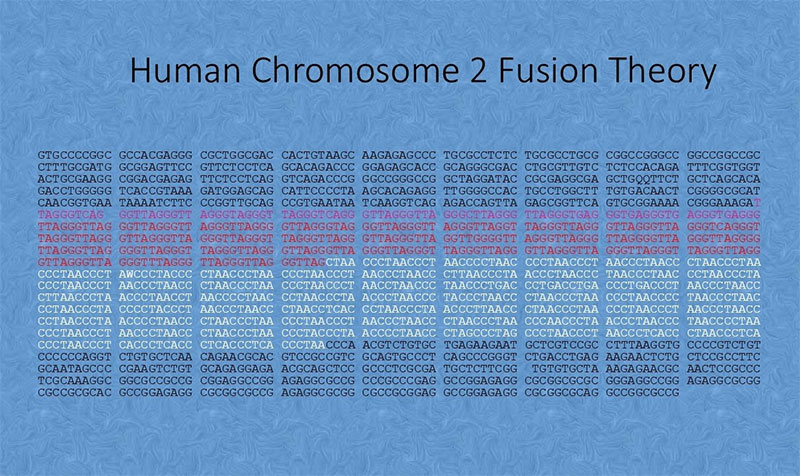
If the so-called fusion site were real, we should expect to see a nice, neat repeating pattern, reversing at exactly the point of fusion. Now it needs to be noted that TTAGGG repeating patterns are not uncommon throughout genomes because they serve multiple purposes. However, the real pattern doesn't look anywhere near this good.
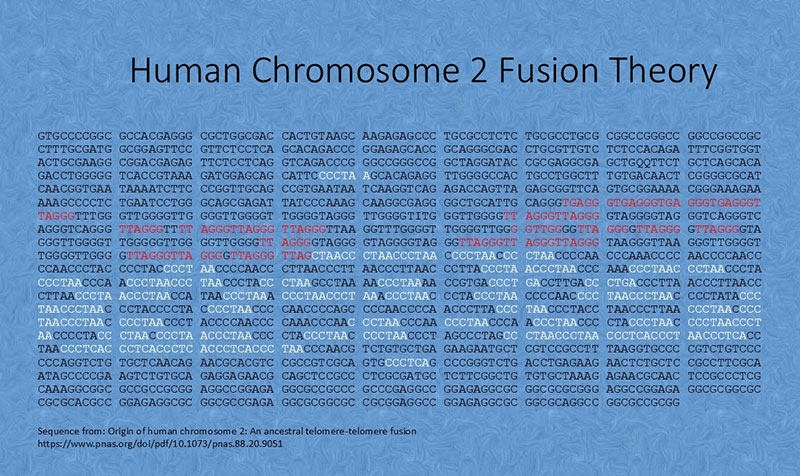
In reality, you have a jumbled mess; while it contains fragments, it is nowhere near what would be expected if it were an actual fusion site. However, it is close enough that it is exactly what someone desperately looking for a fusion site might jump to coming across it in a search.
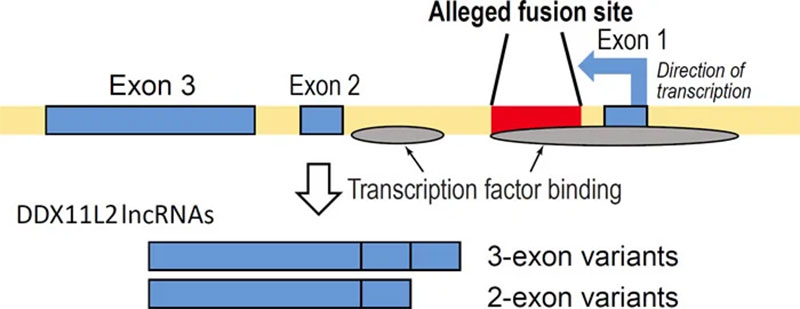
Making matters even worse, the alleged fusion site is located within one of the transcription binding factors of the functional DDX11L2IncRNAs pseudogene, with different Exons of the gene on both sides of the site.
The putative second centromere region does not display the structural hallmarks of a true functional or defunct centromere. Instead, the sequence data show high levels of complexity and functional DNA motifs that contradict the idea of a simple, accidental chromosome collision and degradation.
The claim that human chromosome 2 contains a "fossil" centromere faces major structural and functional contradictions. Structurally, the region is far too small: at just 33,080 base pairs of alphoid repeats, it is a fraction of the 250,000 to 5,000,000 bases typical of normal human centromeres. Functionally, the sequence lies inside the ANKRD30BL gene, spanning both introns and protein-coding exons. The resulting protein is involved in connecting the cell's cytoskeleton to membrane receptors. Because this sequence plays an active, vital role in protein coding, it cannot be classified as a degraded, defunct centromere.
Creationist genetic analyses have shown that when the entire regions of human chromosome 2 and the corresponding chimpanzee chromosomes are aligned using unbiased, comprehensive methods, the sequence homology and structural alignment are much poorer than popularly claimed. This suggests that forcing an evolutionary narrative onto these regions ignores distinct design boundaries between human and animal genomes.
3. Anatomical and Physiological Homologies:
Humans and Apes share core anatomical features that distinguish them from monkeys, including the lack of an external tail, a highly mobile shoulder joint suited for brachiation, broad chests, similar dental formulas, and large brain-to-body mass ratios.
However, while it is true that similarities do exist, there are also significant differences; they are certainly ignored in such discussions. While there are similarities in each of these items, there are also significant differences. The easiest one to see involves the skeleton. The way such comparisons are often made has both the human and the chimp skeleton standing up in a bipedal fashion. This makes the chimpanzee seem to be just a small human being with long arms. However, this does not represent reality.
The reality is that chimpanzees are quadrupedal, and when seen from this perspective, much of the similarity goes away, particularly in the skeleton. The difference in the pelvis is more obvious, along with other ways humans differ from apes, particularly chimpanzees.
4. Biochemical and Immunological Parallels:
Despite their phenotypic differences, humans and apes share profound biochemical and immunological similarities claimed to be rooted in their common evolutionary heritage. At the molecular level, humans and chimpanzees exhibit virtually identical functional proteins, such as hemoglobin, cytochrome c, and serum albumin, that reliably cross-react in standard clinical diagnostic assays. Immunologically, both groups share an identical structural organization of the Major Histocompatibility Complex, complete with conserved trans-species allele lineages, as well as an identical complement of Toll-like receptors driving inflammatory signaling cascades. Furthermore, humans and great apes share distinct biochemical loss-of-function traits that set them apart from most other mammals, including parallel pseudogenization events in the GULO gene, eliminating endogenous Vitamin C synthesis, and in the UOX gene, which inactivates urate oxidase and results in characteristically high levels of systemic uric acid functioning as a primary endogenous antioxidant.
However, humans and apes exhibit critical biochemical and immunological differences that significantly alter cellular physiology and disease susceptibility. The most notable qualitative distinction is the human-specific pseudogenization of the CMAH gene, which prevents the conversion of N-acetylneuraminic acid (Neu5Ac) into N-glycolylneuraminic acid (Neu5Gc); as a result, human cells produce present Neu5Ac instead of the Neu5Gc found in great apes, directly driving distinct parasite tropisms, such as human susceptibility to Plasmodium falciparum versus ape susceptibility to Plasmodium reichenowi, and triggering xeno-antibody responses in humans when Neu5Gc is ingested. Immunologically, humans display unique alterations in Siglec receptor expression—including the expression of Siglec-11 on brain microglia and maintain higher baseline T-cell activation dynamics, rendering humans more susceptible to severe hyper-inflammatory states and rapid disease progression in lentiviral infections like HIV-1, whereas chimpanzees infected with SIVcpz typically avoid chronic immunopathology through immune dampening mechanisms. So, there are significant differences between humans and apes. You can always find similarities, particularly when you are looking for them; however, it is the differences that really make the difference between different kinds of organisms’
II. Arguments Against the Claim That Humans Are Apes
Critics of the claim that humans are apes span more than creation scientists, but linguists and certain evolutionary anthropologists also raise distinct objections. The point is this is more than just a creation versus evolution argument, but it deals with whether this is a proper use of words even from an evolutionary perspective. Just because you have an ancestor that falls into a particular category doesn't mean that you fall into that category as well. I'm a 12th-generation descendant of John and Percilla Alden, who were at the first Thanksgiving at the Plymouth Colony in Massachusetts; however, that does not make me a Plymouth Pilgrim.
1. Linguistic and Colloquial Precision
"Ape" is a common English word, not a formal Latin taxonomic term. Historically and colloquially, "ape" refers specifically to non-human hominoids such as gorillas, chimps, orangutans, and gibbons. Using an everyday word as a strict phylogenetic label causes unnecessary confusion. Of course, causing such confusion is understandable if the intention is propaganda rather than science. The only real reason for using such common terms is to cement the idea of such a relationship in the mind of the listener, rather than making an actual scientific case. In several respects, linguistic and colloquial precision shows that calling humans “apes” is not accurate in ordinary usage. The only real reason to do so is the deliberate intent to cement the idea in the listener’s mind without them thinking about it.
2. Qualitative and Categorical Differences:
Humans possess unique attributes. Humans have true habitual bipedalism, while apes sometimes clumsily walk bipedally; apes are normally knuckle-walking quadrupeds. We have complex symbolic language, while apes have limited vocalization. Humans have and regularly use abstract reasoning; apes are limited to concrete reasoning. Humans engage in high-level technological creation; apes do not. Humans have moral awareness, but apes only have instinct-driven behavior. Humans have cumulative culture, but apes are extremely limited in what they can pass on. Humans have the ability of self-reflection while apes demonstrate minimal self-awareness. Humans have and regularly use symbolic thought; apes, on the other hand, have limited symbolic understanding. All this places humans in a distinct category from all other living creatures.
3. Common Design vs. Common Descent
Creation scientists and Intelligent Design proponents argue that physical, anatomical, and genetic similarities reflect a Common Designer utilizing an optimal blueprint across organisms living in the same biosphere, rather than shared ancestry. Every piece of evidence ever presented in support of common descent falls into one of two categories. The first is that the evidence is equally well explained or better explained by an intelligent designer. Their number one assumption is that independent origins, even from a common designer, is that there would be no commonality, or that it would be random. This would be expected for naturalistic independent origins, but not a common designer. The second is that the evidence has been interpreted under the presupposition of common descent and when those interpretations are removed and the evidence is examined from the perspective of a common designer, the resulting model is equivalent to or superior to that produced by common descent.
4. Discontinuity in the Fossil Record
Skeptics point out that candidate transitional fossils often show mosaic traits or are disputable, representing either extinct apes or fully human populations rather than a clear evolutionary continuum. In many cases, the fossils claimed as transitional end up being fragmented bones from different individuals.
Homo Habilis is a perfect example of this. Not only do you have no complete individuals, but the parts that they do have are highly fragmented; this allows plenty of room for evolutionary presuppositions to affect how they are assembled. As a whole, it is so fragmented that calling it evidence of anything is a joke; it leaves way too much room for presuppositions to affect the interpretation and labeling of the bones.
Even when there are complete or nearly complete skulls, they are still extremely fragmented in ways that leave room for presumptive interpretations in the reconstruction. They are never found with the rest of the skeleton, making it quite likely that Homo Habilis is more of an artificial hybrid than an actual species. Even with it, there is a significant gap, but this is a very common problem with so-called transitional forms claimed by evolutionists
III. Propaganda and Rhetorical Value of the Term
The phrase "Humans are Apes" carries strong rhetorical weight beyond scientific taxonomy. It has a high degree of propaganda value for the idea of common descent. It is the type of phrase that can easily bypass critical thinking because it is a label stated as fact rather than a rational argument.
1. Philosophical Naturalism and Secularization.
Labeling humans as "apes" functions rhetorically to collapse the distinction between humanity and the animal kingdom. By framing humans as merely another primate, it challenges the theological premise that humans are uniquely created in the image of God with special moral accountability. It implants the ideas of Philosophical Naturalism and secularization as a slogan rather than a rational scientific argument.
2. Persuasive Strategy in Public Debate
In debates over origins, using the absolute statement "Humans are apes" establishes the evolutionary paradigm as an undeniable starting definition rather than a scientific hypothesis. It shifts the debate from evidence to nomenclature. This is typical of the nature of propaganda; it sets up conditions that favor the position using it, while hindering attempts by proponents of an alternative to apply evidence and reason in the discussion. I have seen this frequently with evolutionists: when you try to reason with them about an alternative perspective on the evidence, they just come back, if at all, declaring the same old catchphrases.
3. The statement "Humans are apes" Targets children
Phrases like "Humans are apes," along with the fictional march of progress, are frequently used to target children. The reason it is obviously fictional is that the posture on the second and third transitional forms would not only be hard on the back, but there is no possible evidence suggesting such creatures ever existed. The increasing use of propaganda such as this is a natural result of doing science by lawsuit. Nothing does more to insert an idea into somebody's head, that it is unquestionable truth, than having it pounded into them with no alternative being open to honest discussion.
4. De-centering Human Exceptionalism
The terminology is used by naturalistic philosophers and animal rights advocates to reframe ethical obligations, arguing for "great ape personhood" and extending human rights to apes. Conversely, critics argue that reducing humans to apes risks undermining human dignity and moral responsibility. Phrases such as "Humans are apes" also reduce individual rights by reducing people to nothing more than animals.
Conclusion
Ultimately, whether one considers humans to be 'apes' depends largely on the framework being applied. While cladistic taxonomy emphasizes shared genetic and anatomical lineages to include humans in the hominoid family, linguistic clarity, philosophical distinctions, and creationist frameworks emphasize the unique traits and origin of humanity that set us fundamentally apart.
As shown, the discussion isn't just about anatomy or genetics, but it is also about language and worldview. Whether used as a strict biological definition or a philosophical statement about human nature, the terminology we use continues to shape how we view our place in the world.
Defining humans as 'apes' is more a rhetorical strategy than it is a taxonomic choice. Recognizing how the term is used allows for a clearer distinction between empirical biological observations and the philosophical assumptions driving public discourse.
The simple fact of the matter is that humans are not apes; calling us such, even in an evolutionary, common descent paradigm, undermines the way that humans are distinct, while giving a view of origins based more on propaganda than anything, even remotely scientific.