












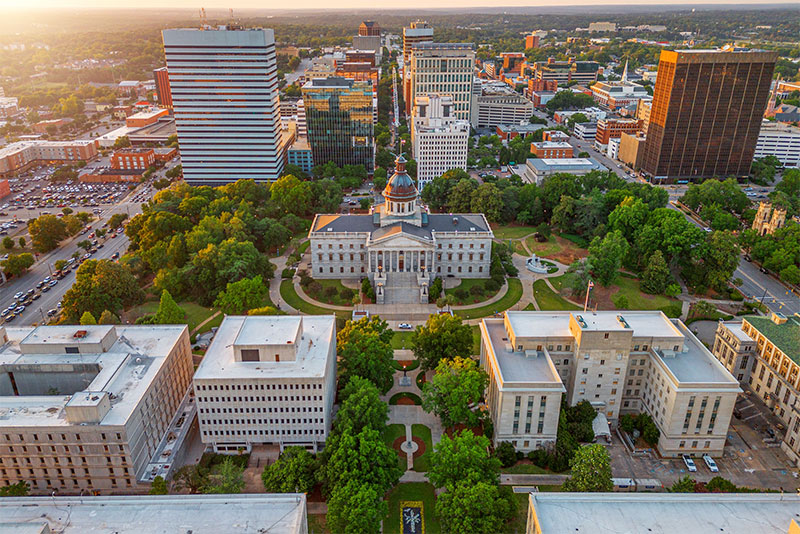
On Monday, S.C. Gov. Henry McMaster released his proposed state spending plan for fiscal year 2027, which starts July 1.
His state budget proposal outlines several familiar policy priorities, including teacher pay raises, additional infrastructure funding, and an extension of the in-state tuition freeze.
So how does this budget shape up compared to last year's final figures?
FY26 final vs. FY27 governor’s proposal
| FY26 final | FY27 governor's | % increase | |
| General fund | $15.1B | $15.8B | 4.4% |
| Federal | $12.5B | $14.1B | 11.3% |
| Other | $13.4B | $14.7B | 8.8% |
| Total | $41B | $44.5B | 7.9% |
These figures include the Capital Reserve Fund.
For the purposes of this brief review, we are not evaluating the individual merits of each spending increase. Some may be justified; others may not. That is not the central issue.
The issue is that policymakers cannot credibly claim a commitment to limited government and fiscal responsibility while allowing the general fund to grow year after year simply because revenues are surging. When the state is consistently collecting far more revenue than it needs to provide core services, it is a clear signal that taxes are set too high.
The general fund is the fund to focus on most closely. It is primarily composed of income, sales, and corporate tax revenue. The tax rate is directly correlated to the amount of spending that the General Assembly allocates from the general fund. If lawmakers and the governor chose to spend less, they could cut the income tax more quickly. Instead, spending continues to grow year after year.
During last year’s budget process, the governor’s executive budget began with a $14 billion general fund. After moving through the House, Senate, back to the House, and ultimately a joint conference committee, the general fund grew to $15.1 billion.
Frankly, agencies across South Carolina that submitted spending requests in 2025 to the state Executive Budget Office were satisfied with the collective $14 billion to fund their services, which was already an increase from prior years. By the summer of 2025, lawmakers determined they needed to allocate an additional $1.1 billion to agencies that had previously requested less money.
This means that when faced with the choice of returning $1.1 billion to its rightful owner – the South Carolina taxpayer – lawmakers instead chose to send that money to various state agencies, some of which likely were undeserving
Put simply, this represents a significant expansion of spending compared to last year. Fiscal hawks should be concerned. As noted earlier about the budget process last year, the governor’s executive budget in recent years has been the smallest version of the budget; it only has grown from there in the hands of lawmakers.
What does SC’s Responsible Budget say?
Yearly, the South Carolina Policy Council releases our Responsible Budget framework. The concept is straightforward: Tax reform is inseparable from spending. The framework recommends a specific general-fund spending threshold that would allow South Carolina to eliminate its antiquated income tax and promote stronger economic growth.
The budget threshold recommended by SCPC relies two variables. The first is inflation, recognizing that the declining value of the dollar requires additional funding to maintain existing services. The second is population growth, acknowledging that a growing state must serve more residents.
To calculate the limit, we use figures from recurring funds because those dollars should be the source of enduring tax relief. We excluded nonrecurring provisos, as those revenues tend to fluctuate more annually; and the Capital Reserve Fund, which was created to be used primarily for fiscal rainy days. That said, in reality, total state spending includes all three funding categories, as reflected in the chart above.
So what is the recommended Responsible Budget limit for fiscal year 2027?
SCPC’s analysis establishes a baseline of $13.25 billion in FY26 recurring general-fund spending. The governor’s FY27 executive budget proposes $14.04 billion – 5.6% above the combined rate of population growth and inflation.
Sometimes complicated issues have simple solutions, and that is precisely the case when it comes to South Carolina’s income tax. If S.C. officials really want South Carolinians to stop paying so much of their hard-earned money to state government, they must break their big tax-spending habits.
At its core, state government has a spending problem, not a revenue problem.