










The county transportation penny referendum failed, with 51.51% voting against it and 48.49% voting in favor. A close result, but a clear decision, and one we need to respect.
Before talking about what comes next, I want to thank District 19.
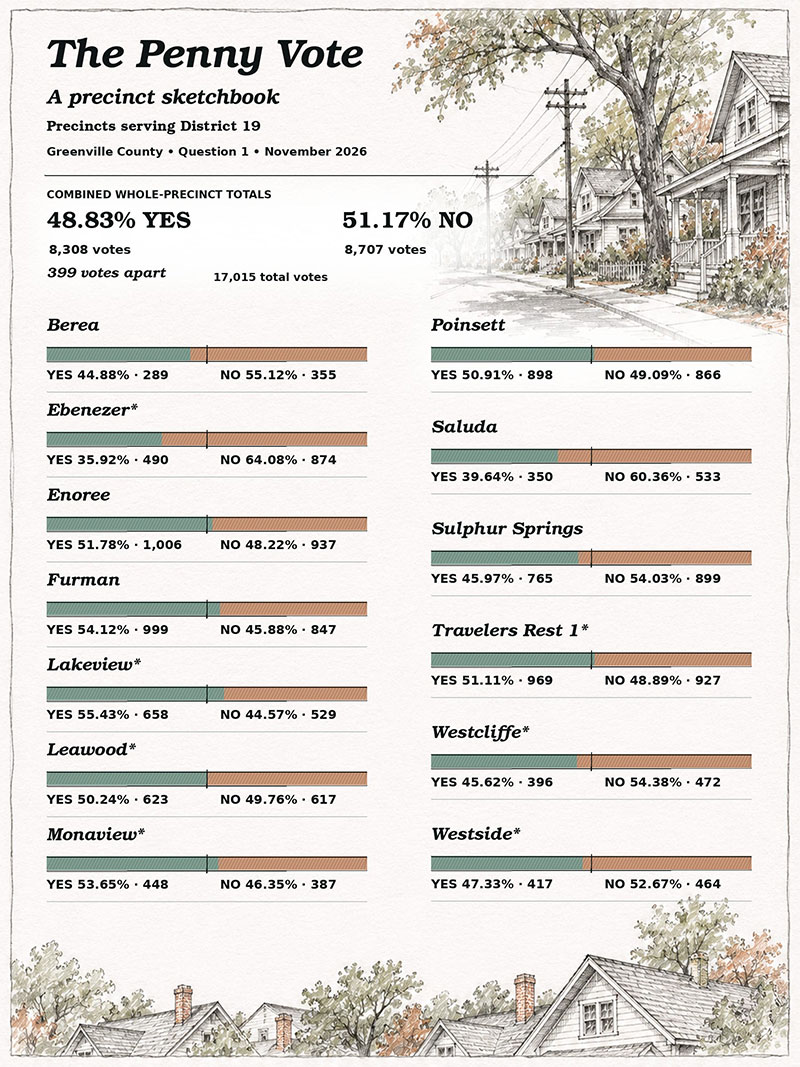
As you can see above, the precincts serving District 19 were closely divided.
8,308 votes in favor and 8,707 against. A difference of just 399 votes.
Throughout this discussion, I did not receive a single nasty email or threat to withhold a future vote because I supported putting this question on the ballot. We had disagreements. You asked questions and shared concerns. But you did so with integrity and civility.
It shows to me, that our district can disagree about a proposal while maintaining trust in the relationship between a community and its representative. I appreciate your confidence that I would not have supported placing this before you without a legitimate reason to consider it.
Representing this hardworking district is an honor. The way you handled this conversation reminded me why.
Giving you the decision
I supported putting the question on the ballot so that you could decide.
We need to leave room for that distinction. Allowing a public vote should not automatically be characterized as Council “throwing another tax at residents”.
A referendum gives citizens the authority to approve a proposal OR reject it.
As your representative, I regularly make decisions based on what I believe serves our community’s best interests. But a countywide result this close demonstrates how difficult it would have been to assume one answer represented everyone.
The closeness does not diminish the outcome. It reinforces why the question deserved public consideration.
I also respect those who opposed it. Government needs accountability, and outside of personal attacks, I view opposition as a stress test. Both for the proposal and for Council’s ability to work through disagreements.
Does the proposal withstand scrutiny? Have we explained the costs? Have we considered other options? Can we move forward together when we reach different conclusions?
Those are fair questions. They remain fair after Election Day.
The proposal failed. The road work continues.
This referendum was a proposed funding approach for work already underway. Its defeat does not stop our existing road program, and it does not remove the conditions that prompted this discussion.
The scale of those conditions deserves an honest explanation.
In a February 2024 briefing, county staff identified approximately:
- $2 billion to repair and resurface county- and state-maintained roads in fair or poor condition.
- Another $1 billion in high-priority projects identified by the county, state, and municipalities.
That is the basis for the widely discussed $3 billion transportation need. It is a regional challenge involving several governments, not a $3 billion paving bill belonging solely to County Council.
When you drive to work, school, or the grocery store, you experience one connected road system. Behind the scenes, responsibility changes from road to road. Addressing the whole system requires coordination among the county, municipalities, state transportation officials, and regional and federal funding partners.
As I have explained in previous newsletters, that cooperation must come with clear priorities and appropriate contributions. The county cannot simply assume responsibility for every unmet need, particularly where another government already has an obligation.
How long would catching up take?
There is no responsible way to promise an exact completion date using the available figures. But we can put the challenge into perspective.
A September 2023 county presentation estimated approximately $78 million in annual transportation spending across the county, municipal, state, and regional funding sources it listed. Comparing the later $3 billion needs estimate with that historical spending amount produces roughly 38 years of spending.
That is an illustration of scale, not a current catch-up schedule. It assumes every dollar could address that existing need, with no inflation, no new problems, and no further deterioration.
We know roads do not work that way.
While one road is repaired, another continues aging. Existing funding also pays for ongoing responsibilities, and some dollars are restricted to particular purposes. A credible plan must show whether we are improving the system faster than it deteriorates.
We are trying to catch a moving target.
Construction costs make that harder. Reporting on the county’s paving program placed the cost per mile at approximately $502,200 in 2023 and $741,900 in 2024, an increase of nearly 48%. That is not a prediction that costs will rise at that rate every year. It demonstrates how quickly the amount of work a dollar buys can change.
Even a hypothetical 3% annual increase would turn $100 million of construction into roughly $116 million after five years. At 5%, it would become nearly $128 million.
Those are examples, not forecasts. Neither includes the additional damage that can occur while a repair waits.
That is why postponement has a cost, and why we must be honest about what our funding can accomplish.
Respect for doing the difficult work
I want to recognize Curt McGahhey, chairman of our Roads Committee, for working through the engineering, funding options, and history behind this problem.
He put time into understanding the available choices and accepted the criticism that came with bringing a difficult proposal forward. Regardless of how anyone voted, that willingness to do the work deserves respect.
Serving currently as both Council chairman and Finance Committee chairman, I understand how the view changes when you must reconcile competing requests with the money actually available. You see the obligations behind the budget lines and the consequences of postponing them.
That perspective does not put us above questioning. It makes explaining our decisions even more important.
I appreciate Curt’s willingness to confront the problem, and I look forward to continuing that work with him and our colleagues.
Public safety and roads need sustainable answers
Infrastructure is not our only pressing responsibility.
Sheriff Hobart Lewis has again raised concerns about compensation and retaining deputies. Those concerns deserve serious attention, alongside the needs of the county employees who provide essential services every day.
My concern is that meeting public-safety staffing and compensation needs could absorb much (if not ALL) of the additional recurring revenue available in upcoming budgets.
That would leave very little room to expand road investment without another funding approach.
It does not mean existing road funding disappears. It means we cannot assume future revenue growth will be enough to substantially expand infrastructure investment while also meeting our other obligations.
Every recurring commitment needs a sustainable source of funding. Every proposed increase needs an honest explanation of what remains available for other priorities.
Where we go from here
We will continue working on solutions. That means setting clear priorities, making the most of existing dollars, preserving roads before more expensive reconstruction becomes necessary, and pursuing partnerships and outside funding where projects qualify.
It also means giving residents a clearer picture of what is funded, what remains unfunded, and what the realistic timeline looks like.
This will take collaboration with our municipalities, state delegation, transportation agencies, and colleagues. Some solutions will take longer than we would like.
I enjoy that part of this job. Bringing people together, working through limitations, and finding a practical way forward is work I look forward to doing.
In future newsletters, I will examine how municipal transportation funding decisions may affect the county’s remaining needs and our shared planning. Those consequences deserve a careful explanation grounded in actual projects, funding, and timelines.
For now, our responsibility is clear:
The voters have spoken, and we need to respect their decision. The road needs are still there, but it’s our responsibility to find a path forward that earns the public’s confidence.
That starts with clear priorities, making the most of the dollars we already collect, and being honest about what we can afford.
I’m ready to get back to work with my colleagues on that.