










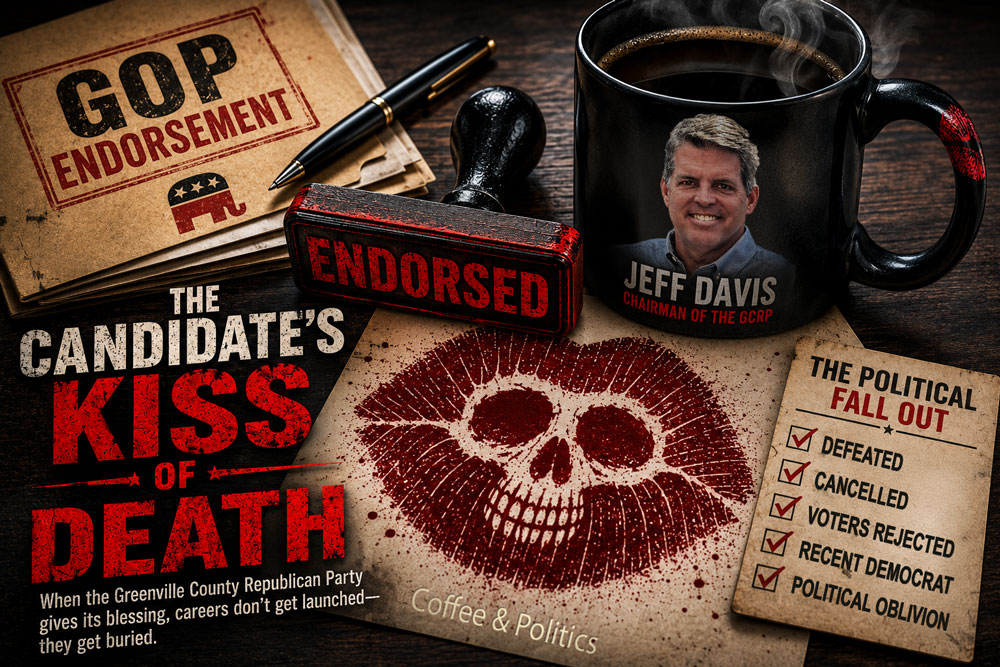
After another primary night of losses, one of the Upstate’s most talked-about Republican political superstitions is getting harder to ignore.
 In Greenville County Republican circles, a political superstition has taken on a life of its own. Mention a candidate endorsed by the current Greenville County Republican Party leadership and sooner or later someone will whisper the phrase, the "Candidate's Kiss of Death."
It is no longer just an occasional joke passed around at campaign events. It has become part of the local Republican political vocabulary. Coffee meetings, social media discussions, text message chains, and post-election conversations have all helped spread the phrase throughout Greenville County.
The term is most often directed toward the political operation built around former Greenville County Republican Party Chairman Jeff Davis and the MySCGOP activist network that has dominated local party affairs in recent years. Fairly or unfairly, many grassroots Republicans have come to believe that candidates receiving the enthusiastic backing of this faction often struggle at the ballot box.
Political folklore usually develops for a reason. Sometimes it is based on hard data. Sometimes it is based on memorable election outcomes. Sometimes it is simply the result of repeated experiences that leave a lasting impression on the people involved.
Whatever its origins, the Candidate's Kiss of Death has become one of the most discussed political superstitions in Upstate Republican politics.
Another reality frequently discussed among Greenville Republicans is the noticeable distance many elected officials maintain from the local party organization itself.
In years past, county party events were often gathering places where Republican officeholders regularly appeared to meet voters, recruit volunteers, and engage with grassroots activists. Today, many elected officials seem content to keep the Greenville County Republican Party at arm's length.
Among local Republicans, a joke has emerged that the organization has become the political equivalent of a quarantine zone. Candidates enter at their own risk. The fear, according to critics, is that the same political contagion associated with the Candidate's Kiss of Death might prove contagious.
Hyperbole? Perhaps. But the observation persists because so many elected Republicans appear reluctant to be publicly identified with the organization unless absolutely necessary.
That perception, right or wrong, is what keeps the Candidate's Kiss of Death alive.
When activists begin joking that a public endorsement may be the last thing a struggling candidate needs, it suggests a deeper credibility problem.
The discussion returned with renewed energy following this week's Republican primary results.
Within hours of the election, social media posts began circulating among Greenville County Republicans listing candidates who had reportedly received support from the Davis political network and who ultimately came up short at the ballot box. The names most frequently mentioned included Nancy Mace, David Pascoe, Allen Kellett, Heather Currie, Randolph Rhodes, Jr., David Atchley, Rick Bradley, and John Ehlers. Political opponents wasted little time pointing to the results as evidence that the Candidate's Kiss of Death had claimed another round of victims.
Supporters may point to candidates backed by the local party who did win. That is fair to note. But many grassroots Republicans argue that those victories often involve candidates who were already established, already well-known, or already carried a recognizable political name before the endorsement ever arrived. In those cases, the endorsement may have followed existing strength and health rather than be affected by the political curse.
What matters politically is that many grassroots Republicans increasingly believe they are witnessing a pattern. In politics, perception often becomes reality.
The irony is that endorsements are supposed to be political assets. Candidates seek them because endorsements are intended to signal credibility, expand voter outreach, and generate enthusiasm. Yet among a growing segment of Greenville County Republicans, the reaction appears to be the opposite. Rather than celebrating certain endorsements, some activists now view them with suspicion.
That should concern any political organization.
Political influence is not measured by how loudly an organization speaks. It is measured by whether voters follow. When activists begin joking that a public endorsement may be the last thing a struggling candidate needs, it suggests a deeper credibility problem that cannot be ignored.
The Candidate's Kiss of Death may have begun as a joke. It may have started as little more than campaign season sarcasm exchanged between political rivals. But like most political folklore, it has endured because enough people have repeated it, enough elections have reinforced it, and enough Republicans have come to believe there is at least a grain of truth behind the legend.
Whether the Greenville County Republican establishment likes the nickname or not, the phrase has become part of local political culture. And after another election night filled with disappointed candidates, few expect the whispers to disappear anytime soon.