












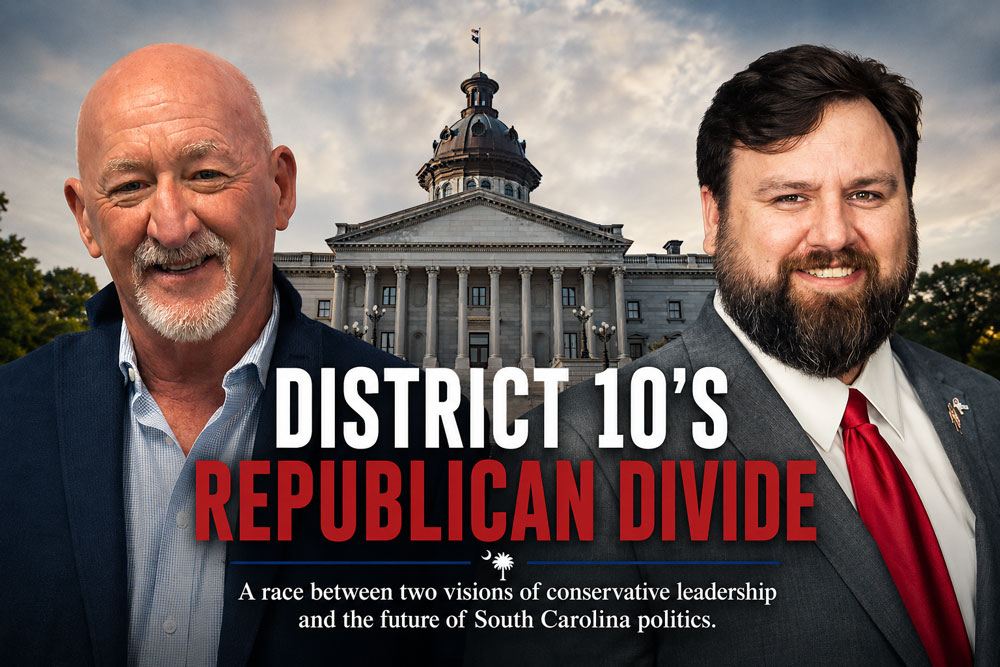
Stewart Watson argues Thomas Beach has focused too much on the Freedom Caucus fight, but many voters may see that fight as the reason Beach was elected.
 The race for South Carolina House District 10 may be one of the most revealing Republican primaries in the Upstate this election cycle.
On one side stands incumbent Representative Thomas Beach, a member of the South Carolina Freedom Caucus and one of the legislators most closely associated with the movement's efforts to challenge the status quo in Columbia. On the other stands challenger Stewart Watson, who recently appeared on the New American Movement podcast and spent considerable time bashing the SC Freedom Caucus.
The discussion was informative, but it also raised questions that Republican voters in District 10 should carefully consider before casting their ballots.
Many SC conservatives view the SC Freedom Caucus not as the source of Columbia's problems, but as one of the few groups willing to expose them.
Watson's central argument was straightforward. He contends that Beach and the SC Freedom Caucus have become so focused on ideological battles that they are neglecting practical district concerns such as roads, schools, first responders, infrastructure, and economic development. He repeatedly suggested that opposition to state budgets and legislative compromise has prevented resources from returning to District 10.
It is a message likely to resonate with some voters. The problem is that the argument depends heavily on how one defines the job of a legislator. Certainly, most voters want their representatives to advocate for projects, funding, and opportunities that benefit their communities. That is part of the job. But is it the most important part of the job? Or is a legislator's primary responsibility to serve as a watchdog over how taxpayer dollars are collected, appropriated, and spent before deciding how much money can be brought back home? Those responsibilities are not mutually exclusive, but tensions inevitably arise when advancing one may require compromising the other.
Throughout the interview, Watson and the hosts repeatedly portrayed the SC Freedom Caucus as a divisive force within the Republican Party. Listeners heard criticism that SC Freedom Caucus members create enemies, demand ideological conformity, label opponents as RINOs, and encourage an "us versus them" mentality. Yet there was a clear contradiction running throughout the discussion. While condemning division, much of the interview itself focused on criticizing the SC Freedom Caucus as a group. While condemning demonization, broad accusations were repeatedly made about the motives and behavior of SC Freedom Caucus members and supporters. While criticizing factional politics, the conversation often sounded remarkably similar to the arguments frequently used by the establishment Republican caucus against the SC Freedom Caucus.
That contradiction deserves examination.
Before going further, it is worth noting that disagreement does not require hostility. I have a great deal of respect for David Cox and the work he and his son have done to encourage civic engagement and political discussion in South Carolina politics. The simple civics platform has provided valuable opportunities for citizens to hear directly from candidates and elected officials, and political discourse is healthier because of those efforts.
That respect, however, does not mean agreement. In this case, I believe the podcast conversation devoted far too much attention to portraying the SC Freedom Caucus as the source of division within the Republican Party, while giving too little attention to the broader political realities that led to its formation in the first place. My disagreement is not with providing Watson a platform. My disagreement is with the underlying premise that the SC Freedom Caucus has become the primary problem facing Republican voters in South Carolina.
The real question is not whether District 10 wants roads and schools. It is whether those priorities should come at the expense of government accountability.
Not surprisingly, Beach and his supporters see the interview very differently.
Beach himself has publicly responded to the podcast discussion, arguing that the portrayal of both him and the SC Freedom Caucus was fundamentally unfair. In particular, he objected to suggestions that concerns about issues such as gender transition procedures for minors stem from hostility toward others rather than moral conviction.
Beach argued that much of his work in Columbia has focused on fiscal responsibility, government waste, tax policy, and opposition to cronyism, not merely social issues. He also took issue with descriptions of the SC Freedom Caucus as a "hate group," noting that such language has frequently been used by progressive organizations and political opponents to marginalize conservative movements.
Whether one agrees with Beach's assessment or not, his response highlights another important question raised by this race. Are disagreements over public policy being treated as differences in priorities, or are they increasingly being framed as evidence of bad motives? That distinction matters because once political opponents are assumed to be acting out of hatred rather than conviction, meaningful debate becomes nearly impossible.
The SC Freedom Caucus did not emerge in a vacuum. Its members rose to prominence largely because many Republican voters believed Columbia had become insulated, unaccountable, and resistant to reform. Whether one agrees with every tactic employed by the SC Freedom Caucus or not, the movement became popular because it was willing to challenge the existing power structure when many others would not. Ironically, even some of the criticisms raised by Watson indirectly acknowledge this reality.
Perhaps the most puzzling aspect of the interview was the repeated suggestion that the SC Freedom Caucus alone is responsible for division within the Republican Party. That claim ignores the reality that much of the conflict originated when SC Freedom Caucus members challenged an existing power structure in Columbia. Critics accuse SC Freedom Caucus legislators of demanding loyalty and drawing lines between allies and opponents. Yet many of those same critics remained silent when reports surfaced about internal caucus loyalty expectations, blood oaths that violated freedom of affiliation and free speech, efforts to maintain voting discipline, and resistance to transparency within the broader Republican establishment.
If drawing ideological lines is wrong, then it should be wrong regardless of which faction is doing it. If demanding loyalty is wrong, it should be wrong whether it comes from the SC Freedom Caucus or from the Republican caucus leadership. Voters deserve a consistent standard rather than one that changes depending on who holds power at a given moment.
If broad assumptions about a candidate are unfair, are broad assumptions about an entire legislative caucus any more fair?
Watson argued that SC Freedom Caucus members obstruct legislation. Their supporters would likely respond that obstruction is precisely what voters elected them to do when legislation expands government, increases spending, or preserves entrenched political interests.
Watson described some conservative social issues as affecting only a relatively small percentage of the population compared to infrastructure and public services. Yet many Republican primary voters view those issues very differently. Questions involving parental rights, gender transition procedures for minors, taxpayer funding priorities, educational transparency, religious liberty, and government accountability are not viewed as "niche" issues by much of the Republican base. They are viewed as foundational issues. Many voters would argue these concerns are not distractions from government responsibility. They are government responsibility.
That leads to perhaps the most important question of the campaign. Is Thomas Beach sacrificing District 10's interests in pursuit of conservative principles, or is he representing the very principles District 10 voters elected him to defend? The answer likely depends on what voters value most.
Watson repeatedly argued that District 10 has not received sufficient state support. However, legislative effectiveness should not be measured solely by earmarks and appropriations. Some voters view a legislator's role not simply as bringing projects and funding back to the district, but also as serving as a watchdog over taxes, spending, and government accountability. That broader understanding of representation helps explain why many conservatives remain supportive of Beach and the SC Freedom Caucus despite criticism that they focus too heavily on ideological issues.
They also reject the suggestion that Beach has done little for the district itself. Supporters note that Beach helped secure funding for local projects, including approximately $100,000 for a waterfront park project and roughly $750,000 brought into District 10 during his first term, among others. They also point to his opposition to tax increases, support for repealing the state gas tax, efforts related to legislation restricting gender transition procedures for minors, and involvement in challenges to CRT-related educational policies. Whether voters agree with those priorities or not, they represent a record that extends beyond the narrow portrayal presented during the podcast discussion.
There is another aspect of the race worth mentioning. Watson has publicly portrayed himself as politically independent and unaffiliated with organized factions. Yet his criticism throughout the interview was directed overwhelmingly toward one of the few organized conservative groups actively challenging Columbia's power structure. That naturally raises questions about where he would fit within the House if elected. Would he become an independent voice, or would he ultimately strengthen the same Republican caucus establishment that has spent years clashing with the SC Freedom Caucus? District 10 voters deserve a clear answer.
Watson says he is not a mudslinger. The interview raises the question of whether he followed his own standard.
There is also recent discussion surrounding social media photographs showing Watson at a Pride event while visiting Seattle a couple of years ago. Some voters have questioned those photographs and comments associated with them, including a social media exchange in which Watson described the experience as having "a blast."
Watson has since publicly addressed the matter, explaining that he and his girlfriend at the time happened upon the event while visiting the Space Needle, remained briefly to listen to live music, and later left. He further stated that he opposes taxpayer funding for such events, opposes gender transition procedures for minors, and opposes taxpayer funding for gender transition procedures. Those statements deserve to be acknowledged and considered fairly.
Whether voters find that explanation persuasive is ultimately up to them. Some conservative voters in District 10 may still view the matter as relevant when evaluating a candidate seeking to replace one of the House's most socially conservative members.
What is noteworthy, however, is Watson's criticism of what he described as "slinging mud" by political opponents. Watson himself stated that he is "not a mud slinger." Yet the reason many listeners took issue with portions of the New American Movement discussion is not that Watson defended his own positions, but because much of the discussion resembled the very kind of "mudslinging" he later condemned.
That brings us back to the central question raised throughout this race. If broad characterizations and assumptions are unfair when directed toward a candidate, are they not equally unfair when directed toward an entire legislative caucus, especially one whose member happens to be your opponent?
At the end of the day, this race is not really about roads versus principles. It is not about schools versus conservative values. And it is not about infrastructure versus accountability. The real debate is whether District 10 Republican voters believe the SC Freedom Caucus has become part of the problem in Columbia, or whether it remains one of the few meaningful checks on the current political establishment culture in Columbia.
Watson spent much of the interview criticizing the SC Freedom Caucus for creating division, drawing ideological lines, and demonizing opponents. Yet many listeners may come away asking whether he spent much of the interview doing exactly the same thing.
Watson says he opposes mudslinging. He says he opposes demonization. He says he opposes dividing Republicans into opposing camps. Those are admirable principles. The question raised by this interview, however, is whether he followed his own principles. Perhaps he should consider the guidance of an old Primitive Baptist preacher: "Those who throw mud at others are the ones losing ground."
--------------------
Watch the New American Movement podcast here to make up your own mind: