












The candidates differed on corruption, judicial reform, and how the office should be led at two very different meetings.
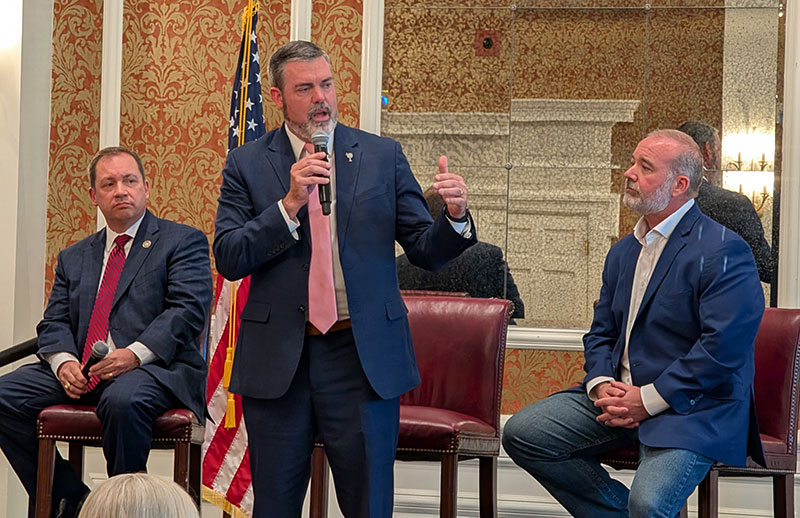
South Carolina Republican voters received two useful but noticeably different views of the three men seeking the party nomination for Attorney General.
One event showed what happens when candidates are given room to explain themselves. The other showed what happens when the pressure rises.
On May 27, SCETV News and South Carolina Public Radio hosted a statewide debate from Columbia featuring First Circuit Solicitor David Pascoe, Eighth Circuit Solicitor David Stumbo and State Sen. Stephen Goldfinch. Gavin Jackson moderated the Attorney General discussion. The debate was part of SCETV’s statewide primary election coverage.
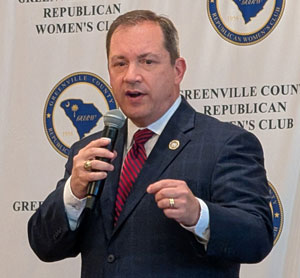
The next day, the Greenville County Republican Women’s Club hosted the same three candidates during its luncheon meeting at the Poinsett Club. Robin Duffie, a recent past president of the club, moderated the question portion of the forum.
The Greenville event was intentionally structured as a forum, not a debate. Candidates were asked not to interrupt one another. They were given longer response times and were told to focus on what they had done or would do in office. Personal attacks were to be saved for closing statements. That difference mattered.
The favorable reaction in the room was noticeable, and several attendees described the Greenville format as a better way to hear the candidates. Goldfinch agreed.
“This is so much better than a debate. I wish we would do these a lot more often, because you can hear us answer in long form. All of our campaigns want us to yell at each other, y’all. I don’t think it’s productive. I don’t like it.”
There is room for both formats.
A debate applies pressure. It reveals how a candidate responds when challenged, contradicted, or accused. It can also produce the sharp exchanges that draw readers into a political story.
A forum provides something different. It gives voters enough quiet to determine whether a candidate understands the office and can answer a serious question without turning every disagreement into a personal quarrel.
In this race, voters received both.
Three Candidates, Three Central Arguments
Each candidate returned repeatedly to a central theme.
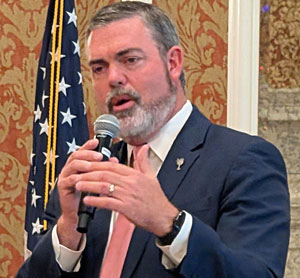
Pascoe presented himself as the aggressive corruption fighter. He pointed to his 33 years as a prosecutor, his Statehouse corruption work and his support for judicial reform. He also emphasized protecting children, increasing prosecutions involving child pornography and pursuing the death penalty in certain child rape cases.
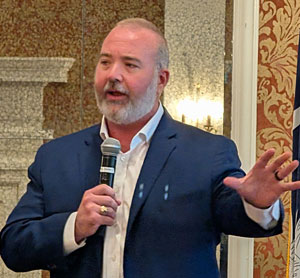
Stumbo presented himself as the experienced career prosecutor. He cited more than two decades of criminal prosecution, including murder cases, child molesters, domestic abusers, drug traffickers and internet predators. He also pointed to his prior work in the Attorney General’s Office and his service as a lead prosecutor for the statewide grand jury.
Goldfinch presented himself as the candidate with experience across several parts of the Attorney General’s responsibilities. He cited his military prosecution work, his service in the General Assembly, his business background and his administrative law practice challenging government agencies.
Those distinctions became clearer as the questions moved from introductions to policy and then into direct conflict.
When the Gloves Came Off
The SCETV debate produced the sharpest moments of the campaign events.
The most heated exchanges involved Pascoe and Goldfinch. They argued over corruption, political associations, trial lawyer contributions, outside counsel contracts and whether each man could be trusted to serve as the state’s chief legal officer.
During a discussion involving the Alex Murdaugh retrial and campaign support from attorneys, Goldfinch accused Pascoe of accepting support from Democratic trial lawyers and said Pascoe’s argument was “laughable.”
Then he went further by saying, “This is a fraud. This is a farce. And don’t put up with it.”
Pascoe fired back by accusing Goldfinch of seeking support for an independent expenditure effort from attorneys connected to Morgan & Morgan. He referred to his opponent as “Stem Cell Steve.”
The exchange moved through the names of former state Sen. Dick Harpootlian, attorney Jim Griffin and Morgan & Morgan. Goldfinch argued that Pascoe should be judged by the company he keeps. Pascoe responded that Goldfinch had also sought financial support from attorneys and political allies.
The argument intensified during another exchange when Goldfinch raised Pascoe’s prior support for Joe Biden and questioned Pascoe’s trustworthiness. Pascoe responded by accusing Goldfinch of having a lower conservative voting record than some Democrats and said Harpootlian had a higher conservative rating than Goldfinch. Pascoe also attacked Goldfinch’s prosecutorial experience and again raised the stem cell controversy.
Those were politically charged claims. The debate obviously did not settle them.
The exchanges did accomplish one thing. They revealed a deep divide between Pascoe and Goldfinch that extends beyond policy.
Stumbo largely declined to join the personal back and forth.
His answer on corruption was that prosecutors should provide law enforcement with the tools needed to obtain records, prepare search warrants and follow the evidence wherever it leads.
“We need to treat public corruption cases, Gavin, exactly like we do murders and other types of cases. We do where the facts and evidence lead without theatrics.”
Orangeburg Became a Proxy Battleground
Orangeburg County emerged twice during the SCETV debate as a point of conflict between Goldfinch and Pascoe.
During the corruption discussion, Goldfinch referred to a recent example in what he described as one of his opponent’s political backyards. He raised concerns about legislators directing public funds to themselves or affiliated nonprofit organizations through the budget process.
Pascoe rejected any suggestion that his solicitor’s office knowingly served as a conduit for questionable funding. He said he did not know about the funding and criticized the legislators and associates who approved it.
Orangeburg surfaced again during a discussion of violent crime backlogs.
Goldfinch cited figures that he said showed Orangeburg County with a larger backlog than Horry County. He framed the difference as a leadership issue rather than a funding problem.
Pascoe disputed the numbers and argued that his circuit’s record was being misrepresented. He also countered that Orangeburg County had a higher conviction rate than Horry County.
The exchange raised a legitimate public policy question.
How should voters compare case backlogs, conviction rates, staffing levels and outcomes across judicial circuits with different populations, crime patterns and available resources?
That disagreement led naturally into a broader question running through the race: how each candidate defines corruption and how aggressively the Attorney General should pursue it.
Corruption and the Corporate Integrity Agreement Dispute
Pascoe has placed corruption at the center of his campaign.
He said he would establish a public corruption unit on his first day as Attorney General and remove lawyer legislators from state litigation contracts. He also said he wants to investigate allegations that a state senator was offered substantial campaign funding in exchange for a vote against tort reform.
Goldfinch challenged Pascoe’s record by raising corporate integrity agreements entered during Pascoe’s earlier corruption investigation.
Goldfinch accused Pascoe of participating in a “pay-to-play scheme” in which corporations paid $352,000 in exchange for not being prosecuted.
Pascoe rejected that characterization. He said the money went to the State of South Carolina and argued that prosecution was no longer available because the statute of limitations had expired.
Once again, the debate generated more heat than resolution.
Stumbo addressed corruption from a prosecutorial standpoint. He said his statewide grand jury work included local government fraud cases and emphasized that corruption investigations should follow evidence rather than political theater.
The Curtis Loftis Question
One of the most important moments of the SCETV debate involved State Treasurer Curtis Loftis.
The candidates were asked about a State Inspector General report examining financial management issues in the Treasurer’s Office.
The report identified alleged mismanagement and financial concerns but did not find evidence of fraud or criminal misconduct. SC Public Radio reported that the review included questions involving a $31 million voting machine loan, a compounding late fee structure and reporting errors that shifted $65 million away from the state’s general fund.
Pascoe offered the strongest defense of Loftis.
He said he had read the report carefully and found nothing outlining criminal misconduct by Loftis or his office. Pascoe argued that negligence should not be mislabeled as corruption and said the report effectively exonerated the treasurer unless additional evidence emerges.
Stumbo gave a more measured answer.
He said he had not read the full report but that the material he had reviewed did not indicate criminal behavior. He added that if the report were referred to him as Attorney General, he would review it professionally and without political motivation.
Goldfinch took the most open-ended position. He said he had read the report from front to back and argued that the referral to the State Law Enforcement Division and the United States Attorney’s Office required an open mind.
The three responses revealed a meaningful distinction.
Pascoe said the publicly available report did not support allegations of criminal wrongdoing.
Stumbo said the available material did not appear to show criminal conduct but required a professional review if formally referred. But Goldfinch emphasized the need to leave the question open.
Goldfinch’s previous role in the Loftis dispute also provides important context. As a member of the Senate Finance Committee’s Constitutional Subcommittee, he participated in the investigation into the state’s accounting problems and later joined Sen. Larry Grooms as a co-sponsor of the resolution seeking Loftis’ removal from office. During the Senate’s April 2025 hearing, Goldfinch helped present the case against Loftis, questioned the treasurer, and voted with the majority when the Senate approved the removal resolution by a 33-8 vote. The House did not take up the resolution, and Loftis remained in office.
The Loftis discussion focused on how an Attorney General should approach allegations of misconduct. The next major issue asked a related question: how should South Carolina protect the independence of its courts?
Judicial Reform: Retention Vote or Federal Model?
Judicial reform produced one of the clearest policy differences among the candidates.
South Carolina judges are screened through the Judicial Merit Selection Commission and elected by the General Assembly. Critics have argued that the current structure gives legislators too much influence over judges who may later hear cases involving lawmakers or their legal clients.
Pascoe called the existing process unacceptable.
He said lawyer legislators should be removed from the Judicial Merit Selection Commission. He also expressed support for a Missouri-style retention system in which voters eventually decide whether a judge remains on the bench.
Pascoe said judges have contacted him and described pressure from lawyer legislators who threatened their positions if they did not act a certain way in cases. He finished, “That is not an independent judiciary.”
Stumbo favored a federal-style approach.
Under his proposal, the governor would appoint judges, the legislature would confirm them and judges would return for reconfirmation every six years. Stumbo said the Judicial Merit Selection Commission should be eliminated.
He also said some of the oldest cases on his docket involved lawyer legislators serving as criminal defense attorneys who were not required to appear promptly in court. Stumbo said most lawyer legislators do not abuse the system, but the possibility of abuse demonstrates the need for reform.
Goldfinch also supported a system closer to the federal model.
He opposed popular elections or retention elections for judges. Goldfinch argued that judicial campaigns could expose the courts to campaign contributions from people who may later appear before those judges.
All three candidates support reform. But they do not support the same reform.
That distinction matters because the replacement for a flawed system can create problems of its own.
The issue appears to have the public’s attention. A statewide survey released by the South Carolina Policy Council found that 72 percent of respondents favored reforming the judicial selection process, while 14 percent said the current system was fine and 14 percent were unsure.
Protecting Children and Confronting Human Trafficking
Stumbo repeatedly placed child protection at the center of his campaign.
He said he was South Carolina’s first Internet Crimes Against Children prosecutor to try cases before a jury and argued that too many predators and child molesters have received probation instead of lengthy prison sentences.
Stumbo said the next Attorney General should work directly with sheriffs and solicitors across the state to determine what resources are needed to protect children and families.
Pascoe also emphasized crimes against children.
He said some counties have single-digit conviction rates in child pornography cases and argued that those prosecutions should be handled more effectively at the local level. He also said South Carolina should pursue the death penalty in certain child rape cases.
Goldfinch focused more heavily on violent crime backlogs and the need for regional Attorney General offices. He argued that old cases become harder to prosecute when witnesses disappear, officers move to other jurisdictions, and evidence becomes stale.
The candidates were also asked a rapid question about human trafficking at the end of the SCETV debate.
Pascoe said the state must become more proactive. He pointed to Greenville and the Lowcountry as areas requiring attention and called for task forces working closely with law enforcement.
Stumbo said higher reported numbers in Greenville may reflect effective undercover operations rather than a uniquely worse problem. He said Greenville’s investigative model should be used more broadly across the state.
Goldfinch said human trafficking should be treated as a top priority alongside the violent crime backlog.
Outside Counsel and the Cost of State Litigation
The candidates also disagreed over the Attorney General’s use of outside law firms.
Pascoe argued that most state litigation should be handled inside the Attorney General’s Office. He criticized large legal fees paid to private firms and said taxpayer money should return to the public whenever possible.
Goldfinch defended the use of outside counsel in some complex cases.
He argued that the state cannot always hire attorneys with specialized mass tort or civil litigation experience at government salaries. Goldfinch said outsourcing should not be automatic, but some cases require expertise that the state does not maintain internally.
Stumbo offered a third approach.
He said the Attorney General’s civil division should be strengthened through fellowship programs that recruit promising law school graduates and train them in government litigation. He pointed to programs used by other state Attorneys General offices, including those in Texas, Florida and Virginia.
The disagreement is not whether outside counsel should ever be used.
The disagreement is how often, under what conditions, and with what level of public transparency.

GCRW’s Forum Questions Went Straight to the Vulnerabilities
The Greenville County Republican Women’s Club saved some of its most provocative questions for the closing portion of the forum.
The questions were direct. But because the Greenville format discouraged interruptions and extended back-and-forth exchanges, the answers were easier to evaluate.
Goldfinch was asked why voters seeking an Attorney General independent of Columbia’s political establishment should trust a candidate who has served inside that system.
He said relationships can be an asset rather than a liability.
“Relationships matter, especially in South Carolina. Relationships matter. You can’t just go burn a place down.”
Goldfinch argued that an Attorney General needs legislative relationships to secure a budget, hire prosecutors, support victim advocates and create specialized task forces.
Pascoe was asked why Republican voters should believe his current party affiliation is based on principle rather than opportunity. He ran for solicitor as a Democrat after earlier involvement in Republican politics and later returned to the Republican Party for the Attorney General race.
Pascoe smiled.
“That’s a great question, although the questions are going downhill now.”
He then compared his political history to President Donald Trump’s prior affiliations and asked voters to judge his record. “Judge me by my fruits.”
Stumbo was asked about his office vehicle reimbursement arrangement and why he used a personal vehicle instead of a government-issued car.
Stumbo said vehicle prices increased after the COVID period and that his office needed vehicles for an investigator and a deputy solicitor. He said using his personal vehicle and receiving mileage reimbursement saved his office an estimated $20,000 to $30,000 over three years. He also said he drove more than 53,000 miles for official duties during that period.
Each question touched a potential vulnerability:
- Goldfinch was asked whether relationships can become entanglements.
- Pascoe was asked whether a party change can become political convenience.
- Stumbo was asked whether reimbursement can become unnecessary expense.
The questions were serious. The answers were not drowned out.
After the detailed policy questions and sharper personal challenges, the SCETV debate ended with a simpler question about how long each man would remain in office.
Term Limits: Eight Years or Less
The SCETV debate closed with a question about term limits.
All three candidates said they do not plan to serve more than two terms as Attorney General.
Goldfinch said he would limit himself to eight years if elected.
Pascoe said he supports term limits and would not seek another public office after serving as Attorney General. He argued that the initials “AG” have too often stood for “aspiring governor.”
Stumbo said he believes he can accomplish his goals in two terms or less. He added that formal term limit legislation is a policy decision for the General Assembly and that institutional knowledge can have value in criminal justice work.
Three candidates. Two meetings. One office that demands more than sharp elbows and polished talking points. South Carolina’s next Attorney General will have to know when to throw a punch, when to hold the line, and when the facts have already spoken for themselves.