












Norman took the heat while Mace seized the moment
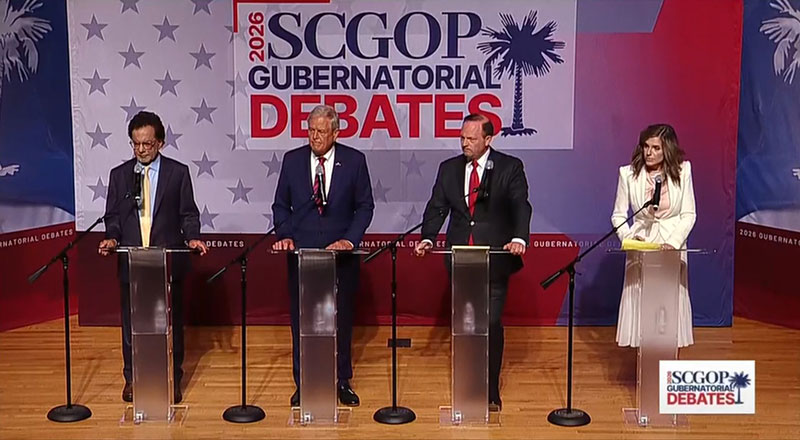
SPARTANBURG, S.C. — Tuesday night’s Republican debate for South Carolina governor was billed as a discussion of data centers, Scout Motors, judicial reform, education, public health, and direct auto sales.
It became something else, too.
At Wofford College in Spartanburg, four GOP candidates used those policy questions as a springboard into some of the sharpest candidate-on-candidate exchanges of the campaign. The debate featured businessman Rom Reddy, Congressman Ralph Norman, Attorney General Alan Wilson, and Congresswoman Nancy Mace. Lieutenant Governor Pamela Evette declined the invitation, while State Sen. Josh Kimbrell did not meet the polling threshold to participate, according to the debate introduction.
Fox Carolina’s Justin Dougherty moderated the debate. Panel questions came from Joey Hudson of the Just the Truth podcast and a 98.9 WORD talk show host, WIS anchor Judi Gatson, WMBF anchor Eric Weisfeld, and WCSC anchor Raphael James.
What followed was less a quiet policy forum and more a televised test of temperament.
Reddy, Wilson, and Norman repeatedly tangled over records, motives, and credibility. Norman took most of the incoming fire, especially from Reddy and Wilson. Mace, meanwhile, worked to stay in the middle of the story without becoming the center of the brawl. She criticized, joked, redirected, and occasionally jabbed, but often did so while contrasting herself with the tone of the exchanges around her.
At one point, after watching the men trade accusations, Mace joked that she felt like she was “in the middle of an oversight hearing.”
Later, she described another round of fighting this way: “I feel like they just took it outside.”
Scout Motors Opens the Door to the First Fight
The first major confrontation came during a question about South Carolina’s incentive package for Scout Motors.
Wilson called the deal rushed and said South Carolina should stop using incentives to cover up deeper problems, such as taxes, regulations, workforce, and education. He said companies should receive incentives only after delivering the jobs and investment they promised.
Mace used the issue to argue that businesses should “pay their own way” until promised jobs are created. She connected the Scout Motors debate to her broader criticism of data centers, earmarks, and state policy that she says puts taxpayers and ratepayers at risk.
Reddy said South Carolina’s political class does not know how to negotiate business deals. He argued that the state gave away too much and said leaders should focus on manufacturing rather than projects he said do not produce enough long-term benefit for South Carolinians.
Norman also called the Scout Motors deal a “boondoggle,” saying politicians “gave it away.” He said business leaders understand negotiations better than career politicians and criticized the lack of stronger protections after Scout placed its headquarters in Charlotte.
That was when the issue turned personal.
Wilson fired back at Norman, accusing him of criticizing Scout while, in Wilson’s words, supporting SILFAB in his congressional district. Norman denied the claim and accused Wilson of lying. Norman then turned to Wilson’s record as attorney general, attacking him over Captain Sam’s Spit, legal fees, and the cost of the Murdaugh prosecution.
Wilson’s response was direct. Two people were brutally murdered, he said, and he would spend what was necessary to deliver justice.
Reddy then jumped into the exchange and attacked Norman as a career politician, saying Norman has been in office for roughly two decades while still running as an outsider. Norman responded by bringing up Reddy’s seawall dispute, accusing him of building a wall illegally and suing the state he now wants to lead.
Reddy framed the matter as a property rights fight.
“If I pay taxes and I own it, I will defend it,” Reddy said.
Mace did not ignore the fight. Instead, she stepped into it without adopting the same tone.
She said she had written detailed critiques of both the Scout Motors deal and data center legislation. She also noted that she had attended a SILFAB hearing earlier that day, saying that when people ask her to show up, “Nancy Mace is going to stand there, right there with the people over the powerful.”

Judicial Reform Brings More Fire
The debate grew heated again when candidates were asked about South Carolina’s judicial selection system, where lawmakers play a major role in electing judges.
Reddy said he had already worked as a citizen to help pass judicial reform legislation in the House and blamed Senate leadership for holding it up. He said lawyer-legislators should not be involved in selecting judges before whom they may later appear.
Norman said South Carolina’s system is like letting Clemson and Carolina pick their own referees. He said lawmakers who practice law should not be choosing judges and called for a system that would give voters more accountability.
Wilson said he has spent 15 years advocating for judicial reform and argued that no one on stage has more direct experience with judges than he does as attorney general and prosecutor. He said he supports giving the governor nominating authority over the people who screen judicial candidates, with the Legislature still voting up or down.
Mace called South Carolina’s judicial selection system part of a “good old boy” circle involving lawyer-legislators, judges, and lawyers with cases before those judges. She said corrupt judges should be impeached and said the current system would end under her administration.
But again, the reform question quickly became a fight over credibility.
Reddy accused Norman of ignoring the judicial reform work Reddy said he had already done. Norman returned to Reddy’s seawall fight and accused him of raising money under one banner while preparing to run for governor. Reddy said Norman did not understand the law and again defended his actions as a property rights issue.
Wilson then challenged Norman’s claim that he is not a career politician. Wilson said Norman had been elected years ago and, if elected governor, could still be in office into his 80s.
Norman responded by accusing Wilson of directing legal work toward lawyer-legislators and his former law firm. Wilson said his office’s legal work had recovered billions for South Carolina and accused Norman of misrepresenting his record.
Mace again chose a different lane.
After saying the men sounded like they had “taken it outside,” she defended Norman from Reddy’s criticism over a Medal of Honor bill. Mace connected the issue to her late father’s military service and said Norman should be praised for supporting veterans.
It was one of the clearest examples of Mace taking the high road while still staying visible in the debate.
Data Centers Set the Early Contrast
The opening policy question dealt with data centers, a growing issue in Spartanburg County and other parts of South Carolina.
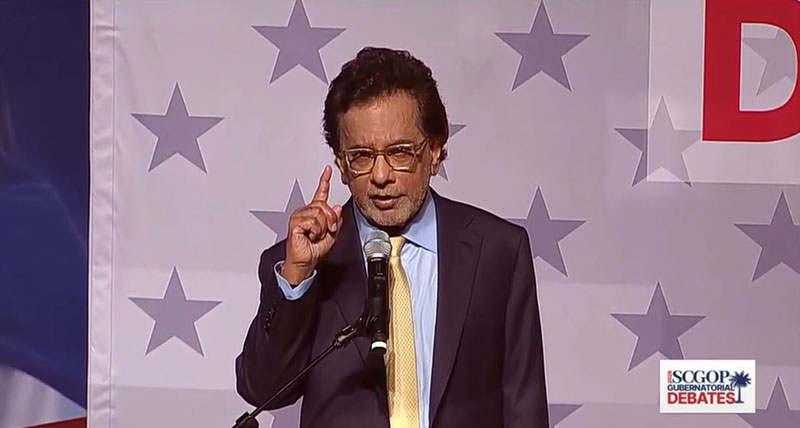
Reddy said he does not support a one-year moratorium because he does not support data centers at all. He argued they consume land, water, and electricity and said state leaders have left local residents fighting those battles, community by community.
Norman opposed a moratorium, saying the government should not impose top-down restrictions on business or private property rights. He said incentives should stop, but local communities and property owners should have a voice.
Wilson said data centers are a national security and infrastructure issue. His position was that communities that want them should be able to have them, while communities that oppose them should not be forced to accept them. He called for a state framework to reduce negative impacts.
Mace was the only candidate to support a one-year moratorium. She said Spartanburg County was the right place to ask the question because residents there feel local officials are not listening.
The data center issue did not ignite the loudest exchanges of the night, but it helped establish the pattern. Reddy attacked the system. Norman warned against government overreach. Wilson argued for a regulatory framework. Mace positioned herself with local residents who feel ignored.
Evette Was Not There, But She Was Not Absent
A question about South Carolina’s public health leadership gave the candidates an opening to criticize Pamela Evette, who was not on the stage.
Norman said he would appoint people who are competent and aligned with conservative values.
Wilson said science and conservative values are not mutually exclusive. But he then turned to Evette, saying she had taken credit for popular decisions from the McMaster administration while distancing herself from decisions that became unpopular. He said he wished she had been there to answer the question.
Mace was sharper.
After Wilson used part of a rebuttal to praise the candidates who showed up, calling the debate a “job interview,” Mace took the point further. She praised the four candidates on stage for stepping into the arena, then said they were leaving “one outside” who did not have the courage to be there.
“No, she didn’t have the courage to be here,” Mace said.
The line fit the tone of the night. Even while Mace tried to stay above much of the Reddy, Norman, and Wilson crossfire, she did not pass up the chance to remind viewers that Evette was not there for the job interview.
Evette may not have attended the debate, but her absence still became part of it.
Public Health Question Adds Another Flashpoint
The public health question itself focused on whether the next governor’s public health appointee should align with the administration’s views on vaccines or be chosen as a science-first decision.
Norman said he would not support the current direction and would appoint people aligned with his conservative values.
Wilson said science and conservative values are not mutually exclusive, but added that appointees should reflect the values of South Carolinians and be competent to run the agency.
Mace said she would not hire a public health director who donated to Joe Biden, supported mask mandates, or supported vaccine mandates. She also said she regrets taking the COVID vaccine and described herself as vaccine-injured.
Reddy called former public health nominee Dr. Edward Simmer “the Fauci of South Carolina” and described Dr. Brannon Traxler as “Simmer on steroids.” He said he kept his own company open during COVID and fought mask and vaccine requirements.
The topic did not produce the same direct personal fight as Scout Motors or judicial reform, but it did allow the candidates to draw sharp contrasts over COVID, public health, government authority, and Evette’s absence.
Direct Auto Sales Brings One More Round
The last major policy question asked whether South Carolina should change state law to allow direct-to-consumer vehicle sales.
Wilson said the state’s dealer franchise laws are constitutional and that he would not overturn them as governor.
Mace said she supports competition and direct sales, calling herself a “free market girl.” She said South Carolina should not block people from buying vehicles directly from manufacturers such as Tesla.
Reddy agreed with Mace and said the state should not restrict the market.
Norman sided more with dealers, saying they had reason to be upset after the Scout Motors incentive package and questioning whether manufacturers should receive large incentives and then be allowed to bypass local dealers.
Then the personal attacks returned.
Norman accused Reddy of trying to buy the election. Reddy responded that being wealthy is not wrong and said he is self-funding because he does not want the election bought by donors.
Mace used the moment to point out that she is not wealthy, saying she sleeps on a couch in her congressional office and drives a 2011 American-made truck. Norman said he also sleeps in his office and drives a 2008 Ford pickup.
Wilson ended that round by saying his campaign is about public service, not money.

Mace Finds Her Lane While the Others Trade Blows
The debate’s most memorable moments were not found in long policy answers. They came when the candidates challenged each other’s records and forced voters to watch how each person handled pressure.
Reddy presented himself as the outsider businessman willing to attack the political class.
Norman presented himself as the conservative fighter with a long record, while rejecting claims that he is part of the political system he wants to change.
Wilson presented himself as the experienced prosecutor and attorney general, willing to challenge Norman directly and defend his record.
Mace presented herself as the candidate who could survive the fight without letting the fight define her.
She still criticized. She still drew contrasts. She still went after Evette for not attending. But when the exchanges between Reddy, Norman, and Wilson became personal, Mace repeatedly used humor, biography, and policy detail to stay above the fray while still staying in the frame.
Her closing statement leaned into that contrast.
“I’m sure y’all thought I was going to be the crazy one tonight,” Mace said. “Turns out I’m not, actually.”
For voters watching at home, Tuesday night’s debate offered a clear look at the personalities behind the policies.
Reddy, Norman, and Wilson showed they know how to throw punches.
Mace showed she knows how to let them land somewhere else.
--------------------------
- All images were taken as screenshots from Fox Carolina / Gray Media broadcast of the SCGOP gubernatorial debate.